

Build the Future Podcast
Evan Goldin — Parking, Public Space and the Future of Cities
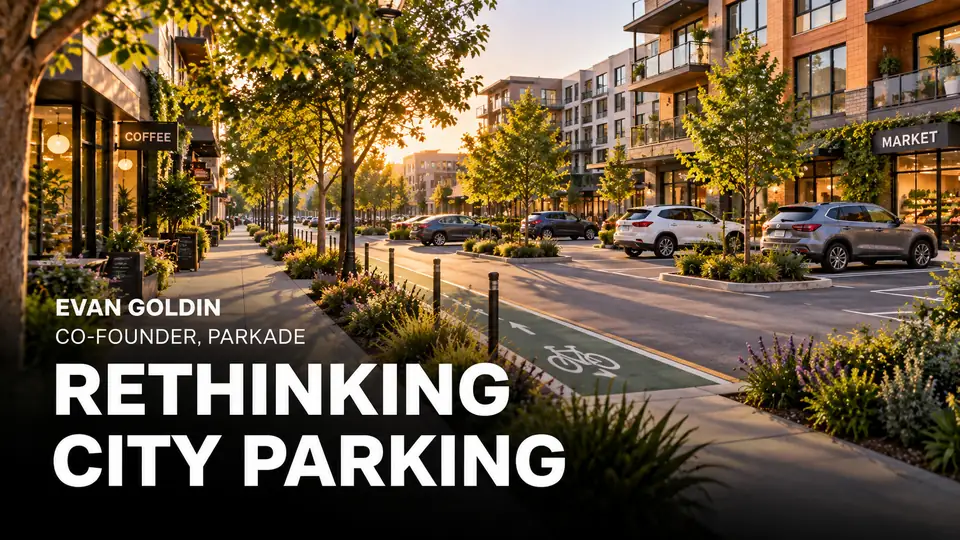
Evan Goldin argues that parking rules and pricing shape housing costs, travel choices and public space.
August 4, 2020 · 35 min



About the episode
"Forcing people to provide this hugely expensive good that they then have to give away for free has been a mistake and it's resulted in a lot less flexibility for businesses. It's resulted in more expensive housing. It's resulted in cities that are flooded with cars and with buses that are stuck in public transit. And I think we're just getting to the point where we're starting to see the light. And we're starting to realize that perhaps the future could look a little different."
In this conversation, we talk with Evan Goldin, the founder of Parkade which builds parking software that helps businesses, cities, and individuals better utilize the overabundance of parking spaces around them.
We talk with Evan about the havoc that free parking has wrecked on our cities, the impact of COVID on our city streets, and the role that parking innovation will play in building the future of cities.
Links
Chapters
Times follow the podcast audio. The video’s timeline may be slightly different.
- 00:00Welcome and introducing Parkade
- 02:34Parking requirements and the cost of housing
- 06:08How parking rules developed
- 09:13Who pays for free parking?
- 13:02Reclaiming streets for people
- 18:13Sharing the parking we already have
- 22:14Workplace parking and travel choices
- 25:04A lifelong interest in transportation
- 27:30Parkade’s starting point and longer-term vision
- 30:17What it takes to change transportation policy
Read the conversation
Open the full transcript
CAMERON WIESE: Welcome to the Build the Future podcast. My name is Cameron Wiese and I'm your host. I've always been fascinated by the ideas and sentiment that drove American culture in the 1960s with the space race. A culture of possibility with a mission to build things, and I quote JFK, not because they are easy, but because they are hard. It's this culture that seems to have been lost and is something that we want to bring back. With Build the Future, we're here to promote the ideas of those who not only see how the world can be better, but those who have plans to get there. It's our hope that these plans inspire you to think about the future you want to live in and create plans to go build.
CAMERON WIESE: Today, we're talking with Evan Goldin, the founder and CEO of Parkade. At Parkade, they're helping create innovative parking solutions within our cities to help shape the transportation and parking of tomorrow. Evan, welcome to the show. Thanks. Great to be here. So Evan, on the Build the Future podcast, we're aiming to share compelling visions of the future from those like you who are building it. Can you tell me a little bit about the work you're doing at Parkade and the future you're trying to create?
EVAN GOLDIN: Yeah, for sure. I mean, transportation is one of those industries that has seen, Parts of it have seen massive, tremendous change in the last decade or two, and other parts really haven't. And that's one of the reasons I'm really excited to be working in the parking space. It's something that people are doing all the time. Everybody wants a place to park, needs a place to park. But the way we do it, the way we find our spaces, and the way we build parking really hasn't changed much in the last few decades. So we're at Parkade setting out to change that. And what we do is enable buildings to completely re-imagine how their parking spaces work. So today, we are so bad at building and using parking that we have about eight spaces for every car in the United States. It's just a horrible allocation of land. And that has real bad impacts to the way we live our lives, the way we spend money, the way we must spend money to be housed. And we're really seeking to change a lot of the dynamics of how that works with what we're building at Parkade.
CAMERON WIESE: Can you tell me a little bit more about some of the changes that you think need to be made in the parking space, but in the transportation space in general as well? What are some of those challenges?
EVAN GOLDIN: Yeah, I see a lot of it being tied back to our land use decisions. So when someone is going to build a new building, say it's, you know, a hundred unit apartment building in Los Angeles, one of the biggest struggles they're going to have is how much parking to provide. And today the government in almost every city in the United States, there are a few exceptions, But almost every city in the United States is going to set a minimum bar under how many parking spaces they have to provide. We make it illegal for most homes and home builders to decide how much parking to actually have on their property. We really hamstring them and say, no, you need to have at least two parking spaces per unit.
EVAN GOLDIN: Because for so long, we've believed that that was in the interest of society. and it really hasn't been. So that's starting to change. We're really hoping to play a role in the acceleration of that change. But for decades, if you are going to build housing, one of the most expensive parts of what you're going to do is pave your asphalt and figure out how to squeeze as many parking spaces as possible onto your property. And then if you do build that 100 unit apartment building and you build 200 parking spaces, you're going to have a lot of parking that then sits empty because we are just not good at using the parking once it's built. So cities love to require a ton of parking to be built and then don't seem to care very much when half of it sits empty for most of the year or most days or most hours. And that has really led to a ton of bad results in our environment, in our equity, in terms of where people can afford to live. And it's just a sad state of the world when someone needs to pay $4,000 a month to live in San Francisco. But if they were a car, they would be paying about $90 a year for about the same amount of real estate. It's a signal of where our priorities have been as a country and as a society.
EVAN GOLDIN: And it's really time for that to change.
CAMERON WIESE: So it's mostly just an inefficient use of space that's causing the problem. There are these standards that are requiring people to build or account for two parking spaces per unit, and those just sit vacant.
EVAN GOLDIN: Exactly. I mean, you can imagine in that new development in Los Angeles by the metro station, which is getting billions of dollars of investment right now, they would love to have maybe 50 parking spaces on site for 100 units. And then maybe with that extra space, they're either able to lower the cost of housing and bring those rents way, way down, or they're able to build more units on the property and allow the building to have maybe 300 units. And this is one of the reasons that we're in the housing crisis. Many of our major metros is because developers have been hamstrung when it comes to providing enough housing because their hand is forced on providing so much parking. So that's been a huge problem in society for the last few decades.
CAMERON WIESE: Yeah, if we dive into the history, how did we end up in this state where there are all these weird requirements around parking?
EVAN GOLDIN: It started with, you know, somewhat of an altruistic desire long ago in the 50s and 60s of trying to make sure that there was enough parking for everybody. And, you know, it started and actually while parking requirements started then, kind of rules around parking originated even earlier in the 20s and 30s. Los Angeles was actually one of the first places early on to try to figure out what to do with this huge onslaught of cars, right? If you rewind back about 100 years, all of a sudden people are able to afford to buy a vehicle because it's being mass produced. They're flooding into the downtown business district. Buses are going slower. Trams are going slower. people are getting killed left and right. And they needed to tame this environment. And the city, one of the first things they actually tried to do was to restrict vehicles from being left on the curb. That was just a natural thing that drivers did was to start parking on the curb. And it very quickly solved the logjam of public transit, but the businesses fought it and went to city hall, said, this can't stay. We need parking to survive as a business, as a community. And so the city backed down and said, okay, okay, we'll devote all of this land to parking. And that started with curb space. But as more and more people started to get cars later in the 20th century, eventually
EVAN GOLDIN: ran out of curb space. And so cities started to say, okay, well, requiring that you can park your car on the curb isn't enough. We now need to require that if you're going to open a restaurant, you need to provide four spaces per table. And if you're going to open a golf course, you need to provide three spaces per hole. And if you're more importantly, building an apartment building or building a condominium or building a single family home, you need to have parking on site because we want to make sure that we don't run out of it. And again, it was done, I think with altruistic means, but they really misunderstood the impact that this would have on the future. And they thought that by requiring as much parking as possible, they would create a better society. And I think we've seen over the past few decades that forcing people to provide this hugely expensive good that they then have to give away for free has been a mistake. And it's resulted in a lot less flexibility for businesses. It's resulted in more expensive housing. It's resulted in cities that are flooded with cars, with buses that are stuck in public transit.
SPEAKER UNCLEAR: And I think we're just getting to the point where we're starting to see the light and we're starting to realize that perhaps the future could look a little different. Yeah, after all this time,
CAMERON WIESE: I would imagine that they didn't expect that cars would be as essential to our daily lives as they
EVAN GOLDIN: ended up being. Yeah. I mean, and they, they certainly are for many people, but of course, if you, if you require every business and every home to provide free car storage, it's only a natural result that the car is then going to be an essential tool for daily life. And that's, that's not necessarily the fair, you know, people go into this thinking that's the fair outcome, right? That by requiring every business to provide free parking or every home to provide a ton of parking, that we're keeping things equitable. But in fact, it's very often the opposite. There was a great study in New York, which was considering congestion pricing for the first time would be the first city in the United States to do it. And they found that people at the lowest end of the income scale are 30 times less likely to own a vehicle than people at the top of the income scale.
EVAN GOLDIN: So when you require this car storage to be on site, what it ends up becoming is somewhat of a tax on the people that don't have cars, right? Everybody's paying more in apartment rents. They're paying more for their restaurant bills because the cost of parking is being bundled with everything. And that means that if you're someone that's living below the poverty line and you don't own a car and you're getting to all these places by bicycle or by bus, you're paying for that parking whether you want to or not. And it's part of this assumption that, oh, of course everyone wants this because everyone has a car, but everybody doesn't have a car.
CAMERON WIESE: I was reading about, I think it's Hong Kong, where the price of real estate is so expensive that only the ultra, ultra wealthy have cars. So when you go there, you're seeing Lamborghinis and Ferraris and all these high-end luxury cars because the only people who can afford to park there are the people who also have money to buy extravagant vehicles. But the entire city is still paying to, they're essentially subsidizing that through taxes. And that's so fascinating.
EVAN GOLDIN: Yeah, it's a very strange dynamic.
CAMERON WIESE: Yeah, because when I think of transportation, obviously it's like, okay, how do we improve our bus system, make that more efficient, or maybe restructure our cities so that people don't need to drive. But one of the problems that people don't address is, oh, we have to pay for or account for all this free parking or all of these parking spaces that
EVAN GOLDIN: go unused. Exactly. I mean, it all ties back to land use. If you think about how we allocate space in our cities, most of the land that is owned municipally is often used for either vehicle movement or vehicle storage. It's pretty typical for 80 plus percent of city land to be parking spaces or vehicle travel lanes. And that is certainly not, you know, that has massive ramifications in how we use our cities. Obviously, with the COVID pandemic rising really quickly, everyone's flocking to parks, everyone's going outside. And then we're wondering, why do we have so little space for this? Well, we have so little space for this because we've devoted so much of it to storing and moving cars, which is inherently an inefficient way to move people. I mean, we often moved people more efficiently 100 years ago than we do today.
EVAN GOLDIN: Now, of course, today, it's a lot easier to live 40 miles from work. And there are some upsides to that, right? It's easier to have a backyard and to have a larger house. But that doesn't mean that we're doing a better job of moving people. And I think in many ways, we're doing a worse job
SPEAKER UNCLEAR: than we used to. Yeah, you said something interesting about our cities being mostly parking and vehicle transit. What should our cities look like?
EVAN GOLDIN: Yeah. I mean, I think they should look a lot different than they do today. I think it's been fascinating watching the impact of COVID on this question, right? We've been a small number of kind of people like me that are passionate about this have been advocating for more street space for outdoor dining, for people to walk, for people to shop, for people to just, you know, put a blanket down and relax. And that's been a pretty quiet minority of people making that argument for the past, you know, 20 years or so. All of a sudden, my social media has been flooded with business owners I know, clamoring for their streets to be shut down. I mean, it's crazy how fast the future has moved on this and how quickly minds have changed.
EVAN GOLDIN: That all of a sudden, as we've seen how important and vital it is for businesses to be able to use this space, because in many cases they can't use their indoor space anymore. all of a sudden many communities every community around the country i think is being faced with this decision of oh crap we've devoted the main thoroughfare through our city to just moving and storing a small number of vehicles whereas we could use this space for outdoor dining for parks for i have a friend who who owns a gym in palo alto they're planning on reopening their gym by taking over the streetscape in front of their gym and using that for workout classes. I mean, that's, I think, a wonderful, wonderful thing. And it just doesn't even seem like it would have been possible six months ago. So the world has moved very quickly on this. And as horrific and disastrous as COVID is, I do at least love that there are some silver linings. And I think this is one that we're very quickly being forced to reevaluate how we're using our land. And I think that's hopefully going to be a long lasting upside.
CAMERON WIESE: Yeah, especially as we see more and more cities start to invest in restructuring their roads. I mean, San Francisco, what was it earlier this year? They shut down Market Street.
EVAN GOLDIN: Exactly. Yeah. Pre-COVID, of course, which was at the time a really, really big deal. It had been advocated for for 30 years to limit Market Street to just bikes and taxis and buses. And that seemed like a crazy proposition 20 years ago. And that was enabled by this transformation in thinking around how we should use our spaces. But I think we're going to see that accelerate really, really quickly. And I just hope it's not a temporary phenomenon. right I hope six months from now a year from now if there's a vaccine and we can move restaurants and gyms and things like that back indoors my hope is we don't all of a sudden say okay great well now I can park my two-ton truck out front of the gym again for free for four hours I hope we'll say you know actually it's really nice that people can work out outside it's really nice that this has become a congregating space and as we're seeing the recent protests around Black Lives Matter have actually brought some attention to this too, because you look at what protesters are trying to do at a very basic level is trying to use our streets to congregate and to send a message. And they're being arrested for doing that. And why? Well, they're being arrested because that's not their space. That's not space for people. That's space for vehicles.
EVAN GOLDIN: and there's a really timely element there as well of if we were not devoting 80 percent 90 percent of our city land to car storage and car movement that's a lot of space we could get back and we don't just need to get it back for restaurants and businesses we can give it back to the people to use for protestings for gatherings for whatever they want and not get arrested just for sitting in
SPEAKER UNCLEAR: a public square for hours on it. Yeah, it's really important that we create more space for people, especially in cities, to gather because the analogy that another guest used was we all are in pursuit of this great big glass box in the sky. And we get this apartment and we're a little lonely. Why? Because everything in the city is set up for the individual rather than for the community gathering. And so if we pull cars off the streets and convert them into public gathering places, people can watch movies in the streets. I mean, my sister lives down in Capitol Hill in Seattle and they set up a little community in the streets. They're playing music, showing movies, they're hanging out. It's like people are spending time together. And the more we can do that, the better, I think our society will function because people are spending time together
SPEAKER UNCLEAR: and I have the space to do so. Yeah. And, you know, people are going to ask a fair question of, okay, well, if I can't park in that square in Capitol Hill anymore, where do I put my car? And that's where I think we can help because so many of these parking spaces that we've built, even in downtown cores, sit empty for weeks, months, days on end many times. And that's a huge waste. We walk into a lot of our partner buildings and talk to them for the first time about how they use their parking or how their residents use their parking. And we hear them say things like, oh, everybody has a car here, but there's no spaces sitting empty. And what parquet does is allow someone in a building to easily share their parking spot with someone else that lives in their building. And so, you know, we'll go to a property manager, we'll go to someone at the front desk and we'll say, hey, wouldn't that be great if your residents here could just easily share their parking with someone else? And so many times we hear, no one needs to do that because all these parking spaces are used all the time. And we'll talk them through it, we'll get to the point of launching the building, and all of a sudden we'll discover, my God, there were like 15 to 20% of spaces in this building just sitting empty permanently because people didn't know what to do with them. They bought a condo and got a deeded parking spot, or they rented a unit and
EVAN GOLDIN: it came with a parking spot and they're not using it. Or they're paying $25 a month for parking because it's super underpriced in their building and they're holding onto their 1992 Volvo that's all paid off and they haven't used it in months just because the parking is free. And so actually, if there were an easy way to share it, they considered getting rid of their car. And in some cases we've talked to people that have, because all of a sudden there's something to do with their parking space that previously, you know, maybe they would have had to go through the work of putting up something on a bulletin board or doing something difficult like that. And we make it really easy. And so I hope in doing that, we can answer the question of where do these parking spaces go. You know, there's so many parking spaces that are just sitting empty today. There was a great study in Washington, D.C. that found that even at the peak period of demand, so they did studies at about two in the morning, 40% of parking spaces in multifamily buildings in D.C.
EVAN GOLDIN: were sitting empty. And what a waste that is, right? And again, it goes back to the cost of housing for, you know, those developers that built those places had to spend a boatload of money to dig, you know, three, four stories down to create a parking garage. And these spots can cost $50,000 per spot and up in downtown cores. And for those to be sitting empty, and then for us to wonder, you know, for us to then demand all of this parking out on the street is just a horrible
SPEAKER UNCLEAR: tragedy that I hope to bring an end to. Yeah, it's absurd that there's all this other, there's just other solutions to the problem, instead of trying to crowd our streets. I really like how you guys are, how you're thinking about it. Because when you think of solving big problems in transportation, people would think, okay, well, how do we get autonomous vehicles? Or how do we install scooters? How do we help people move around better? How do we build new things? And And the approach sounds like you're taking is there's actually this neglected thing over here, which is these empty parking spaces. If we go fill these up, we'll make it easier for people to park here. We create more space over here to have outdoor restaurants, to have community spaces, right? So it's just a reshifting of the demand, right? Yeah. I mean, that's a perfect encapsulation
EVAN GOLDIN: of what we're trying to do is show that we can take the cars off the street and get them into buildings that already have parking that are just, you know, not using them. We've just done such a horrible job of allocating these spaces and requiring that they get built. And we've, you know, we see this phenomenon at work and at home too. This isn't just a kind of problem specific to apartments and condos, we also see it at offices where most offices in the United States just get this free parking lot bundled with their rent or their land and then give it away for free, right? Whether it's corporate headquarters in Des Moines or the Airbnb office in San Francisco, there's often parking that is going to waste and being very, very underpriced, right? If I bike to work or if I walk to work, it's pretty rare that I get paid to do that, right? The company is not going to spend money on me doing that. But if I drive to work, it's incredibly common that the company provides me a free parking space. And that's a huge, huge expense from the company. Of course, it gets passed on, which is part of the reason that you don't, you know, and employees don't often pay these costs. But it's pretty common for a company to spend 25 to 50% of its real estate budget on parking in some sense, right? If they compare the cost
EVAN GOLDIN: of a building with no parking to the cost of a building with tons of parking, they're going to pay a lot more. And then chances are they give it away to their employees for free. And then they wonder, wow, why does no one carpool? Why does no one bike here? Why does no one walk to work? Why does no one take transit? And a big part of solving that puzzle, we believe, is going to be bringing paid parking to offices and making it the norm that even if you're working in Fremont or you're working in, you know, Bethesda outside of DC, that it should be the norm that you pay something, you pay some portion of the cost for that parking space. Because when you don't, and when the cost gets passed on to your employer, to a business, to whomever, we're all the worse off. And we make very different decisions, right? If I have to decide to pay $5 to park at my office, that might be enough to change my behavior. Maybe I live a mile from work and I would walk if it was, you know, a $5 difference. So that's a change we're really hoping to institute, not just at home, but at work. There's just a horrible allocation of parking.
EVAN GOLDIN: And we really think that there's a lot of opportunity to change that.
CAMERON WIESE: yeah so you're at lyft you're at chariot you've you've spent a lot of time in the in the
SPEAKER UNCLEAR: transportation space what what got you into it i mean it's probably it's been a lifelong obsession of mine i mean i was as a three-year-old growing up in the bay area i had a season pass to roaring camp which is like this railroad kind of it's not a museum but it's a place where you can like ride steam trains and stuff i've been you know even then was wearing conductors overalls around my house and that kind of stuff when I was learning to crawl. But I've been kind of obsessed with transportation all my life and it never really extinguished. And I went to work in technology after college in 2008 and spent a couple of years working in social networking and enjoyed that. It was fun. You know, it felt like we had some impact. But when I looked around in 2011 and saw that I had this iPhone in my hand, but yet I was getting around in the same way I always had, I knew something was going to change. I mean, it didn't take, I moved to downtown San Francisco in 2010. And even in, I mean, this is only 10 years ago, to get a ride to somewhere else in San Francisco, my roommates and I would go downstairs, we would spread out. So each of us would go to a different corner and we could all see each other because we lived on a hill. So one of us would be on Pine Street, one on Bush Street, one on Sutter Street, and we would all have our hands up and we would try to be flagging down a taxi. And it, I mean, I remember this taking as
EVAN GOLDIN: long as like 10, 15 minutes in the downtown core, like where the taxis are coming back to from dropping people off. And it was insane how difficult it was. And then when we got the ride, it was it would be $30 to go across town and I just knew that things were going to change there was so much pent-up desire for people to be able to get places in an easier way that I really wanted to be a part of that and I knew something was going to change and so when I found these kooky guys working on a ride-sharing ride-sharing product on Brandon Street I knew that I needed to make the leap and really wanted to devote my life to working on transportation. And that hasn't changed, you know, even since leaving left, it's been, I think will continue to be a lifelong
SPEAKER UNCLEAR: passion of mine. Yeah, it's that reminded me of 10 years ago, getting around San Francisco, as you said, was completely insane. And now it's push a button and go anywhere. And so the culture has shifted. And if we look ahead, I see, I almost see something very similar happening when parking is easier, more accessible. We're going to see that shift and we're like, how did, how do we ever live with cars driving down the street? I can't imagine not having like lunch here.
EVAN GOLDIN: Exactly. Yeah. And I want it to be, you know, I want parkade to play a role in push button, get parking. Right. And you know, we're really focused on push button, get parking in your own building. That's really the kind of use case we think is most ripe is there's all these parking spaces in your own building that are sitting empty. And the interesting thing about that has been that they're being wasted to such a degree that when we actually get people to start using our app, the prices that people ask for these parking spaces are 25 to 40% what the market price would be. So, you know, some of our buildings, one of our buildings in downtown San Francisco, the retail rate for parking, if you were to go to a commercial parking garage, there is like $3.50 an hour, $4 an hour, or $500 a month. Now that that building is using our app, we're seeing parking being bought and sold for about 25 to 50 cents an hour and about $150 to $250 a month. So just crazy cheap compared to what we've been doing. And keep in mind that a lot of those prices that people are paying today for commercial spots are city subsidized, right?
EVAN GOLDIN: That's like the Sutter Stockton garage that the city of San Francisco spent tens of millions of dollars building. It's like 13 stories. It's still expensive to park there. And so we want to enable buildings to better use the parking they have. That's what we're about. And maybe someday that will be opening that building up to some strangers parking there. Today, it's really focused on how can we just help the tenants that already have access to that garage, whether it's an office or a condo building or an apartment, how can we help them better utilize the spaces that they already have access to? They just don't really know how to park, right? I don't know today, hey, how can I easily get a parking spot from Cameron with just a couple taps? So that's where we're starting. But in a long-term vision is definitely trying to just help people share this infrastructure in a new way. And we think in doing so, we can really transform how buildings are built and how land is used.
CAMERON WIESE: Incredible. Out of all the time you spent in transportation, what surprised you the most?
EVAN GOLDIN: I think the most surprising thing I ran into was actually not at Lyft. It was at Chariot. So I went to work at Chariot in 2016. I was coming off of Lyft. And being at Lyft, we'd been fighting tooth and nail with cities, right? We launched and weren't sure what the future would hold for us. We weren't sure if the city of San Francisco was going to send police in to bang down our doors and arrest us. We launched in a lot of cities that issued cease and desist that were eventually somewhat successful in shutting us down. You know, obviously in the long, long haul, you know, ride sharing has won out to a degree. And in almost every city around America, it's commonplace and legal now. And I think that's a great thing. But I was used to fighting tooth and nail. And so when I went to Chariot, one of the things I was most excited about was the belief that cities would be on our side, right?
EVAN GOLDIN: That like we were doing something that was, I thought, a little clearer of a win for them. We were putting a large number of people in a few number of vehicles and launching essentially on-demand shuttle service in these markets. And I naively thought cities were going to welcome us with open arms. And the most surprising thing I ran into was that really wasn't the case. Cities were very cold to us. We had a couple places that encouraged us to come, but for the most part, it was really difficult. I recall we launched in Seattle, and in Seattle, King County Metro had veto power over any new shuttle or kind of mass transit service operating in town. So we literally had to beg them for permission to operate.
EVAN GOLDIN: And I believe in my entire time there, they never gave it to us. So we had hired people. We bought vehicles. We trained people. We did marketing. And all in the hopes that, you know, King County Metro would eventually say, yeah, of course, this is great. This is transit innovation. And they never did. and we eventually, I had left by this time, but they eventually just wound Chariot down. You know, this was one of many reasons, but it really wasn't welcomed with the open arms that we thought it was going to be. And I think the signal of that is cities have been very resistant to changes in transportation. It's a very, very heavily, heavily regulated industry. it's very difficult to make money in the industry and I thought that that would change if you offered something that was more aligned to cities interests but from everything I've learned at Lyft at Chariot at Parkade and Parking I think cities I think we're going to have to push cities if they're going to change and it starts you know with advocacy I again I'm delighted by the changes we've seen just in the past few weeks and months of businesses finally getting behind a lot of these changes in streetscape and transportation. But I think regular citizens are going to need to get out of their cars, you know, get off their bikes and really demand a change in how cities
EVAN GOLDIN: allow transportation, what transportation is used, what's subsidized, like why, you know, as a city do we provide, why does San Francisco provide a million essentially free parking spaces in the city on the street, but not subsidized bike rides or bike share or anything like that. I think we have to start asking a lot of tough questions to our city and really push our representatives to change transportation and parking policy. Because I think without it, cities, the bureaucracy as it is, is going to be pretty resistant to technological innovation. and technological innovation is banging down their door. So it's not going to get in alone. It's going to rely on citizens opening that door for us.
CAMERON WIESE: Thanks for joining us for this episode of the Build the Future podcast. If you're interested in learning more about the future of parking and transportation, follow Evan on Twitter at Evan Goldin. If you're interested in learning more about Parkade, specifically if you live in an apartment complex or own a small business and want to better utilize your unused parking, head on over to parkade.com. Lastly, if you're building, want to get support, or simply want to hear about specific topics, ideas, or from certain people, shoot us an email to hello at buildthefuturepodcast.com and we'll see what we can make happen. Thanks again for listening, and that's it from us. Until next time, go build!
SPEAKER UNCLEAR: Thank you.
More episodes
All episodes Garrett Scott — Pipedream and the Future of DeliveryGarrett Scott explains Pipedream’s proposed underground delivery network and its approach to scaling infrastructure.
 Jamie Gull of Talyn — Electric Flight Between CitiesJamie Gull explains Talyn’s two-part aircraft concept and its focus on regional trips.
 Gonzalo Espinoza Graham — Building a Flying Car at WatflyGonzalo Espinoza Graham outlines Watfly’s approach to a small electric aircraft and its proposed recreational starting market.