

Build the Future Podcast
Garrett Scott — Pipedream and the Future of Delivery
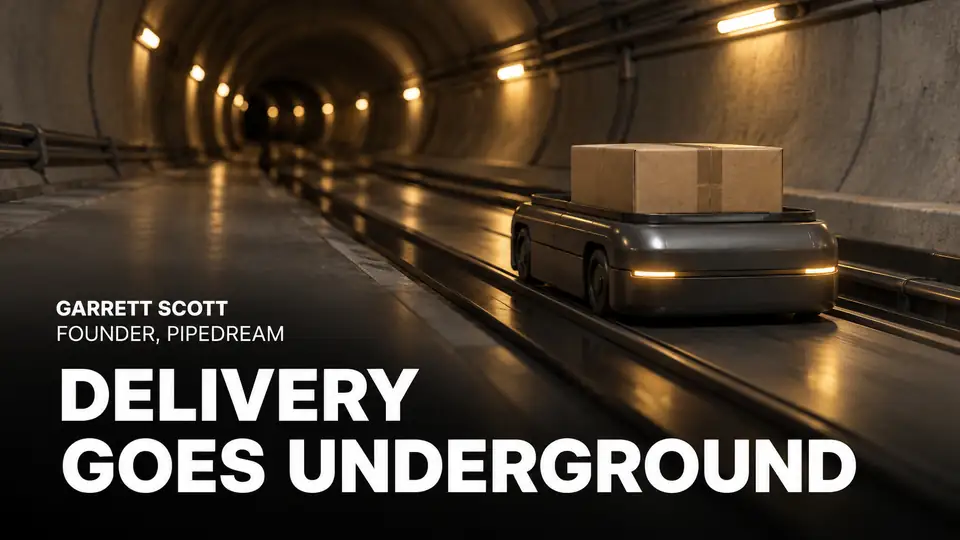
Garrett Scott explains Pipedream’s proposed underground delivery network and its approach to scaling infrastructure.
October 20, 2020 · 32 min



About the episode
In this conversation, we talk with Garrett Scott, CEO of Pipedream Labs, about the world of hyper-logistics. Hyper-logistics is the ability to instantaneously receive goods, delivered to you no matter where you are, within seconds. “Think beyond food!” Hyper-logistics via an underground tubing system will be used to deliver goods and tools, to relieve the need to purchase and store items only needed on occasion, and after the items have been used they can be returned through the pipeline to the sender.
Join us today as we discuss the possibilities of logistics and our ideas to create a better and more efficient future.
Links
Chapters
Times follow the podcast audio. The video’s timeline may be slightly different.
- 00:00Welcome and introducing Pipedream
- 01:43The vision for hyper-logistics
- 05:05Sending and returning physical objects
- 08:14Tunnels, pods and the network design
- 11:02A first useful delivery loop
- 15:46Sharing tools instead of storing everything
- 18:35What changes for homes and commerce?
- 24:21No-code tools and more people building
- 28:57Finding collaborators and building in public
Read the conversation
Open the full transcript
CAMERON WIESE: Welcome to the Build the Future podcast. ! My name is Cameron Wiese, and I'm your host. ! I've always been fascinated by the ideas and the sentiment that drove American culture in the 1960s with the space race. A culture galvanized to dream about the possibilities of tomorrow, whether it's food, transportation, cities, biology, or anything else. It was this cultural mindset rooted in optimism that the world tomorrow would be better than the world today. A mindset where people were compelled to build things and I quote JFK, not because they were easy but because they were hard. It's this desire to build and to dream that seems to have been lost and is something we're here to bring back. With Build the Future, we're here to promote the ideas and stories of those who see how the future can be better and promote their plans to get us there. It's our mission to get you to dream about the future that you want to live in and inspire you to go build.
CAMERON WIESE: Today, we're talking with Garrett Scott, the CEO of Pipe Dream Labs. At Pipe Dream Labs, they're building a network of underground tubes that offer near instantaneous delivery of objects to and from homes and businesses. I'm thrilled to have Garrett with us today to explore this future, so let's jump right in. Garrett, first of all, stoked to have you here. Thanks for coming on. Thanks, man. Yeah, I'm excited. I want to start with the basics. Tell me about the future you're building with PipeDream. What's the vision?
GARRETT SCOTT: Yeah, so what we really want to do is we want to bring on this world of hyper logistics. And what we see as hyper logistics is getting delivery times under 30 seconds.
CAMERON WIESE: Okay, so paint the picture for me. What does that entail with PipeDream as a company? So you're going for 30-second logistics. Give me a little more context there.
GARRETT SCOTT: Yeah, I think logistics is just so sexy. There's just so many moving parts. There's all these things that have to work together. It's just in and of itself is a really cool system. And so we look at the internet and what it did for data. And, you know, you have Moore's Law, which in a really exponential way is just everything moves faster and faster and faster and data moves faster and faster and faster. and every time it does we unlock new economies and new scale and a better world for us to live in. You know I was listening to an economics podcast today and they were just talking about how the internet and all new technology while it hasn't dramatically increased how much people make it has deflated a lot of the costs around a lot of stuff that we need. So whereas someone could never dream of going to Bali for the weekend. The barista at Starbucks, because of Airbnb and reduction in costs in air travel, they can go to Bali for the weekend and it makes economic sense. And the idea of technologies creating a more accessible, a better world for people is just, that's what we need to be building towards. So the internet did a really good job of doing that with data, doing that with processes, automating a lot of information. What we saw was logistics has not caught up. I think what Amazon did was really the start of it. Logistics is not keeping up with Moore's Law. People won't even consider logistics even applying to Moore's
GARRETT SCOTT: Law. So it wasn't growing as fast as it needed to. So we just started thinking like, okay, let's go to the all the way to the other side of logistics all the way at the very end the inevitable end is teleportation where you can just zap atoms from one place to another place like okay that's a definite future it's going to get either to that place or right next to that place so let's work backwards and let's let's just try to get as close to that as possible within this next decade. Like, don't think about how do we improve our current systems? How do we make warehouses closer to people? How do we make automated cars work with package like forget all that? Let's just go to teleportation and just get as close to teleportation as we can.
GARRETT SCOTT: And just just with the faith of being able to see how the internet has improved so many lives, we know if we get if we get close to that, we can improve so many lives, like whatever it takes to get there is worth it. So that's kind of where we started. And we just like we said, we're going to call that world hyper logistics of just right next to teleportation. And that's really where we started from a research standpoint with Pipe Dream. We never said like, let's go underground. Let's, you know, let's build this pipe and tube system. That was really the research focus was what does that world look like? And how can we bring that into being this decade?
CAMERON WIESE: That's so dope. So you kind of did the inverse of what everyone would do. It's like, how do we fix the existing system. It's like, no, no, no. Let's go imagine what the ideal should be. Let's go live in the future. Everyone's teleporting, but that's maybe N number of years out. What's the closest we can get? So tell me, how'd you think through that process and like, how'd you arrive on what
GARRETT SCOTT: PipeDream is doing now? Yeah. Yeah. So we looked at hyper logistics and just kind of imagined what the world would look like with that. So, you know, you're able to get objects in 30 seconds. It's really cool. What you're also able to do is we don't even think of logistics as anything other than delivery, because that's all we've optimized for. We don't even have a word for it. But in a true, you know, hyper logistics world, there's delivery, but there's also uploading. So just like a computer is able to download information and upload information, and that's where the efficiency comes from. In hyper logistics, you're able to download objects and really, in a really frictionless way upload those objects too yeah so so that that was a spec in this world people can download and upload really frictionlessly it's really fast and and there's just so many cool things you can do with that just like how the internet allowed people to take the local storage on their computers and upload it to the cloud and they got way more access to not only more storage but more compute power and all this stuff that they were doing on their local device they were able to do on a much more powerful machine in a much cheaper way in the cloud. And instead of having to carry around these big computers, we were able to carry around just a phone and we became more mobile and we owned less electronics and it cost less. But it took an increase in internet speeds, upload and download to get there. So what we saw in HyperLogistics is when you get those download and upload speeds so quick, we're able to upload, quote unquote, a lot of our local storage of things and access things
GARRETT SCOTT: in the thing cloud. So we just kind of, we realized, wow, there's some really, really interesting things from an economic standpoint, financial standpoint to an environmental standpoint that can happen in that world. What we need to do is define that as like a list of specs. So let's get a list of specs to make that world exist. Frictionless upload and download. It needs to be automated, but it can't be automated in a way where you're batching items together, they need to be independent and self routing, just like packets of data on the internet. And you need it to be really fast. So really how we got to the technology set that we're working on today is everyone needed access in their house, everyone needed access on a business on the street, and you needed to be able to, in a frequent way, you know, access that node, put something in, take something out, and you'd be really fast. So we were working on this idea where you have like this car on the sidewalk that's really fast.
GARRETT SCOTT: And we're like, okay, well, you can't go fast around people. It's going to have to be covered in that way. It's protected from the elements. It's consistent. It works every time. And by the time you're covering something, it just makes the most sense to put underground at that point. So that's how we ended up there. And I think that's where with ULS, Underground Logistics Systems, because we kind of backed into that, I think we ended up in a place, you know, people hadn't ended up before where everyone looks at like pneumatic systems or something where the infrastructure costs a lot. Since we backed into it, we, I think we didn't have that prior knowledge and we're able to come up with a much more efficient system.
SPEAKER UNCLEAR: So we just got kind of lucky. Nice. Okay. Tell me, tell me a little bit more. Let's, let's like, let's dive a little bit into the system itself. So what is the system? And I know we'll, we'll jump back to logistics, but what is the system itself? And then what are some of the components?
GARRETT SCOTT: Yeah, absolutely. So just to use the analogy of like a fiber optic network, you have your nodes. So that's where data is going in and out of a system. So those are above ground modules that accept the pods and put the pods into the below ground network. And then you have the tunnels themselves. And because we needed to grow this network, a lot of people have tried the reversal of what we're doing, where you have a really expensive initial infrastructure. And then the individual pods are really cheap. And just because that's really hard to scale and requires a lot of money, we kind of put that on its head and said, okay, let's keep the initial infrastructure really cheap, make it dumb, make it immovable, as simple as possible. That way, it's really cheap to put in the ground. And then as you scale the network, you know, put all the technology in the pods and they become a unit cost. It's cheaper to scale up. So the tunnels themselves are just plastic sewage pipe like tunnels. There's, you know, a lot of people know how to put that in the ground. It's very easy. It's very cheap. There's a, you know, a whole marketplace for those type of tunnels. And then the pods themselves are cylindrical cars. So they're electric motor based, they have wheels, and they self route in the system. So when you come to a branch where, you know, a group of cars are going, they self route, you know, do I go left and branch off? Or do I stay on the main pipe and keep going with the group? So you have the individual pods, and then you have what we call the mules. The mules are, if you imagine, you know, like a train
GARRETT SCOTT: has individual cars, and then they have the engine, the mules are just adding a lot more speed to a group of pods. So when they're in those main tunnels, they can just reach higher speeds together as a group instead of having to put that kind of technology into every pod but the pods can
SPEAKER UNCLEAR: go themselves they're just not as fast so okay so you have the the mule which serves kind of the the accelerant for for all the pods yeah okay i'm trying to visualize what this looks like right because i imagine my house i have a little kitchen appliance i toss a package in there and then it goes down to the ground into one of these into the tunnel and then it starts moving along and then the mule comes and kind of pushes and accelerates it to like wherever it's trying to go
GARRETT SCOTT: Exactly. Imagine your package is a car and you drive your car from your home on kind of the off streets. And then you move on when you need to go somewhere farther, you move onto the highway. Imagine a race car just came up behind you and bumped you and then pushed you really, really fast down the highway. And then you would get off the exit road and go to your destination.
SPEAKER UNCLEAR: That's kind of how it works. Love it. Okay. I'm so curious. How do you go about rolling this out? you're working on your MVP, you have like pipes that you're testing stuff with right now. How does the, and then on your website, you have the kind of the phases broken down. Talk me through that process and how you guys are thinking about bringing this thing to market.
GARRETT SCOTT: Yeah, it's a huge chicken and egg problem. Yeah. And I mean, you can't hook someone up to one of these tunnels and say, you know what, in 10 years, this is gonna be really useful. So just hold on. So we looked and said, okay, this is the inevitable end. And do we build this right now or do we wait and build it later? But it's going to take a long time to build no matter what. So it's best to start now. But what we saw was there was a really interesting way to use our technology to supercharge logistics as they stand today and get a lot of value out of our technology and then use that as a stepping stone to go forward. So what we looked at is this thing that we call the loop.
GARRETT SCOTT: And what it basically is, is a subway system for parcels in a city where kind of like the New York subway where you have a stop at every neighborhood and people walk from their home to the stop. They take the subway to their destination and they get off and go to their final destination. You can do the same thing with parcels. We're going to tell our grandkids about Uber Eats and they're not going to believe us. We're going to like tell them like a human being or a one ton car drives to a restaurant, picks up your six count of chicken nuggets, drives it to your home, drops it off and then goes and does that for someone else. and they're going to be like, well, how does it make any economic sense? I don't know. It didn't really make much sense. It's just really inefficient. But however, with a parcel system, you're only using the human in the car to make really short local stops. So instead of one driver going 45 minutes to another neighborhood to drop off or cut it down 20 minutes to drop off food in another neighborhood, they're picking up six orders in their neighborhood. And then those six orders are going to six different neighborhoods. Each order ends up at a neighborhood with five other orders from five other neighborhoods. That Uber Eats driver in that destination neighborhood picks up all six of those orders and then drops them off to the house. And you've used two drivers to complete six orders in the same 45 minutes. So it creates a lot of cost reduction. And that's consistent across grocery delivery, food delivery. There's a lot more object delivery that we could do in the same way we do Uber Eats, but it can't handle
GARRETT SCOTT: the impact to the bottom line to sustain that type of delivery, right? So if you're able to reduce the cost as much as we can with the loop, those companies are going to be able to deliver a lot more lower cost things because they don't have to rely on the food margins to kind of, you know, eat that delivery cost. So that not only does that like really help like Uber Eats drivers and DoorDash drivers, There's millions of dollars poured into Starship and these drone delivery services, which are awesome. And I love them. And we are obsessed with drones and we always have been. But they're tough to bring to market. However, you know, our subway system, the Loop, matched with drones and sidewalk delivery robots is actually the perfect marriage of an automated system that we could accomplish within the next five years.
GARRETT SCOTT: If a drone is only handling deliveries from a node to a destination, that's always within one to two miles, which is the perfect range for a drone. So between drones picking it up, dropping off a node, it makes the world of automated delivery really possible over the next five years. So that's what we're focused on right now is just bringing the loop to as many cities as possible. And from there, as we kind of understand how automated delivery is going to work, that's when we'll start hooking up from the loop to the individual homes and businesses as people
SPEAKER UNCLEAR: see the use case for it. That's fantastic. Yeah, dude. Oh my God. It's like, it's so obvious that that's the missing piece because the reason that the reason Starship and some of these drone companies are, they're great for the last mile, but it's like, how do you, how do you kind of bridge that gap between like the restaurant to the end user across town? It's like they're, they're not there's that that gap so under underground logistics hyper logistics can help ease that transition and slowly work us to a world where you can get anything you want within 30 seconds i noticed like alexis ohanian tweeted this kind of fashion 2.0 being dominated by rental and you're like oh yeah yeah everybody it's great because costs are gonna get driven down and people are gonna like rent stuff and this goes into your your cloud of things uh hypothesis or or you're kind of thinking there, what are some of the other second order effects of
SPEAKER UNCLEAR: the cost being driven down? Oh, yeah, yeah. So like one that I love talking about is screwdrivers, because and we have like, what, maybe 8 billion screwdrivers in the world, maybe 9 billion, somewhere around there. So we've produced, you know, in the billions of screwdrivers. And the only reason we produce so much is because everyone needs them close to them for convenience. So we produced all these screwdrivers out of convenience and we made them really cheap so that everyone could afford one and have a screwdriver close by. And we did that across so many objects. And we hoard all these objects out of convenience. And so we probably only need 2 million to 3 million screwdrivers correctly allocated at the right times, right? And so if you're able to make walking to your PipeDream node and grabbing a screwdriver you just ordered off Alexa, as easy as reaching into your drawer and grabbing the screwdriver, then no one needs to own a screwdriver and we don't need to produce as many screwdrivers.
GARRETT SCOTT: So the amount of screwdrivers in the world goes down, the quality of each screwdriver goes up, the amount of capital that we as humanity apply towards screwdrivers drops dramatically. So we're able to free up, you know, both time and actual resources to other things because we don't have to produce as much objects to keep them nearby people. So we see that happening across all home-based industries where, you know, you have these things where, you know, we have so much out of convenience and the cost keeps getting driven down and we're all spending money to own things, which is crazy. So you're able to like someone moving into apartment has the same access to all this stuff that someone who's been living in a home for 30 years does. Because, you know, Right now, you move into an apartment, you don't have tools, you don't have crafts, you don't have utensils, you don't have silverware, and you have to start just collecting all this stuff over time.
GARRETT SCOTT: You have to take care of it, which sucks. That person has the same access to the same amount of things as someone who's been living in a house for 30 years. The other one is our trash system is kind of like the only way we have to upload things into logistics. And it's just like terminal, right? Like, or our best guess is like, okay, I'm going to send you this in a package. And since you can't give that package back, I'm just going to make it out of things that we can throw away. So put it in a pile and then we'll all go put all our stuff in a pile and we'll just never use it forever. But with PipeDream, you know, since you're able to return things and put it back into the network, reusable materials and reusable packaging becomes a lot more useful because it's as easy as putting in the trash or putting in recycling, but you're putting it into something where it's able to route right back to the person who needs to use it again. And you're able just to reduce so much packaging and, you know, all the disposable stuff we use for convenience. We don't need to be disposable anymore.
CAMERON WIESE: That makes perfect sense. And it's really exciting. We've kind of seen with COVID, everyone sort of take delivery a bit more seriously. Like, oh, actually, this is a thing. People are going to be delivering stuff to my door, to get my food, to get my groceries. So we kind of accelerated that trend. But most people aren't thinking about what is like food and groceries and packages seem to kind of cap out in people's minds as like, oh, okay, I'll get this in a day. And like, what is, I'm curious, like what is the average person, someone not in Silicon Valley, not in tech, not thinking about, you know, far out in the future, what does the average person not understand about like the way the world is going to evolve in this sort of direction?
GARRETT SCOTT: Yeah, I think it's hard to know. But we saw in the same way the internet allowed software to eat every industry, hyper logistics is going to allow e commerce to eat every industry. It's tough to know. It really is. It's tough to know. And, you know, even the greatest futurist of the internet couldn't, you know, imagine that the internet would allow people to rent out their homes and feel safe about it. Yeah, yeah. It wasn't like building trust through software. Like no one could have suspected that. So I think way more than you think. I think, you know, we're moving towards a world where we realize it doesn't matter where I live. And a lot of our home is dedicated to storage of things and making sure you have access to your things.
GARRETT SCOTT: But if you've automated access to your things, things not only does your home not need to be as big but you don't really need to be there you know in one place you become a lot more mobile and you have the same access to the same things just like the internet is allowing us to work wherever you know I don't know where you are you don't know where I am I could move to Phoenix and we have the same relationship yeah I can move to Phoenix and have the same access to my same things and you know the world becomes more and more mobile yeah
SPEAKER UNCLEAR: we definitely certainly don't need as much I mean I think a lot of a lot of people who you know work online they've kind of picked up on this like oh i just need my laptop and like an internet connection because i get my food through uber eats or i get my groceries from instacart and so and like maybe i get my okay i have a backpack with you know some clothes i would love to have more but i don't want to carry them around so i make that trade-off but in the future you won't have to because right oh i want new clothes for this week or i want some certain books or i want my screwdriver boom like it's it's everything it's kind of like the evolution of everything on demand yeah which unlocks all sorts of interesting business opportunities so yeah there's so many so
SPEAKER UNCLEAR: many interesting things that are going to be built on top of that tell me about that what are some of
SPEAKER UNCLEAR: those those things that could be built on top of this that excite you yeah i i think blue apron was
GARRETT SCOTT: a really cool business idea just wrong decade like if if i needed to go on to a recipe site and like what do I want to make tonight? It's like, oh, this is a really nice chicken alfredo. Boom, hit order, 30 seconds, all the spices in the right amounts, all the chicken breasts in the right amounts. Every single thing that I need to make that dish, boom, it's in my home. I pull it out. I cook it. There's no food waste. If there is food waste, I put it back in the pipe dream. It goes right back to the place. And I don't need all these spices. I don't need all this stuff like i have exactly what i need right there you know do it it's kind of like having the infinite
SPEAKER UNCLEAR: pantry i think the infinite pantry one is really cool yeah it's i'm reminded of the neil stefferson's the diamond age like the the part like the on-demand like particle assembler where it's like cool hey like homeless people or anyone who like wants there's a public service utility where it's like go press a button and you can get food you can get water you get blankets you just have like your bare essentials is like on demand in this world it's like atomically assembled one by one but in a way like that may not i mean that technology is probably 20 30 years out and but we can get to that world faster through really redoing how we how we think about logistics in our cities what what else is kind of are there any other points in like the urban logistics space that that you think are worth kind of sharing or or ideas that maybe kind of relevant to this
SPEAKER UNCLEAR: In urban logistics, I'm just so excited for human mobility. We've gotten so much out of scooters. I've gotten so much out of, you know, distributed scooters. I have an electric skateboard, changed my life. Like, I'm really excited for like this next decade. I think there's a lot of, there's a lot of room to grow there, especially city to city. So that's really exciting. I think there, I think, you know, this isn't a new idea. I mean, people talk about it all the time, but I think it's time to really get focused on it and make it happen. And in between countries, we have a really good standardization of shipping, you know, with the shipping containers and cargo ships. You know, it doesn't matter what's in that container.
GARRETT SCOTT: You're going to put something in that container and it's going to fit in the cargo ship and no one cares and it's going to get to the destination. And that standardization has been such an unlock where it's like, I can't even, it's crazy how cheap it is to mail something from China. It's bonkers how cheap it is and how fast it is. And it's doing a large part to that universal standardization of long range shipping. We have not seen that in short range shipping. That's where I think we have the most opportunity to get really efficient, especially as we move towards automated urban logistics. It's going to take some standardization. And we're working on it, but it's going to take more people all kind of agreeing that we do need that standardization to make it happen. But I think there's room. If someone wants to work on that, I think there's room for a company to own that. I think that'd be really cool. It would be immensely more efficient with some standardization.
CAMERON WIESE: Yeah, I haven't even thought about that. Going off of what you're most excited about. So we talked to logistics, hyper logistics, and stuff with Pipetream. Outside of the work you're doing and the field you're working in, what are you most excited about for the future?
GARRETT SCOTT: What I'm most excited about, I think it's definitely no code. I know that's such a lame answer, but I found no code like four years ago. And just it's in a light bulb. It was like a light bulb moment off in my head where there's no gatekeepers to building things anymore. And if you want to build something and you have an idea and you're the creative, give it a weekend. You could have it done by Monday. That's so cool. It's kind of like, you know, where there was a shift from if you're someone who knew construction, well, you're the one who gets to decide what the building looks like because you're the one who knows how to build it. So, you know, you have the Mark Zuckerberg type founders where I'm a technologist. I'm very logical. I like know in like, I think code definitely like, I don't want to get canceled on Twitter. Code is amazing. It's going to continue to be super important.
GARRETT SCOTT: But that's like not the point here, but the point is like a building is not a novel idea. So the person who gets to design the building should be the architect, right? Because construction is ubiquitous and everyone knows how to do it. Seeing that in software where if you're someone who can draw a building, well, then you can figure out how to build that building. That's really cool. It just opens the door to a lot more ideas and a lot more cool things being built with software. So I think NoCode, I'm always so excited about NoCode.
CAMERON WIESE: I haven't heard anyone champion no code in the way you just did. That's fantastic. Oh, really? Yeah. Like everyone's like, I mean, people want to go talk about Neuralink. They want to talk about Supersonic Jets. And it's like, no, no, no. Like, let's go to the basics here. Like no code because it unlocks. It puts people in the driver's seat. Like, actually, no, I want to create something. I want to try something new. And that paired with the ability to learn anything on the Internet is kind of increasing the number of people who can go build or can get the resources for themselves to go. maybe set up a solid base for themselves by building out something with no code tools and then they go take a bigger bigger shot on something like airships or hyper logistics or like flying cars because they're like okay cool like i feel confident in my ability to go do
GARRETT SCOTT: something yeah i think there's so much room in no code if i wasn't doing this i would i would
SPEAKER UNCLEAR: just be doing stuff in no code yeah yeah one of the things that you said that i on twitter that i very much agree with is like 2020 seems to be the year that people are realizing like things aren't as stable with a nine to five job and there's like the future that we need to be worried about COVID especially for me like I started this the podcast and the project because I'm like we can't deal with this sort of COVID like response again it's gonna happen and we need leadership and we need like a plan and I think it seems like people are waking up to that I'm curious, I'd love to hear your thoughts on kind of what you think is going on culturally that's enabling the shift and some of the cool things you've seen as a result. I don't know. You put
GARRETT SCOTT: it really like eloquently. I don't really know what it is, but there's definitely more people building towards the future this year than there's ever been. At least that's what it seems like to me. And people realizing like, okay, maybe we need to start voting for the future with our money and our time and instead of like building oh that's it's a horrible example now it used like six months ago it's great building another note taking app uh turns out there's a lot of innovation in that but anyways instead of like uh putting all our money towards the next big sas company maybe it's going to put a little money and time towards a really base infrastructure that you know advances our world um in the hard tech space or the longevity space or you know med tech biology Yeah, exactly like you're saying. Our world worked perfectly for exactly the circumstances we were experiencing. And when those went awry, this doesn't work anymore. Where software is great and it's unlocked so much, but we need hard tech to keep up. And I think people started to feel really hopeful this year, maybe, or they felt the call to arms.
GARRETT SCOTT: So it's cool. There's going to be such a cool class of entrepreneurs out of 2020 that are going to look really different than the class of entrepreneurs from 2019.
CAMERON WIESE: That's a great. Okay. I love that framing. It's like everyone in 2019 was building SaaS and fintech. And everyone's like, we don't need those. We need new things, new innovations.
GARRETT SCOTT: We need some of those. We need some of those. But we also need everything else.
CAMERON WIESE: Okay. So as we kind of get close in here, how can people support you and Pipe Dream? What do you need?
GARRETT SCOTT: Yeah, we need collaborators. So go to pipedreamlabs.co and apply. And we may not have a full-time position for you, but we might have a part-time position or, you know, super part-time position. Like we just need, you know, as much talent as we can accumulate, even if it's just for a little bit. you know we have some people who just spend four hours a week and if you have four hours a week to spend on something cool let's talk and then other than that I think what I did the worst in my early career that I've gotten better at now and kind of reap the benefits from now is you know if you're building something no matter what it is start talking about it before it's ready and just be honest about where it's at and I like to kind of build in my garage and wait till it's done and and show everybody. But it's way, way better to kind of build in public, talk about what you're building, and you're going to attract just the power of serendipity on the internet is so strong.
GARRETT SCOTT: You need to be talking about it as much as you can. If you have something that you really want to do, just start talking about it and start building. Being able to talk about what you're doing and back it up by building is, you'll get where you'll need to go with those two.
CAMERON WIESE: Yeah, just to kind of add a little bit on that, can you talk about your, real quick, like your experience with Twitter and how that is, how that is kind of played into that.
GARRETT SCOTT: Oh, yeah. Twitter's crazy, man. Twitter's crazy. You know, I didn't start using Twitter really. Let's see, on July 20th, I had like 30 followers and I just kind of like lurked on Twitter and I'm like, wasn't really big. Yeah. If you're building something, you need to be on Twitter. I think it's a necessity. You know, you'll find so many, like I, all I've ever wanted is just to be around people building cool stuff and who help each other out and that community exists on twitter so it's been an amazing experience i definitely you know don't use it as much as i could but but the amount that
SPEAKER UNCLEAR: i've used has been absolutely amazing yeah i think it's i think it's all about finding the right the right community which seems like you have landed on the perfect like mix of the people who are interested in building cool things and are actually working on this and so yeah like back to what what we were talking about it's like you get to zone all the other information out and it's like oh no what is everyone talking about oh it's future tech oh it's like big moonshot projects it's ambition it's like staying fit staying healthy like moving towards your goals and like yeah then like oh okay that's what everyone else is doing reality that's not what everyone else is doing but like that's what you're seeing and so you're influenced by it which is yeah you're
GARRETT SCOTT: exactly what you're saying before we started uh the podcast um you're right like the more you feed that information into you it just becomes part of your vernacular and then eventually you You know, it becomes part of just how you live.
CAMERON WIESE: Thanks for joining us for another episode of the Build the Future podcast. If you're interested in learning more about Garrett, you can find him on Twitter at VGarrettScott. And you can find out more about Pipe Dream Labs at pipedreamlabs.co. Lastly, if you're building and want to get support, want to hear about certain topics or from certain people, or just want to get involved in helping build the future, shoot us over an email at hello at buildthefuturepodcast.com or follow me, Cameron, on Twitter at Cam Weesey and we'll see what we can make happen. That's it from us. Until next time, go build.
More episodes
All episodes Jamie Gull of Talyn — Electric Flight Between CitiesJamie Gull explains Talyn’s two-part aircraft concept and its focus on regional trips.
 Gonzalo Espinoza Graham — Building a Flying Car at WatflyGonzalo Espinoza Graham outlines Watfly’s approach to a small electric aircraft and its proposed recreational starting market.
 Ro Gupta — Maps, Autonomous Transportation and Urban MobilityRo Gupta explains the maps, road data and practical decisions behind autonomous transportation.