

Build the Future Podcast
Rick Guidice — Art, Science, and Space Settlements
Rick Guidice describes how architectural illustration prepared him to turn NASA’s space-settlement studies into vivid paintings.
December 1, 2023 · 53 min



About the episode
In this conversation, we talk with Rick Guidice, an artist and illustrator renowned for his visionary depictions of space habitats and futuristic concepts, which have significantly contributed to NASA's Ames Research Center's visual explorations. His iconic work has played a pivotal role in shaping public perception of space exploration and human settlement beyond Earth.
In this conversation, we talk about the impact of Rick's space-themed artwork on envisioning future possibilities; his artistic process, inspirations, and the cultural influence; and the evolution of space exploration imagery and its role in shaping public perception and enthusiasm for space endeavors.
Enjoy!
Links
Chapters
Times follow the podcast audio. The video’s timeline may be slightly different.
- 00:00Welcome to Build the Future
- 01:10Introducing Rick Guidice
- 01:53Why art makes future ideas tangible
- 03:07From architecture to NASA illustration
- 08:33Digital tools and the changing illustration industry
- 12:01The space-settlement design study
- 17:49Designing places people would want to live
- 21:32Perspective, color and the painting process
- 24:56Painting at home and raising a creative family
- 26:52The artists and stories that inspired Rick
- 30:55Growing up with Silicon Valley
- 34:17Ambitious projects and unrealized concepts
- 39:06Exhibitions and preserving the NASA art archive
- 44:20Space art’s influence on a new generation
- 49:12Film imagery and advice for aspiring artists
- 53:37Closing
Read the conversation
Open the full transcript
CAMERON WIESE: Welcome to the Build The Future podcast. My name is Cameron Wiese and I'm your host. I've always been fascinated by the ideas and the sentiment that drove American culture in the 1960s with the space race. A culture galvanized to dream about the possibilities of tomorrow. Whether it's food, transportation, cities, biology, or anything else. It was this cultural mindset rooted in optimism, that the world tomorrow would be better than the world today. A mindset where people were compelled to build things and I quote JFK, not because they were easy, but because they were hard. It's this desire to build and to dream that seems to have been lost and something we're here to bring back. With Build the Future, we're here to promote the ideas and stories of those who see how the future can be better and promote their plans to get us there. It's our mission to get you to dream about the possibilities of tomorrow, to dream about the future that you want to live in, inspire you to go build. Welcome to another episode of the Build the Future podcast. Today, we're talking to Rick Guidice,
CAMERON WIESE: an artist and illustrator from NASA. Rick is one of those people who made the art that made the future. Rick's an icon. He's one of those people who really, really sparked people's imaginations. In this conversation, we talk about obviously Rick's work with NASA, space settlements, the role that art plays in shape and culture, which is a recurring theme on this podcast. We have to have to put forth visions of the future that we're excited about and compelled to build in much, much, much more. So I was honored to have this conversation with Rick. He's kind of a hero of mine. And so without further ado, let's jump right in. Rick, we are here, we are live, we are recording an episode of the Build the Future podcast. And today I'm excited to talk with you about your art, your background, the work you've done with NASA and all of that good stuff. But first of all, thank you for coming on.
RICK GUIDICE: Thank you. I'm glad to be here.
CAMERON WIESE: I want to tee this off with a very simple perhaps question. What's the importance of art in depicting visions of the future?
RICK GUIDICE: Well, like the old Saint, you know, a picture's worth a thousand words. And it can summarize a whole body of work in one picture. And the layman, without reading all the technical data of, let's say, some work like it did for NASA of a space settlement, they see it in a picture and it becomes real to them. And that it works really well. And I did that, that's how I started doing architectural renderings for projects before the plans were done or anything else was done. So people could visualize it and buy into the concept prior to actually building it.
CAMERON WIESE: You guys start doing that at 16, if I understand correctly. And you got involved in an architecture firm in San Jose?
RICK GUIDICE: Yeah, when I was in high school, the student teacher there worked at a firm doing renderings. And he noted that I had a natural sense for drawing and perspective and asked if I wanted to try out for the job. And he graduated from San Jose State. And when he left, they hired me to fill this position. And I started doing architectural renderings for this firm for for quite a few years.
CAMERON WIESE: Up until, and then you keep working on that because at some point someone from NASA, it's like, we need an artist, we need work done. And I went to, I think it was Dick Clark and Dick Clark was like, you guys gotta talk to Rick. And that's my understanding of how you got sort of looped into the NASA ecosystem, is that?
RICK GUIDICE: I had been working in an architectural firm and at nighttime, you know, I was very ambitious, I was young. I would paint illustrations just to show what I could do. So I invested a lot of time and effort in creating certain paintings. And then I entered them in the Western Art Directors Club. And the Western Art Directors Club, they're all art directors in which you saw as annual reports and cards and letterheads and printed material. And here's a great big painting of a race car or something I would do. And I felt, gosh, I'm out of place or maybe I shouldn't have entered that big thing. But it just was well received. And all the art directors then remembered that I was an illustrator. So when I left the last architectural firm that I had worked for, where I did thousands of color renderings just over and over and over again, all during that period of time. So I had honed my skills, I could paint, knew how to paint and draw. And so I started immediately when I went to work freelance at 25 years old, all the local art directors started calling me. And I was the first commercial
RICK GUIDICE: illustrator in the Silicon Valley.
CAMERON WIESE: No way. I did not. Okay. I did not know that.
RICK GUIDICE: Yes. And so there was a lot of artists that did illustration, but they were, they call themselves, you know, commercial artists and designers. So they did brochure designs and graphic designs also, where I was specific just to illustrating during that period of time. And so all the art directors got to know me. So when NASA started fishing for illustrators, They went to quite a few of the art directors in Silicon Valley and they all said, oh yeah, who you need to talk to is Rick Guidice. And so they called me and I drove over there at NASA Ames Research at Moffin Field in Sunnyvale and went in through the security gate into the art department and I showed my portfolio and they gave me three paintings to do right on the spot. And I walked out and brought them back to my studio in Los Gatos and proceeded to paint all three of them and brought them back to them and they were just super pleased. And this was a time, a period of time when NASA had great funding and the Apollo projects were going on and there was a real optimistic view for the future. And so they had the extra
RICK GUIDICE: money to illustrate many of their programs. I did work for the Stahl Aircraft Division, the Aerospace Division, the Aeronautics Division, and then other people saw the illustrations and they went to the art department and said, gosh, we want to have our theme and product illustrated. And they partly used it as their sales tool to get funding and government grants for their particular scientific study, which was important to them. And the illustrations worked as a great tool for creating interest and positive results.
CAMERON WIESE: Now it's sort of your job and the illustrators at NASA to like make the art that makes the future. It sort of gave everyone something tangible to point to like, oh, this is what we want to do.
RICK GUIDICE: And quickly understood, you know, It always has worked for architectural renderings terrifically. And then with architectural renderings, my skill was developed by, they had me a set of what they call, you know, working drawings or pencil line drawings of elevations, all done in flat elevation. No perspective, no isometric, nothing done to it. And I would then turn that look at the floor plan and look at the elevations and draw a perspective drawing of that. This is before any computers, and they could lay it all out nowadays. Computers, you put in your floor plan and your elevation, and it makes a perspective drawing for you. So I'd be out of a job if it was back then. That gave me the ability to draw things in perspective.
CAMERON WIESE: Out of curiosity, what do you think about the change in our ability to use technology to visualize some of this stuff? Because to me, it seems like there's something, there's a human touch that definitely seems to be missing in a lot of the automated architecture rendering for even some of the AI-generated art. When we're using these digital tools, what do you think is...
SPEAKER UNCLEAR: Is there something we're missing?
RICK GUIDICE: there was a real slide away from art and illustrators and art directors and people didn't buy illustration anymore. So all of a sudden it didn't became a viable future and people stopped training for it. So there's not very many people left that are specifically have their life dedicated to illustrating. But I have to say that I've been very impressed by certain things lately that just give me hope for the future and the magic of a painting or a drawing. And even some of them are created digitally that are amazing. Like the series of Mandalorian, the subtitles, the ending pictures that they work from are just beautiful and amazing. And so there is a medium alive there of some sort that people can appreciate.
CAMERON WIESE: Yeah, the medium definitely dimension changes. What happened that led to the slowdown in art directors sort of investing in illustrations? Cause it seems like there's a ton, if you look through popular science or any magazines or really any brochure, it seems like every company was hiring illustrators to visualize their products for ads, for promotion. And then, you know, some, I seem to slow down. So this one, I look at a lot of art, stuff that resonates with me is, it's like pre 1970, pre 1980. And then after that, there's, it's like kind of everything, it's few and far between for these really sort of compelling pieces of art.
RICK GUIDICE: Yeah, when I grew up in the, you know, the fifties and six, you know, in the fifties, all the famous magazines and all, every car ad was painted was an illustration. and all the Detroit automotive companies all illustrated all their cars in competition with each other. So it was a heyday for the top illustrators and they turned out some beautiful work during that time. But I think that the newer generation just started relying on stock photos and something to put together quicker and cheaper. and a lot of them were never trained in school how to buy art from an illustrator and many of them may have been fearful of how to do that and they just go to take the easiest path and do stock art, clip art.
CAMERON WIESE: Why photography maybe? Yeah in photography. With the push-to-like efficiency, oh, this is going to take too long. It's going to be too expensive. So let's use stock assets. But like we lose something in that.
SPEAKER UNCLEAR: Like we really do. Yeah, I agree. I know.
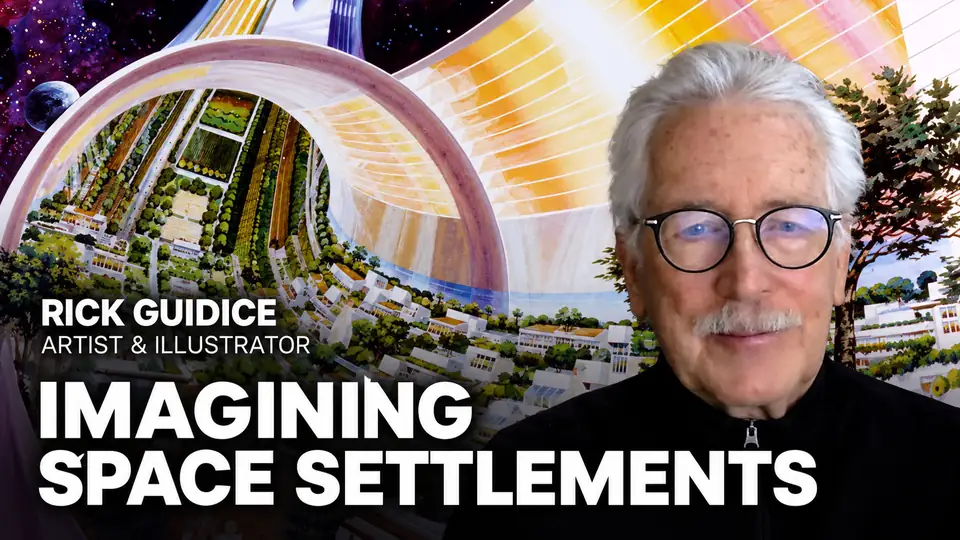
CAMERON WIESE: I'm preaching to the choir. I went on this rabbit hole several, about a month ago now on space habitats. You know, I had the high frontier sitting on my bookshelf and I finally decided to crack it open out of curiosity. And I just was kind of enthralled with the vision that Dr. Neil put forth. Not the technical vision, but the details paired with the art. Because I look at the cover of the book, I'm like, this is incredible. I want to live there. And you have one sort of in the background here, and now there's several other pieces. But that's sort of what got me hooked. And when I ordered a copy of this, so space settlements, design study, I was delighted to see your name just sort of written right there. I'm like, oh, I got to talk to Rick. Because I want to know all about this and sort of talk about your again, as I mentioned to you before the process of actually helping articulate these these visions that inspired like millions of people to want to go explore space. I'm wondering, can we start? Can you tell me about and how sort of audience like what this project was?
CAMERON WIESE: like that, and how it sort of came about.
RICK GUIDICE: I've been working for NASA for about five years before this particular assignment came along. And I worked on the Pioneer project and the Venus project and quite a few other illustrations, did the surface of Venus, which appeared in Carl Sagan's book. And stuff published all over the world in regards to these particular missions. So when the summer study series was devised and participated with NASA and academia, people from colleges around the world who are doing particular important studies on robotics and artificial intelligence and all the things that were their specialties, were all gathered together with a whole group of engineers. And they would all powwow for several weeks and come up with a summary of possible explorations or projects for NASA to do and for the academia to focus on as far as future technologies and science. And this particular summer study series brought along Jared O'Neill to give a presentation. And he had been working on space colonization. He called it for two or three years prior to coming to this study.
RICK GUIDICE: So he had a wealth of technology and scientific study done on it. And he always said, it's feasible. Here's how you do it. So everybody got on board. NASA was there, and NASA was there to help contribute their resources to help develop the ideas for the study. And the study just turned around and focused on space, what they call space settlements, rather than colonization. And they offered up me as an illustrator to produce renderings of all their concepts during that study. So I did the first painting, which was O'Neill's Double Cylinder. And it was kind of in a hurry sort of thing. And they came in and one of the guys from the study I met, I wish I had written down his name, he seemed as pretty important fellow at the time. And he gave me the, you know, a quick background of what they wanted and some of the literature that had been produced on the double cylinder, which had been, you know, quite a bit up to that point. And then I went and went away and I came up with a view that was totally different from anybody had done before and a little more dramatic
RICK GUIDICE: and challenged the viewer by having parts of the image bleeding off the page. And I brought back a perimeter and a little sketch and they approved it and I went back and painted it. Well, I really It's like I just painted, slept and ate for, you know, about four to five weeks. You know, painted day and night and turned this out and brought it in and it got just, it blew everybody away and they just loved it. And then they said, okay, we got another one for you. You know, so we went onto the Bernal Strier and then the Taurus wheel and then the related interiors for those. And it was great. And then quite a few paintings on the growing and management of food, habitats for growing and animals and cutaways of that. And then quite a few paintings about where to get the resources and how to build the space colonies, the space settlements from materials that are from the moon and from asteroids.
CAMERON WIESE: What about this was compelling to you personally?
RICK GUIDICE: The technology, you know, the idea alone is fabulous. It compelled me to paint the pictures that you see and the feeling you get from seeing the pictures that I painted, you know, I was, you know, totally enthralled with the concept. I said, well, it could be more fun than to be involved in this. And I had tremendous freedom to paint what I wanted to the way I wanted to, which was pretty, pretty amazing. They just left it up to me, you know, to put it together with certain types of, you know, instructions such as the interior would be they wanted to kind of like English, French country said, you know, Neil said that. So I had a lot of rivers and trees and everything else. And I said to myself at the time, man, who's going to pay for this? I mean, they're going to be wanting to rent property, you know. And it's certainly going to be higher density than this in reality. But that's what we did. And nobody, nobody said anything about the practicality of such, you know, beautiful countryside. So in the Bernal sphere, I got a little more denser with the building
RICK GUIDICE: structures. And then he wanted to look like their houses in the countryside. So they have little roofs on them. And you know, kind of typical, what's familiar to people in nowadays, I mean, I could have done a Mies van der Rohe home or a Caboosia type international architecture, but I kind of chose to do something a little more country, as Jared O'Neill wanted to.
CAMERON WIESE: The specific photo that we're referring to. This one,
SPEAKER UNCLEAR: correct?
RICK GUIDICE: Yeah, that yes, that's that's the Bernal sphere. And that's the one that's a little a little denser still, but it has the rivers and the green belts in between. And, and then I made like little villages up the hill. And that would circle all around the inside typically with a green space in between. They're kind of like modern planning would be on an ideal situation, a large parcel of land.
CAMERON WIESE: If you hadn't received the instruction to do the French countryside and you can have free, or if you were gonna do it again and you didn't have that instruction, like what style would you have gone with? Because presumably, it's like you draw it in a way you would want to live in it.
RICK GUIDICE: Well, even today in modern architecture, there's a whole sensitivity to dealing with a large amount of people. More people need to be housed. More people need to be in a close to their work situation and more of a self-sufficient an area of operation for an individual, not have to drive 40 miles to work. So that would be the same sort of concept that would be in a space colony where it would be very expensive to build that thing. And you certainly wanna get as many people comfortable as you could into it to make it worthwhile. So I would even think that the buildings and everything would be a lot more denser. Like the one I did for the Taurus wheel was a lot denser and it's still paying respect to green belts and everything else.
CAMERON WIESE: What was the process that you went through when you're like, because you got the assignment, I guess for this particular piece, you're like, okay, here's the assignment. how do you sort of go about taking that set of instructions and then turning it into with a little bit of magic clearly something this gorgeous and this compelling that invokes that feeling of, wow, I wanna be there. How do you do that, Rick? What's the secret sauce?
RICK GUIDICE: Being able to use color in a positive way and be bold with it. And as my space backgrounds are more like space nebula than dark space. And reflective shields where the sunlight is that I want to have it cast a warm glow. And then of course as an architectural renderer and a designer, it was easy for me to create a whole bunch of convincing and functional buildings on the inside of it. terraces and walkways and skylights and all kinds of fun stuff. I had a good time doing all that. It's great fun. I start with a blank piece of paper, some drawing, illustration board. Because of some of these are so elaborate in their concepts, I'll do a sketch beforehand. And I usually would do what I call a cartoon, the second step, which means do a pencil drawing where I can erase and move it around and do a tissue and get that approved, where a lot of these later ones I just skipped the cartoon stage and actually created the drawings, constructed them right on the illustration board, just because it so I didn't have to duplicate or transfer it from the tissue to the board.
RICK GUIDICE: And so I drew it right on there. And then I'd start with a lighter transparent, paint and acrylic, which is a medium that dries fast. And it's a real permanent, holds this color forever. You know, it's a plastic based paint. And I would use the phthalo colors, which are the ones that are transparent. and I can use them like watercolors. So I would start roughing in color and shapes. And if I need to airbrush anything, I would airbrush it at the first thing. And then just to get one special effect, but I hardly use it at all. Most of it just done with washes with a brush. Then then I'd work up from a transparent glazes where I can still see my pencil line underneath where the detail is. So I don't lose, I don't opaque out the drawing. I can work around the drawing all the way through till I start using opaque paints, all the whites and all the final lines that are in it. And then I paint the background and filled it in all around everything. That's kind of how I the process of painting it.
CAMERON WIESE: And then start to finish. So like for some of the last ones, you said it was like five weeks of just nonstop, eat, paint, sleep, eat, paint, sleep. That's it. I think that's how great things get done. You know, you have to kind of put the blinders on like, this is all I'm gonna do.
RICK GUIDICE: The family doesn't know what's going on. But I did have a studio at home. And I would load my painting up, drive it home, have dinner, go to my studio at home. And my young daughters would all hang around and watch me paint. And I set them up with a little easel and thing in their place. They'd paint too. And they both grew up to be graphic designers. And then my oldest daughter is the art director and owner of the company and she hires illustrators.
CAMERON WIESE: Nice. What impact did sort of like these drawings have on your daughters? Like clearly they became, they grew up to become graphic designers and illustrators. But like, was there something about the sort of like wonder of space that like, did they catch the space bug? Yeah, through this work?
RICK GUIDICE: To a certain degree, you know, being a graphic designer nowadays is a lot of work and they just, they're in the grind every day of producing work and getting new work and looking after their business and their health and their sports. They're always in the gym, cooking dinner, growing vegetables and riding their bikes
SPEAKER UNCLEAR: and then back to work again.
RICK GUIDICE: you know, so but they, they certainly are knowledgeable about all I went through during that period of time, and became as your little kid, your dad's painting space stuff, it seems like that's real to them.
CAMERON WIESE: When you were going through the process of, you know, kind of laying everything out, could you have some vision in your mind, like prior, so my understanding is like, NASA, like they They provided some drawings, other stuff Dr. Neal had sort of provided. What did you use as reference? You're like, I want it to look like this or that because today anyone who's doing anything space related, they reference your work. They're like, Oh, I want to do something like this. Like we did a poster for space habitat and like in the mood board was like, we're several of your pieces. Like, Oh, this is the pointer to something that we like, we love. But what was that for you? Because I know like Robert McCall was probably one of the...
SPEAKER UNCLEAR: They never pointed to anything because they...
RICK GUIDICE: It just didn't exist, right? They had never seen or realized that they could have this kind of level of work at their facility. So they just left it up to me. But I was greatly influenced by Robert McCall and Chesley Bonestall and the people who came before me doing these great things, you know, like Robert McCall did all the, the 2000 Space Odyssey paintings and they built a lot of this stuff, just like he imagined it in his paintings. and they're beautiful works. And I never got a chance to meet him, but I met his daughter and visited with her. But I did meet Chesley Bonestall, and that was always an interesting meeting with him. And he was one of the, we had kind of a parallel career because we both do architecture. architecture. And he was an architectural renderer. And that drove him right up to being top in his architectural firms. And then he went to work doing movie sets, the matte painting on the backgrounds, which big, big time paintings. And so he really owned his skill at that. So he always loved space and did some famous illustrations that were in life
RICK GUIDICE: magazine in the early 50s. I was just a kid. Here's the rocket ship landing on the marsh. It looked like the V2 rocket on the back, standing on its fins, on the surface of the moon with people walking around. It caught my imagination for sure, really influenced by those sort of things. And then, you know, Star Trek was going on at the time and other space things that sparked the imagination of, you know, having warp drive and being able to go to all the different planets in a flash, you know. I watched Flash Gordon too when I was a kid. And the little rocket, you know, floating around in the scene with smoke kind of coming out of the rear of it. So it was great fun and duly impressed me as a kid.
CAMERON WIESE: Did you ever watch some of Disney programs with Man in Space or Our Front of the Atom?
SPEAKER UNCLEAR: Did you ever see any of those?
RICK GUIDICE: Yeah, I probably have, but I can't recall the time though.
CAMERON WIESE: They did a series of shorts to promote. Before they opened Disneyland, they did a series of pieces on different parts of the park. So you had Davy Crockett to promote Frontierland, and then they did Man in Space to promote Tomorrowland, and they had TWA and the rocket.
RICK GUIDICE: I remember all that. Oh yeah, the trip around the moon. They illustrated. Yes, I remember that. What do you feel like growing up in that era where the future seemed to hold so much promise? Oh, it was wonderful, you know, in the period of time. And then I'm a product of what I called the great generation, which was my parents, which emerged from World War Two, changed America from an agricultural-based country to a high-tech country. And the growth during that period in the 40s, after the late 40s, all the way through to the 60s, was an amazing time in the growth of America. I grew up in a community in Willow Glen, California, San Jose, and Silicon Valley, and then grew up all through the evolution of Silicon Valley. And it was part of all that. So it was really fun and interesting and watching all the development of that. Being an illustrator in the advertising market and all my art director clients had Hewlett Packard, General Electric and all the high tech companies. I did illustrations for the high tech news,
RICK GUIDICE: articles and magazines. And they come up with a technical idea and I'd illustrate it for them. So I watched the full development of Silicon Valley through paintings I did for products and and did a lot of work for some work for Lawrence Berkeley labs on the linear accelerator. And I got to meet with all the scientists and work on all that. And then working with NASA to meet with each of the scientists from each individual department was truly a joy because they're so excited because they know they're going to get a nice painting. So they're giving me the royal treatment, you know, far as giving me the tour of their particular departments and showing on me what all they're doing and why they're doing it. And then it was a great time.
CAMERON WIESE: It's a nice blending too, because the deep technical brilliance in a lot of these companies, especially at NASA, is unparalleled. But with that deep technical brilliance doesn't always come the deep artistic component, be able to like transit those ideas into something that other people get excited by. It's like you look at any of that stuff like, wow, okay, that's what you're talking about. I get it. Oh, I want that. It increases the desirability of a lot of these things.
RICK GUIDICE: Very much so, yes. It's a sales tool. I worked in advertising, so I brought that mindset to whatever I paint. Plus, I can't help but paint something that's pretty, and it has some joy to it. It just happens. It just comes out of me. I can't control it.
CAMERON WIESE: Were there any other in that, like when you were growing up, I think we had the space elements vision is something that was very compelling and very exciting that it got popularized as a result of the work that you and many others did. Were there any other things that you were really excited about that either didn't capture the public's imagination the same way or or did that other people like that I may not know about?
RICK GUIDICE: I have my whole range of architectural projects that had notable clients and are well known locally but not worldwide like the NASA work. And the space settlements work is the most notable for its worldwide popularity. So that has to be the most important thing that I was involved in. And like mentioning working for things that I felt were important, and big obligations by Congress financially, like the linear accelerator cyclotron, where they shoot around neutrons and protons and crash them together and create quarks and which is a underlying byproduct of the Big Bang in the universe. And there's this element that floats around everywhere in the universe, and everybody kind of wants to know, well, what the heck is this thing? Can we harness it? Can it do something with it?
RICK GUIDICE: So those things were very important, at least in my list of projects that I worked on.
CAMERON WIESE: What else do you think you didn't work on, perhaps? Was there anything else that was super exciting at the time that, for example, in the 70s and 80s, everyone thought, oh, the future is going to have space settlements. And we haven't quite gotten there, which we'll talk about. But was there anything else that being exposed to everything that was happening, especially in Silicon Valley, that you're like, oh, this is compelling and this is exciting. like this is going to be the future that may have not turned out that way.
RICK GUIDICE: Well, we talked about zero gravity cars. I had a guy come to me one time, you know, that said he had the secret of anti-gravity for a vehicle. One would need to paint a picture of this vehicle so he could go after funding to continue to develop the anti-gravity machine. And of course, he didn't have any money to pay for it. I kept questioning this as well. I got to know, I could have to know something, it was secret,
SPEAKER UNCLEAR: stop secret. You know?
SPEAKER UNCLEAR: Of course, of course.
RICK GUIDICE: So that never really happened.
CAMERON WIESE: I think you've gotten all sorts of interesting people to reach out to you about wanting to depict things. Is your energy cars hilarious? It's a great example of like, oh yeah, someone's like, I need to visualize this. Is there anything else like that that you think is worth?
RICK GUIDICE: You know, another Disneyland with spacecraft, you know, and then we wanted to do a theme park and and we painted, you know, rockets and rides that all look like that. And then for NASA wanted to this is a real project, wanted to do an aerospace museum on the property next to NASA there. And they had available to them the geodesic dome done by Buckminster Fuller that was in the, I forget what year it was, probably early 70s World's Fair in Toronto. And that dome was available. So they wanted to utilize that as part of the museum. So I did a whole series of renderings and drawings and designs for you got to design it to for the aerospace museum. And I knew none of it really worked into a full color painting, but I did a whole series of pencil renderings of the museum. And it never came to fruition, but that was a pretty significant effort.
CAMERON WIESE: Bookman Sir Fuller was definitely one of the leading sort of visionaries of the time, and it's brought a lot of people to think a little bit differently. That project is still sitting on some, it's probably sitting on
SPEAKER UNCLEAR: some shelf somewhere.
RICK GUIDICE: It is. Yeah, well, just like all the paintings, you know, that I do are, are basically the property of NASA and the government. And they're all in an archive.
SPEAKER UNCLEAR: It's all this stuff, it just is sitting there. And you know, I
CAMERON WIESE: I think, I saw you did a gallery, you know, exhibit in San Jose, not, it's probably several years ago at this point. I don't remember the date on the essay. And your work's in the MoMA right now, isn't it?
SPEAKER UNCLEAR: What do we got here? All right.
RICK GUIDICE: You know, it's the, there's my work on the cover. Boom. And it's on the.
SPEAKER UNCLEAR: Emerging ecologies. Nice. Yep.
RICK GUIDICE: And so all the art was lined up. They worked on it for a year. The archivists at NASA put it all together. And right down to the final thing with the artworks going, they couldn't get a contract signed. The MoMA didn't like the government's contract. And they did an amendment to it. And then the whole thing fell through. But in the books, my paintings, you know, like they're going to be on display. But they didn't
SPEAKER UNCLEAR: make it, which is unfortunate. That is unfortunate. We need more people to see these.
RICK GUIDICE: It was on in the San Francisco MoMA. It showed, they showed there.
CAMERON WIESE: Okay. Everyone sees these things online too, but I think the powerful bit about having them all sort of one place is you get the full sort of breadth of both your work and the sort of story of like, oh, it's not just a single snapshot. It's just how it's like the whole thing. So there's like stories being told through multiple, multiple paintings.
RICK GUIDICE: Yeah, the first time I had been working with NASA and I've been to several of the art directors homes. And all of a sudden, I see my illustrations on their walls. And I go, Well, wait a second here, you know, where the common practice, or the the latest practice during that period of time, was that the artist maintained the property of the originals, and is sold the reproduction rights, the illustrations, where I had to give up the paintings and then Joe Smough was taking them home. And I went on a campaign with NASA to get them to protect the archive and protect the artwork and try to identify it all. So they had photos of everything that I'd painted, but they didn't know where the work was. So they put together a whole program to dig through all their records and put it in the care of the archivists at NASA. So they did that, which was terrific. And one of the head of the departments was retiring and he asked me, what is it that I can do for him before I retire? And I requested that he protect the body of my body of work, that it can be saved for future generations
RICK GUIDICE: and shared in the public. And then my next step was to try to get the NASA sophisticated enough to be able to lend artwork such as museums do to each other. They have a whole, you know, a whole established protocol for lending and ensuring and packaging and transferring. And NASA needed to kind of get up to that point to be able to do it. Well, you know, finally, a curator at the museum here in my town, Los Gatos, nice museum, heard about me and said, we're gosh, we got a local artist here that's done internationally significant work and we need to do a show. And so I put her in contact with the Ames group and I had been working with Ames to try to get this ability to lend in place. And it all came to a head for this show. And there was like, I think 12 or 13 pieces of the space settlement paintings on display in a room all at once. And I walked into that and I hadn't seen many of those for 40 years. And to see them all at one time, you know, in the room, I mean, I was blown away, you know, I go, holy smokes, look at this, they're beautiful, you know? And I had a lot of fun with it
RICK GUIDICE: and it got national publicity from all over the world. So they've been, they've shown in the architectural museum in Paris, the design museum in London, and you know, the San Francisco MoMA, and then of course the new museum in Los Gatos. And then little shows here and there. There was a Smithsonian show quite a while ago that was kind of like Back to the Future or How the Future Seen, and they had several of my paintings in a Smithsonian traveling an exhibit that worked this way around the country. There's just like, there's something powerful about this,
CAMERON WIESE: this, this art and like the depictions. It's funny, I was looking on, you know, I was just doing some prep and I went on Reddit. And, you know, we're talking about the some of the depictions and like some of your pieces. And the comment that was like, there's so many comments, but, you know, people who who saw it when they were kids, and like it got them super excited and like, that was a world they wanted to live in. And then, you know, there's sort of this like, nostalgia for that now, because that stuff hasn't really come to fruition. And I'm curious, like, how do you feel about, I mean, really, you're, you're on the forefront, like, in the rooms helping depict and galvanize and get this sort of entire movement resource and supported. How do you feel about like, how it's all sort of played out?
SPEAKER UNCLEAR: I was just reading something the other day here.
RICK GUIDICE: There's a book and it's called, you know, Mega Structures. Oh, yep. And if anybody wants to talk about, you know, future projects that far out, Neil Blevins, right? Neil Blevins had put this together and it's great. And he talks about when he was a kid, looking at our paintings, my paintings, And then how happy he was, you know, it just gave him a whole insight to what was in the future. And he never let it go. That's why he put the book together. But right on the first page it said, the book is dedicated to Gerard, Sidney, Rick, Don, Carl, and Gene. And of course, that's, you know, that's Sid Meade, Rick Guy, Don Davis, Carl Sagan, and I think Gene Rodmerry. So you know, to be included in that group of people that influenced him and other older scientist now. It's kind of a good feeling to be recognized for that work and the good results has come from it. The optimism that they felt about it has been rejuvenated today and they've kept it in their spirit. And Bevins talks about how there was a real down period during a certain
RICK GUIDICE: time. And O'Neill talked about this also in a speech he once said that space settlements can only be built, can afford to be built by the government. And the US government could do this now. But in 20 years, they won't be able to because there'll be too many, too many government issues with population and economics and resources that it will never happen. And then it ran away that kind of made me go, Oh, wow, you know, that's just not going to happen, you know. And then all of a sudden, now we've got, you know, we've got the whole vision that the young people that saw these pictures, you know, you know, just as Elon Musk, SpaceX, I'm sure you saw those pictures where he's a kid. And all the people that dream that space exploration and it is the new frontier will happen. And those people are all in the driver's seat today. and the future of space settlements of some sort, you know, are being taken up by private enterprise. So that is such a new and enthusiastic result of what's going on at the time. I look forward to a bright future and the idea that we're going to go to Mars.
RICK GUIDICE: I mean, that's just an incredible idea and a vision, and NASA's working toward it, and SpaceX and everybody else is, so.
CAMERON WIESE: It is incredible. I think you and Dr. O'Neill and several others have like, captured the flame of this sort of like, optimism alive through the sort of trials and triumphs.
SPEAKER UNCLEAR: You know, people are like, what's happening to the future?
CAMERON WIESE: Because everyone that I know, and they're thinking about space, they point to the names of the people that you mentioned, yourself included. It's like, oh, this is what we want to be doing. This we want to aspire towards. And so it's just incredible to me that we do have people who see it and they're like, okay, let's go, let's go do this now. And that the flame is the flame hasn't been extinguished. No, it's a regenerated. It's great. As we, as we wrap here, I want to ask what, like, so two quick questions. So a lot of your work has been sort of illustrated in various forms of media, books, TV shows, movies. Are there any articulations of the vision that you help that have been most compelling to you?
RICK GUIDICE: Oh yeah, well, you know, a lot of the, quite a few movies that Interstellar and, you know, the last scenes were, looked like the interior of my painting that I did. And then I got all kinds of phone calls, you know, people going, hey, Ricky, you made it look good too. there's an influence of the movie. And so that was something that made me feel good that somehow today I influenced many of the people who went on to do incredible things nowadays. Now, my work, painting these things are very unusual and very hard to do during the time, but there's young video computer jockeys jockeys that are turning out fabulous imagery of space ships and things that are going on nowadays that are quite impressive and impressive impresses me. But I was so fortunate to be at a special time where, you know, the work was stood out by itself.
CAMERON WIESE: And that was pretty good. But what would you say to a young sort of aspiring artist who aspires to the same level
SPEAKER UNCLEAR: of impact?
RICK GUIDICE: It may be hard today because of the technical assistance that computer generated imagery has given to so many people. And like all the colleges, you know, they're not teaching painting anymore. or there's a few people taking painting, but there's not much illustration being taught. And everybody is training all the kids to go to work for Pixar. So that's the focus, and they learn all these skills to work on the computer. So the competition in that area of visualizing is pretty tough. And also film, you know, since Star Wars came out where they're incredibly digital, action-packed, thrilling, realistic imagery, it's all created with a computer, it's just mind-boggling, you know, people start taking things for granted. And that where they didn't when I was working, you know, It's difficult for a young illustrator or creator to do that. But if that's your mission, you work at it, you publish it on the blog, you do whatever you can. And then maybe you can do a book one day or something or work in that regard.
CAMERON WIESE: Yeah, if nothing else, I think you're a clear testament to art can change the world and can inspire people to do things that they didn't think were possible. So with that, Rick, thank you very much for coming on. Thank you for being such a brilliant source of inspiration and for lovely conversation. Is there anything you want to point listeners to or any last words you
RICK GUIDICE: want to leave people with? The people that inspired me were just such a big part of my life when I was young. And then if you have you have a vision yourself of what you want to do, it's important to latch on to it and make it your vision, even though other people say don't, you know, you can't do that. You go ahead and do it anyway, and it's something nobody's done before. And, and you you make a living at it, you know. So it's, it's just be a be a good visionary and own your skills and work hard, have a good work ethic, you know, and then good things come to you then.
SPEAKER UNCLEAR: Incredible.
CAMERON WIESE: Rick, thank you so much. My pleasure. Thanks for joining us for this episode of the Build the Future podcast. If you loved it, we'd be really grateful if you share it with a friend or post a review on whatever you're watching or listening to this.
SPEAKER UNCLEAR: That's it from us. We'll see you next time.
CAMERON WIESE: Until then, go build.
More episodes
All episodes Isaac Arthur — From Physics to YouTubeIsaac Arthur connects everyday progress with the much larger futures he explores on Science & Futurism with Isaac Arthur.
 Geffen Avraham — CubeSats and a More Accessible Space EconomyGeffen Avraham on making satellite launches accessible and building connected systems in orbit.
 Laura Crabtree — Epsilon3 & Space ExplorationLaura Crabtree reflects on her time at SpaceX and explains why she founded Epsilon3 to support complex engineering operations.