

Build the Future Podcast
Laura Crabtree — Epsilon3 & Space Exploration
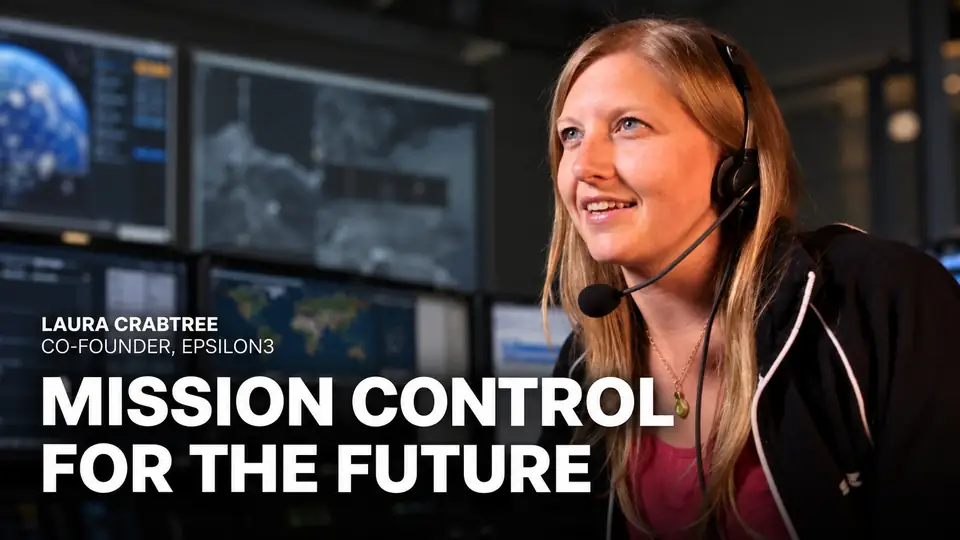
Laura Crabtree reflects on her time at SpaceX and explains why she founded Epsilon3 to support complex engineering operations.
September 21, 2021 · 38 min



About the episode
In this conversation, we talk with Laura Crabtree the founder of Epsilon3 and a former SpaceX engineer. At Epsilon3 they're building a software stack to help teams working on space exploration and complex engineering projects operate more efficiently.
Links
Chapters
Times follow the podcast audio. The video’s timeline may be slightly different.
- 00:00Introducing Laura Crabtree
- 00:38A growing space startup ecosystem
- 01:49The pull of the unknown
- 02:43Star Trek and the power of imagination
- 04:57Making space more accessible
- 07:14The Moon, Mars and the path ahead
- 08:29Space research and benefits on Earth
- 10:27Partnerships across organizations and countries
- 11:47Travel and learning across cultures
- 14:11The international space ecosystem
- 15:46Why Epsilon3 focuses on software infrastructure
- 16:41Connecting design, testing and operations
- 18:39Integrating engineering tools
- 20:27Making operations work for small teams
- 21:17Explaining space innovation to more people
- 23:34Disaster response and practical benefits
- 24:50Imagining life on Mars
- 26:57Food, family and curiosity
- 29:20Life beyond Earth: speculation and questions
- 32:06Hopes for the next generation
- 34:37Epsilon3 beyond space
- 35:22The ocean as another frontier
Read the conversation
Open the full transcript
CAMERON WIESE: Welcome to the Build a Future podcast, where we host conversations that promote positive and exciting visions of the future. Today we'll talk with Laura Crabtree, the founder of Epsilon 3 and a former SpaceX engineer. At Epsilon 3, we're building the software stack to help teams advancing space exploration and complex engineering projects operate more efficiently. Let's jump right in. What are you excited about these days?
LAURA CRABTREE: And there are so many things I'm excited about that I guess I'll go back to like, when I was at SpaceX, so I was at SpaceX for 11 years. And I went to SpaceX because it was like the place to go if you want to challenge yourself if you want like to join a startup. This was 2010. And there wasn't a startup ecosystem that there is now in space, mind you. There was in other industries. So like, you know, coming up in 2012, you had like Dropbox and you had Instacart coming up and all these things like building, but nobody was innovating around space in like the small startup world. Well, fast forward to 2020 when I left SpaceX, and I pulled my head up because I was [unclear] tunnel vision while I was there, heads down on all the things, just making sure everything that I was doing my job. And I come up for air and I look around and there are thousands and thousands of space startups geared towards innovating this communications piece, innovating on cameras and communications and human transportation. And like, it's just booming and I'm so excited about it.
CAMERON WIESE: One of the things I love to ask people who I meet who worked at SpaceX or her gonna be in the space and just like, why is space so exciting?
LAURA CRABTREE: I think it's the unknown. It's like this unattainable unknown piece that I can't define. It's doing something that nobody else has done and doing it in a way that's all your own. So for me, space was this unattainable thing. I was eight, I'm trying to figure out what I wanna do with my life. Granted, I didn't know what I wanted to do with my life at eight, but I see shuttle launches, and I think that would be amazing. And then I started talking to everyone about space and realized that it was an attainable thing. And then I just chased after it, and I've been chasing it since.
CAMERON WIESE: The pursuit of the final frontier, as they say.
LAURA CRABTREE: Yeah, and I mean, I grew up watching Star Trek. I watched all the space shows that were out there with my dad. He was a Trekkie, so we watched a lot of Star Trek, and obviously we watched a lot of Star Wars too. And so I kind of grew up always wondering about the next frontier and the exploration piece of it. So that's probably why.
CAMERON WIESE: What are the Star Trek or Star Wars lore excited you the most? Because there's lots of different concepts. You have the holodeck, you have the future governance, like, oh, San Francisco is a beautiful, thriving place.
LAURA CRABTREE: Yeah, I think for me, it was them going to new planets, and they would always go to a new place and discover new people, and every type of people that they would meet would have different laws and different ways of doing things, not dissimilar to how we are on Earth, right? But seeing other fictitious people really got me excited, And then obviously the part where they're healing each other, that I thought was really cool. So you know, the potential for science and the potential for discovery in space, I thought was really exciting too. It was awesome.
CAMERON WIESE: Yeah, I think that one of the things I like about the Star Trek, kind of the ethos is just like it gave a lot of people things to aspire towards, right? And a lot of people are like, Oh yeah, I want to go explore the galaxy. I want to go go pursue the final frontier. The reason I even say final frontier is because Star Trek was like made that a meme and it's out in the zeitgeist. Everyone's like, oh, final frontier, final frontier,
SPEAKER UNCLEAR: final frontier.
LAURA CRABTREE: And then you've got the ability to beam yourself to other planets. I mean, what could be better? I actually have this mug that my dad has from the late 70s, early 80s when I was really young and well, I wasn't young in the late 70s, but either way. So it has three of the guys from Star Trek. And if you put hot coffee in it, they disappear like they're getting beamed up.
CAMERON WIESE: Beam me up coffee or something.
LAURA CRABTREE: Oh my God, that would be amazing. This is maybe where like all of the wonders started.
CAMERON WIESE: It's like an artifact of an era that was imbued with optimism and impossibility. It feels like there's something in the air now where people are starting to get excited about the space race again. And like there's lots of innovation being pumped into it. And I'm really excited to see how the culture shifts and how receptivity to this new era, new frontier actually starts to resonate with people as they see being used for more than just space tourism.
LAURA CRABTREE: Or like GPS satellites that are in GEO that are owned by the government and Earth observation satellites that are owned by the government. And expanding that into the private sector, I think more people will get involved, more people will start understanding and doing research about what's going on in the space. And I am really ready for that.
CAMERON WIESE: What do you think is gonna be the most transformative thing? Because there's lots of stuff being worked when I got Delia and Will and Varda doing manufacturing. You have Starlink, the satellites, you have SpaceX, you have Mars.
LAURA CRABTREE: I would have to like nail it down to a single sector. Because I think the thing that's gonna get people most excited and that's going to be most transformative is when more people can actually experience space. And I think that's coming. Getting more people to space is going to be kind of the catalyst to everything else, I think, but we have to get there.
CAMERON WIESE: Yeah. What do you think the path to getting there looks like? Is it kind of through Blue Origin and SpaceX? Or is, I mean, you have like space perspective, which is that kind of balloon company, it's like a bunch of cool things being worked on. What's most
LAURA CRABTREE: promising to you? There are a couple of balloon companies that are doing like near space or microgravity. I think that will also be transformative, but I think it will come from when we can be orbital with people for more than a day or even take people to the moon. So I'm really looking forward to SpaceX launching civilians and I'm really looking forward to Artemis and I'm looking forward to Mars. I think that's part of the end goal, right? Is getting people to Mars and I am definitely drinking the Kool-Aid on that one. I think that's going to be a huge, huge step forward.
CAMERON WIESE: That's one of the questions I have. Like there's like kind of in the space camps, there's pro Mars and anti-Mars. Everyone wants to go explore the galaxy and you know, you have the Elon Musk, we have to go to Mars, the Bezos being like, why do we go to Mars? Mars is boring. Like there's much more of the stuff we can do.
LAURA CRABTREE: We should go everywhere.
SPEAKER UNCLEAR: We should go everywhere.
CAMERON WIESE: How do you think kind of like we can get the best of both worlds? What does that look like? You got Mars colonies and then what like, what else, what else we developing?
LAURA CRABTREE: I don't know when we're going to have Mars colonies, but I think it's definitely on the roadmap. I think that there are a lot more innovations that have to happen to allow people to be multi-planetary. So we've got to have innovations in science, in food engineering, in like microgravity. So I think there is like a little more time that's needed to find out when that's going to happen. I think we could go to the moon easier because it only, it'll take a lot less time and probably do a lot of that research to allow us to get to Mars. Obviously the the environment is totally different, but there are some similarities that would allow you to explore the moon and then translate that to Mars. So I'm hoping that we can get there.
CAMERON WIESE: How do we get people excited about the narrative around going to Mars and how that, like the stuff that we have to do to enable that coral to exist is going to feed back to life on earth.
LAURA CRABTREE: Yeah, I think one of the things we need to do is we need to talk about, talk a lot more about the innovations that have come from humans living on the space station for a long period of time. There's so many people that don't know about any of the innovations that have actually helped us back on Earth. And so we need to get more of the word out about what NASA has done and all of the things that have come out of that research. You know, they're growing plants on the space station. They're studying cells, they're studying bones, they're studying your eyes and how they change in space. And so we need to talk to people about that, as well as, you know, keep pushing to
SPEAKER UNCLEAR: get to Mars. Do you have any examples of some of the innovations on the space station? I think
LAURA CRABTREE: there's a lot on the biological side of things. They did a lot of studies on mice. We sent a lot of mice up there. They're doing a lot of studies on humans and like blood and like human bone density and how your eyes deteriorate. And we need to understand if the radiation in space will actually help you or hurt you. We need to get there. And then there's just manufacturing that's been done on the space station. So things that have been done in the small because you can only take small sizes of payloads. So space station, you can't take enormous payloads. And so things that have been done on small scale with manufacturing probably need to be done at a larger scale. And so we need to develop out those capabilities as well, because you can't always plan for the things that go wrong. So you need a way to, you know, either manufacture new parts or repair parts. And so that is something that I think needs to be able to be done in space as well.
CAMERON WIESE: The other thing that like the space station did, or has done really well is like international relations. And like, I don't think people appreciate enough how everyone coming together to kind of do research and be stuck in this spacecraft for a bit has improved or reduced the tensions between the US and Soviet Union for Earth, Russia.
SPEAKER UNCLEAR: Yeah.
LAURA CRABTREE: That's definitely been really helpful in a lot of different ways. I have a friend that just moved over to Star City and is working in partnership between NASA and the Russians over there, because they do have, between NASA and the Russians, a very strong partnership that has been forged over numerous years and numerous flights. I mean, it did take time to develop that partnership, not dissimilar to the partnership that SpaceX and NASA have as well, because it wasn't always perfect in the beginning. They wanted us to be able to do things, but we as a SpaceX contingent wanted to do things our way, which was going to make things faster and cheaper and better. So we had our own thoughts about it. And likewise, NASA and the Russian partnership has differing views on how things should run, but they come together for the greater good to ensure the livelihood of the people in space.
CAMERON WIESE: How do you think about the role of cities changing, particularly when it comes to us doing all of our commerce, shooting stuff up on rockets and landing? Because even SpaceX has their shipping thing. I don't think they've talked about recently, but it's like you send the rocket
SPEAKER UNCLEAR: up and then it comes down on the other side of the planet. There are some hypersonic airplanes
LAURA CRABTREE: and vehicles that are being built as well to enable travel across the world in a short period of time and I think that's going to change how we think about exploring our own world as soon as those things come to fruition and it'll change probably some of the international relations because people will be able to travel more freely hopefully maybe without restrictions
SPEAKER UNCLEAR: like we have now. Okay if we play that out what do you think that looks like?
LAURA CRABTREE: I don't know, I hope it looks like less restrictions on travel. I think genuinely people need to see and experience other cultures and other places to really, truly appreciate what they have or what they don't have. And I think for me, like one of the most transformative things was, you know, I moved to England by myself at a young age and yeah, it's England and yeah, they speak English, but it's a completely different place and with completely different culture and completely different value set. And I had to learn to appreciate and exist in a culture that was not my own. And that is something that is completely invaluable that we don't talk about a lot. I'm hoping that that means that we have, you know, still maybe a very important citizenship to our own country and a nationality, but we can appreciate other cultures maybe a little bit more than we are able to do now.
CAMERON WIESE: Yeah, well, there's other interesting components, which is how does the definition of citizenship change when people can move with this sort of frequency and flexibility? You pair that with not to get all sovereign individual, but very like the crypto economy and people able to kind of move money around or hold their wealth like online outside of
SPEAKER UNCLEAR: the role of any government.
LAURA CRABTREE: Outside of the US dollar or the euro or the British pound, and then they can travel anywhere and do anything without any citizenship or need to convert money anywhere.
CAMERON WIESE: That is interesting implications too on innovation because it means that ideas get spread a lot farther. That's true. The way I see the future is the US is concentrated a lot of the space stuff right now, but as market picks up and there's more and more going on outside of the Earth's atmosphere,
LAURA CRABTREE: Actually, there's so much going on in space outside of the US. The space industry in Europe is booming. There is a large contingent of space companies in England, Estonia, France, Germany, Italy, launch companies, satellite companies, everything. And I've been diving into that full steam ahead because I want to learn about what they're doing over there to see if there's ways in which we can support and build together. So yeah, that industry is going crazy right now.
SPEAKER UNCLEAR: It's awesome.
CAMERON WIESE: Is there anything that they're doing over there that you think is innovative or more innovative than what's being done by SpaceX or Blue Origin that would be interesting to
SPEAKER UNCLEAR: learn from?
LAURA CRABTREE: I think they're building like a lot of constellation and infrastructure over there. So, in the like communication space in the Earth observation space, there's a lot happening in that arena. And then obviously with the European Space Agency, they're doing, they actually have like feelers out for innovation. And so they, they do grants much like you know, NASA or or the SBIR program does grants for innovation,
SPEAKER UNCLEAR: which is cool.
CAMERON WIESE: There are a lot of like unsolved problems in the space too. I love to have you like kind of touch on that and then kind of talk about how the work you're doing kind of fits into this landscape.
SPEAKER UNCLEAR: Sure.
LAURA CRABTREE: A lot of the industry is focused on hardware and you know, new sensors and new bus technology and you know, how do I make this thing smaller? But the way I see things going with the industry booming, not as many people are focused on the infrastructure. So like the software that backs up the innovation that's happening on the hardware side. And so I started Epsilon 3 to focus on the infrastructure to back up what everyone's doing on the hardware innovation side of things. So that's kind of where we've positioned ourselves as the industry is booming. We want to support that industry with the software to back up what they're doing on the hardware side.
CAMERON WIESE: We were talking before, we hit record on how the software stack continues to get layers of abstraction added onto it. I'm sure that's happening in space as well. Are you thinking about, or are you thinking about the hardware side, like the software support, the hardware side is continuing to be abstracted?
LAURA CRABTREE: When I talk to people about their software stack, they're using tools for requirements, they're using tools for work tracking. Then on the operations side, they've got their command and telemetry system. Epsilon 3 is designed to sit aside the command and telemetry system and then provide a feedback loop back to operations and design. Back all the way to the requirements so that you can iterate on your design. Because something that we did a lot at SpaceX was, we performed a test, we iterated on the design, and then we made our designs better. And so that's what I want to sort of enforce that kind of design feedback loop in the space industry.
CAMERON WIESE: So kind of like operationalizing kind of the process that you are doing at SpaceX, that like it's clearly worked very, very well.
LAURA CRABTREE: Yeah, and really making sure that if you perform a test, if you perform an operation, you have a good record of what you did. I found that so many people send commands to their spacecraft and may or may not have a record of what they did, or it's in a convoluted way. So you have a record, but it's very hard to find what you did and who did it. So it's all stored in a database somewhere, but parsing that database to find what you did is a little bit more difficult. So we're trying to make that easier so that a smaller company doesn't have to have a ton of infrastructure to be able to do that kind of thing.
CAMERON WIESE: How do we reduce the infrastructure requirements or like the tooling requirements such that more people can readily go enter the space, no pun intended.
LAURA CRABTREE: No pun intended. I do that a lot.
CAMERON WIESE: What's not being done in the space that you would love to see done enabled by the work
SPEAKER UNCLEAR: you guys are doing at Epsilon?
LAURA CRABTREE: I think there are a lot of really cool companies coming up surrounding the manufacturing processes. I know you talked to Chris at Hadrian. So surrounding manufacturing and supply chain and sort of like the process to get to actually building the vehicle. So there are software solutions on the design side that will assist in design and make sure your designs are sound. And so what we want to do is we want to interface with all of those software tools to create like a really powerful stack so that you really don't have to go out and source like 10 different software pieces to have a software stack. You can have like three or four and they all talk to one another because the biggest problem that I found is like you have this really awesome tool and it sits by itself on an island. And what do you do with all of that is it sits by itself, right? So if you build an integration back to other tools, now you can create that feedback loop and now your tools are just 10 times more powerful than they are by themselves. So that's kind of the vision that I have.
SPEAKER UNCLEAR: That's super exciting.
CAMERON WIESE: There's like all this, there's like, there's so much stuff that needs to be done. It's like, okay, we need to make this easier for people to build. This might be like the incorrect parallel, but I think about kind of what y'all are doing. I think like, okay, like AWS-esque, where it's not like, it's more like the, the base layer that like supports and like helps everyone else kind of move faster, move quicker and like reduces the cost of innovation or the kind of the bare to entry.
SPEAKER UNCLEAR: Is that fair?
SPEAKER UNCLEAR: Yeah.
LAURA CRABTREE: And when you have a really large company and you have thousands of people, you can have processes that take a lot of time because you have a lot of people. But if you have a company with 20 people and you're trying to do the same thing, if your process takes two hours, now that's time prohibitive and you're never going to actually innovate because all you do is spend time on the process. If your process takes more than two minutes, now you're broken. What we're trying to do is make the process of defining what your operation should look like, and collaborating with everyone on your team easier so that it takes really one or two minutes or maybe even one or two seconds to perform an action. And then it's recorded, you don't have to think about it and it's already in the database and easy to find.
CAMERON WIESE: What do people like not get about the space?
LAURA CRABTREE: I think people don't understand how much innovation is actually occurring within like the deep tech, like personnel, I'll just de-tech engineers and operators. People kind of get it, but as soon as you go outside of that, like I could go to a dinner party, not that we're having dinner parties right now, but I could go to a dinner party and somebody would ask me, what do you do? And I would try to explain it in three sentences or less and their eyes would glaze over. But the only thing that I can tell people is like, oh, I worked at SpaceX. And then they're like, oh, that's so cool. But if I try to tell people about innovation in space or what's happening in the space industry, it's just...
SPEAKER UNCLEAR: What? Why do you think that is?
LAURA CRABTREE: I have no idea, but I'm trying to fix that. Every person I talk to, I get more and more excited to try to explain to them what's happening in the industry and how much innovation is actually occurring, how many space companies are out there. And so I get really excited to tell them. And as I talk to people more and more, they start getting excited or they start understanding. But the thing that I still don't understand is that when I talk to certain people, they still don't know that there are people living in space. I usually ask people, how many people are living in space if we're talking? Do you know how many people are living in space?
SPEAKER UNCLEAR: It's 12?
LAURA CRABTREE: Well, on the space station.
SPEAKER UNCLEAR: Is it six then?
LAURA CRABTREE: It's six right now, yeah. But it could go up to nine and then it goes back down. So it depends on if there's another vehicle there.
CAMERON WIESE: Anyway, people are just like, oh, there are people out there. People still get this. That's wild.
LAURA CRABTREE: Yeah, people don't know. People don't know.
CAMERON WIESE: When I think about this, like, how does this stuff translate to people's lives? Oh, there's lots of companies being started. There's lots of satellite companies, infrastructure companies. And, you know, going to the moon, the moon and Mars. I think that the missing element is more or less like, how does that affect people's lives? I'm curious, kind of like if you were to frame kind of your excitement for like the whole industry, like to communicate to people who, you know, may not have any context. How is this stuff going to change their life on earth? Like, why is it something to get excited about?
LAURA CRABTREE: I think we need to start telling people that this is going to change the amount of time it takes for us to respond to a natural disaster. The amount of time it takes for us to predict what the weather might be, because that can affect greatly whether you do or don't do something. Like if you knew that there was going to be a huge snowstorm, would you go and summit a mountain? Probably not. And likewise, if you could see or you could have some predictive nature of there may be a natural disaster, because I know that there are people working on predicting natural disasters and or responding to natural disasters. And so I think if you can relate it in a way that will enhance people's lives, then they might be more apt to listen. If there's a humanitarian crisis, we would have the ability to have point-to-point communication in real time without the need of a handheld and a dish or something. So thinking about how that affects either how our military or how just civilians act in a crisis situation, I think that would help explain things as well.
CAMERON WIESE: It still feels like abstract for people in a way that I can't quite put my finger on. But I mean, that's kind of why I think I mentioned like the underlying project here behind the podcast is the revival of the World's Fair. What are the stories we can tell about space that like we'll collect with that random person in this context like at that dinner party. And you're like, oh, but look at all the amazing things. It's like, what do we show? What do we tell them? Or rather like what sort of experience to be allowed to step into.
LAURA CRABTREE: I would hope that you could step into like a world where you step onto Mars and you get to experience Mars.
SPEAKER UNCLEAR: What would that look like?
LAURA CRABTREE: I feel like it looks like the Martian, but it probably doesn't look like the Martian. I really want a habitat where, especially like I'm growing a bunch of plants, that would be my ideal. I would love that. I always marvel at the movies when they have plants growing in space. And even if they have like gravity in space, which I don't know how they do that. But that's the thing that I would be like, this is amazing. If they have like a greenhouse space station or a module, that's just a greenhouse. Like I would be excited about that.
CAMERON WIESE: Imagine eating a meal on Mars, like grown in the Mars habitat or like you look out at window or outside of the geodescent dome that you stepped into and you can see kind of the Mars landscape outside. You can see, you know, Curiosity was the most recent rover, if I recall correctly, right? Yeah. Or is that the one? Okay. And then like whatever the next one is, if they've named it, you just see it like out there flying and buzzing around.
LAURA CRABTREE: That would be amazing. Well, actually it was, so Curiosity was the past one and then Perseverance was the new one. And so Perseverance was the one from last year. And so if you actually got to like grow food and have, I don't know if you have animals, but like, ideally you would have animals and you'd have food and animals and be able to like grow your own vegetables, that would be incredible.
CAMERON WIESE: On the animals note, what do you think about cultured meat as a food source moving into
SPEAKER UNCLEAR: the future?
LAURA CRABTREE: I've been looking into that. I would love to try it, but I've never tried it. Have you?
CAMERON WIESE: Not yet, but someday, someday soon. Are you keen on the idea of being able to grow meat in the lab?
SPEAKER UNCLEAR: Or does that seem kind of like strange to you? At first, everything might seem strange,
LAURA CRABTREE: but then you get used to it and you're like, this is normal. So I could definitely get behind it. If that was what was available and I readily available and I could buy it, I would probably
SPEAKER UNCLEAR: eat it. Would you live on Mars? Probably. As long as my husband was okay with it and my kids could
LAURA CRABTREE: come with me. We've talked about it and we said if we could all go together we would go. So I have
SPEAKER UNCLEAR: a five and a six-year-old and they would come with me. Is this what dinners look like in the
CAMERON WIESE: Crabtree household? All right, do we want to go to Mars? Let's talk about this. Yeah, actually,
LAURA CRABTREE: so my husband is a professor of engineering and he also designs general aviation aircraft. So we We talk about lift drag, we talk about microgravity, we talk about space, and my kids are, yeah, they know all of these things. It's kind of interesting. They ask me a lot of questions, which is good,
SPEAKER UNCLEAR: because they're curious. I love that.
CAMERON WIESE: A lot of people get irritated when kids are asking, why, why, why? The counter's like, I don't know, what do you think? And you kind of get the kids in the conversation, get them to kind of invoke their sense of the matter, like their imagination, because like kids have crazy ideas, amazing ideas, because they're not corrupted by the rest of the world.
SPEAKER UNCLEAR: It's so true.
LAURA CRABTREE: My six-year-old asked me the other day, why does the earth spin? And I got to explain to him the tides and the earth spinning and the earth spinning around the axis and the earth spinning around the sun and all of these things that I was like so happy to get to explain to him because he asked me one question. We talked about Newton's laws And we talked about that there are no forces in space. So if you throw something, it just never stops. And I said, well, that doesn't happen on earth, does it? And he said, no, because of gravity. And I was like, oh my God, I love you. I love you so much. So he at least is listening to me when I speak about these things. So I'm very proud.
CAMERON WIESE: You should be, you should be, absolutely. Absolutely. That's adorable. Have y'all had the Alien UFO discussion in your household?
LAURA CRABTREE: They watch alien movies and alien shows, like there's a bunch of kids' shows, and they ask me, you know, do I think that aliens exist? And I think I have to say yes. I mean, there has to be other life out there.
CAMERON WIESE: Do you think we've been like, visited by aliens?
LAURA CRABTREE: I don't know. What do you think?
CAMERON WIESE: I feel like probably, yeah, if I put my like 10 foot out, like probably around the development like the nuclear bomb, but like, oh, it kind of like we got put on the radar of like, oh, the civilization has sufficiently advanced, we should probably check it and see what they're
SPEAKER UNCLEAR: doing.
LAURA CRABTREE: And make sure that they're not going to kill themselves and everyone else on the planet.
CAMERON WIESE: Or they're like, they get some sense of like entertainment out of like seeing what happens to civilizations like after they develop the bomb it's like and there's you can imagine bookies on like another planet being like all right what do we think is earth gonna make it or are they not and there's like you know 50-50 bets like oh no they are and then people are kind of coming to the planet to inject chaos into the system so this arrow we're in is like seeded by alien force
SPEAKER UNCLEAR: this is this is getting too far out of it. Maybe I don't know that's that's a little far out I'm
LAURA CRABTREE: I'm not sure, they might know what we're doing. I don't know if I believe that they've been here.
CAMERON WIESE: I can buy into that as well. Although, if I want to get out into kind of wild territory,
SPEAKER UNCLEAR: does it seem to presume you're familiar with the Fermi Paradox? No.
CAMERON WIESE: Okay, so sometimes there are concepts that like, when you have shared understanding of them, you can talk about them. But when you don't, it's like, oh, I have to explain it. But effectively, it's this kind of idea, like if there are aliens out there, like where are they? Right, because we, I'm gonna tell us, were like, the universe is quite large. Where are these things?
SPEAKER UNCLEAR: Like, why do we not have any evidence? Have we been visited? Have we not? It's hard to tell.
CAMERON WIESE: And you'd think, like, in a universe so big, we'd have some signal. So this philosopher posed, like, OK, why? Why have we not been visited? Or why have we not seen these? And there are a bunch of proposed reasons why. And one thing that someone proposed was that sufficiently advanced civilizations, Instead of going outward into exploring the galaxy, they revert inward. And so there's this question of global consciousness or a singular consciousness that people end up exploring through the psychedelic-induced states like lucid dream states. And that's kind of their entertainment and their exploration, the frontier within instead of the frontier without. So I wasn't sure if you had thought about that.
LAURA CRABTREE: I've never thought about that. No.
CAMERON WIESE: So outside this realm, what are you excited about? I guess like you have with your two kids, like what kind of world do you want them to grow up in? What does the future look like for them?
LAURA CRABTREE: I want them to grow up in a world where, you know, they don't have limitations on what they can do. They're not told that they have a limitation and they can really be and do whatever they want. I see and I want a world where, if my five-year-old wants to be a drummer, he can be a drummer. And my six-year-old wants to build houses on Mars, then he can do that. And I also really hope that innovation and science, technology, engineering are things that they develop a passion for in school. I really hope for that. I don't know if that's gonna happen and I'm not gonna push it, but I'm just going to hope that because of my background and my husband's background that that's you know what they'll get. But for you know other things I really hope that somebody in the you know medical field can help maybe elongate our lifetime. So I'm really hoping for a longer life than I'm looking at. I want to live a long time. I want to see every one of my people grow old and I want to I hope that we can find cures for cancer and other really bad things that are out there.
LAURA CRABTREE: Cause I think that sometimes the best people develop the worst kinds of afflictions and diseases. So I want them to live long lives as well.
CAMERON WIESE: There's a lot of cool stuff going on in that space as well. David Sinclair's latest book, Lifespan, is a good read. And then I don't know if you're following what Celine and Holly was doing over at Loyal, I'll put her on your radar as well. They're doing longevity in dogs as a path to market to test different pathways and help man's best friend live longer. And then the idea is that while they're doing that, the culture will shift where people are more receptive to viewing aging as a disease versus, to my understanding, it's not classified that way right now, which is sad.
SPEAKER UNCLEAR: That's awesome. I'm going to look that up. That's amazing.
LAURA CRABTREE: And, you know, there's a lot being done in cancer research and cell regeneration. And so I'm excited for all of those things to come to fruition. And hopefully the space economy can help make some of those things happen.
CAMERON WIESE: Yeah, I think there's like lots to be revealed, lots to be uncovered. People are working on it, which is exciting. Or where can people find you? And like, how can they support you and the work you're doing?
LAURA CRABTREE: Well, we're looking for any company who has complex engineering problems. in the integration tests and operation space. So, you know, space industry, we're supporting eVTOL companies. We are also supporting ocean exploration and robotics companies, and also, you know, in the electronic vehicles and energy space. So any of those companies, if they're looking for management of their operation, they can come to us. I'm just Laura at Epsilon3.io.
CAMERON WIESE: Cool. There's so much more we can riff on.
SPEAKER UNCLEAR: Energy and oceans.
LAURA CRABTREE: I know. I've had so much fun. The ocean exploration thing is just something that I'm really passionate about as well. I was always fascinated with the ocean. And when I was in undergrad, my senior project, I did not develop a space vehicle. I actually developed an underwater vehicle to test the salinity and the temperature of the ocean. So doing some ocean testing while being towed behind a vehicle. So like a boat would tow the vehicle and then that my vehicle would dive and come back and it would do like tests of the ocean. So that we could make sure that we could map the oceans and that's actually happening now and I'm so excited about it.
CAMERON WIESE: What are the implications of that? Like they want to map the oceans. Why is that a big deal?
LAURA CRABTREE: There's so much we don't know about the ocean. And I think the ocean, it really fuels the planet. We need the oceans, we need the waters. Obviously, we need the fish and the fish need the coral and the coral need the temperatures to be in a certain way. And so I think it's just the whole ecosystem of understanding the ocean and how it reacts to different temperature changes and how the migrations occur. Because there's only so much we understand about fish and whale migrations as well. And so I think there's just so much to learn about the ocean. And I think it's amazing as well.
CAMERON WIESE: Another frontier for us to go pursue.
SPEAKER UNCLEAR: That's what I was going to say.
LAURA CRABTREE: I was going to say it's the other frontier or the other other frontier.
CAMERON WIESE: Yeah, the other final frontier.
SPEAKER UNCLEAR: Yeah.
LAURA CRABTREE: So, you know, exploring space is one thing. But as you were saying, look inward. This is a frontier on the earth that we have yet to fully explore and understand. So I'm really excited about that too.
CAMERON WIESE: Laura, thank you so much for coming on. This is a blast.
LAURA CRABTREE: It was really fun. Thank you so much. It was great talking to you.
CAMERON WIESE: Thanks for joining us for another episode of the Build the Future podcast. If you want to support the show, please share your favorite episode with a friend. If you want to get updates on the events we're hosting, new podcast episodes, and follow along as we build the new World's Fair, you can follow me on Twitter at c-a-m-w-i-e-s-e. Until next time, go build.
More episodes
All episodes Justin Glibert — Factories on the MoonJustin Glibert imagines lunar factories that use local resources and eventually make their own equipment.
 Felix Ejeckam — Satellites and Internet Access for EveryoneFelix Ejeckam explains Akash Systems’ use of diamond in semiconductor thermal management and its 2020 satellite-communications plans.
 Don Davis — Space Art & Humanity’s FutureDon Davis on painting space settlements, working with Carl Sagan and imagining life beyond Earth.