

Build the Future Podcast
Don Davis — Space Art & Humanity’s Future
Don Davis on painting space settlements, working with Carl Sagan and imagining life beyond Earth.
December 12, 2023 · 55 min



About the episode
In this conversation, we talk with Don Davis, an artist and illustrator who has spent his career helping us imagine the wonders of space. His work with NASA, Carl Sagan, and the U. S. Geological Survey's branch of Astrogeologic Studies has been seen by millions and helps us bridge the gap between imagination and reality.
In this conversation, we talk about Don's childhood fascination with space, the influence of science fiction on his work, and how the ideas around space colonization evolved.
Links
Chapters
Times follow the podcast audio. The video’s timeline may be slightly different.
- 00:00Welcome to Build the Future
- 01:10Introducing Don Davis
- 01:46Apollo 11 and historical perspective
- 05:51Growing up in the space age
- 08:14Joining the USGS and painting the Moon
- 11:56How new data changes space art
- 14:39Meeting and working with Carl Sagan
- 18:19Visualizing knowledge and filling the gaps
- 21:18Dinosaurs, reconstructions and film
- 27:20Space settlement art and the L5 movement
- 31:48A living ecosystem inside a space habitat
- 37:07Reusable rockets and future access to space
- 39:52Keeping the vision of space settlement alive
- 42:272001, books and visions of the future
- 51:33Don’s work and plans for an art book
- 52:46Closing reflections from Things to Come
Read the conversation
Open the full transcript
CAMERON WIESE: Welcome to the Build the Future podcast. My name is Cameron Wiese and I'm your host. I've always been fascinated by the ideas and the sentiment that drove American culture in the 1960s with the space race. A culture galvanized to dream about the possibilities of tomorrow. Whether it's food, transportation, cities, biology, or anything else, it was this cultural mindset rooted in optimism. That the world tomorrow would be better than the world today. A mindset where people were compelled to build things, and I quote JFK, not because they were easy, but because they were hard. It's this desire to build and to dream that seems to have been lost, and something we're here to bring back. With Build the Future, we're here to promote the ideas and stories of those who see how the future can be better and promote their plans to get us there. It's our mission to get you to dream about the possibilities of tomorrow, to dream about the future that you want to live in, and inspire you to go build. Welcome to the Build a Future podcast.
CAMERON WIESE: Today we're talking with a brilliant artist and illustrator, Don Davis. Don is an absolute legend, having created some of the most prominent paintings of the the moon of our solar system and of space habitats. Don is without a doubt one of the giants whose shoulders we stand on when we think about what it would look like for humans to explore space. So lovely conversation with Don. Let's jump right in. Don, good to see you. Thanks for coming on the podcast. Excited to talk with you today about space and art and all related things. Thank you, good to be here. So you and I had a, we had a call a couple of weeks ago after I sort of dove down the rabbit hole on space habitats and was deeply moved and inspired by one of the images that you did for Gerard O'Neill or a couple of them needed for the space settlements. And then I found your blog and kind of dove down the rabbit hole there. And one of the pieces that really stood out to me was your anniversary sort of log on Apollo 11. And you know, I want, can you tell me, can you tell me about the, like that sort of series of posts?
CAMERON WIESE: Cause it was, you know, 20 plus years. And then when I read it, I was like, wow, this feels very nostalgic and also very sort of like, powerful, because you document both the current moment and you know, 50 years prior. So you tell us a little bit about about that sort of like, why you were doing that, what the moon means to you and the sort of things that people forget about and like why the moon is important.
DON DAVIS: An amazing bit of reference and perspective that we can apply with our lifetimes, and then extending that to history, the historical record going even a lot further. A lot of that is really profound, a ponder. And when we look back at the, say, 50 years after Apollo 11, and then we really imagine what took place in the 50 years prior to Apollo 11, where we were then, what stories were making the news, what passions and concerns we're making around then. And every time I did that look back, looking through several huge, thick historical volumes I have and such, I was struck by parallels or references to science and astronomy and the opening up of frontiers at partaking place then, as well as news headlines, some of them rather grim, and some of them which resonated with themes ongoing in the present. So the perspective as well as the commonality and the differences intrigued me. So for some 20 years, I wrote of these in the context of where we were at that time. So each year we see a progression.
DON DAVIS: I stopped doing that when 50 years before Apollo 11 was 1917, because that was the birth year of John F. Kennedy, the president who set the ball rolling on Apollo. When I thought that was a good place as any to call it quits. But I would go back to the 50th anniversary, I think, if you pick any one of those to read, where I put my all into it. It's just, because I thought I would stop doing it then. The passage of time, the attainments, the hopes, the dreams, the tragedies, the terrible things, with the ongoing pathway where we're struggling upwards, where we're in a constant race between attainment and achievement and decay and catastrophe. And those themes intrigue me in how we are trying to climb the ladder, which is burning around us sometimes, and what we can do to make a better future and a better life. I think the perspective of what we have done and what can happen as our imagination gives us, I think that there's plenty to work with for people who have hopes for the future.
SPEAKER UNCLEAR: Really? Yeah. I love your quote. I wrote it down. Yeah.
CAMERON WIESE: The day seems to be on the horizon when a new generation will know what we have known that the earth is not the limit for humanity. I just thought that was like a really sort of beautiful encapsulation of like all of that history. Just like this is not the end.
SPEAKER UNCLEAR: Well, it's just a, it's like in the big,
DON DAVIS: after the last words in the first Star Trek film, the human adventure is just beginning.
CAMERON WIESE: Like what was it like, I mean, you're telling me that, you know, you're a child of the space race. Like what was it like growing up? Tell me about when you were watching the Apollo mission. Like what was that like? What was the world like at the time for you as a kid?
DON DAVIS: Oh, it was such a grand adventure. I was just old enough to appreciate what it was about. Invariably, I have to refer to my first memory of the news event, which was the launch of Sputnik 1. In October, 1957, our kindergarten teacher made sure that we had that event impressed on our little minds as she marked it on the calendar on that day. And that sort of sets the mold for my being a child of the space age. And so as things continued, the way I would see on TV, you know, the Mercury flights, the progression from the one-man space capsule to the two-man ship, the Gemini, as they were working toward, I see the capabilities they would need for rendezvous and such in order to make sure a project Apollo had cleared sailing. And so the progression to the three-man spacecraft, Apollo took place in the later 60s. And that was, again, we had so much to look forward to. Magazines and books were full of concepts of what it would be like on the moon of anticipating this great adventure. And so I remember the first Saturn V rocket when that launched, that was shown
DON DAVIS: live on TV and just seeing that thing, this just 360 plus foot tall leviathan launching on its pillar of flame and you can hear in the background everybody cheering and the press control room wherever that voice could reach the microphones that sense of human passion of trying almost to levitate it by the sheer force of will, all the will, the work that came into seeing that moment take place. And if it was a first Saturn 5 launch, that was a very pivotal moment. And of course, after that, we would start reaching for the moon, because once we had the vehicle to get there. The pivotal moment for me in my interest in the moon was working for the US Geological survey branch of astrogeologic studies. I pronounce that very carefully because a lot of people have said astrology studies or such. Truncate the syllables and such. But so what happened was I was in high school in the San Francisco Bay Area, and the USGS branch in Menlo Park, they were looking for students they needed for a relatively menial but skill set requiring
DON DAVIS: task of coloring maps. You see, back in the days before they had color printers, they would have these big machines, sort of like blueprint machines, like the smell of ammonia, and these big sheets would come out, the massive sheets that wide, and they would have the lines, the boundaries of the different provinces, geologic units as they were called. And so we would take those and we had on the wall a big array of colored pencils and each of the pencils had a specific label which matched the designation of each of the areas that we had to color. So we would hand color these maps with these prismacolor colored pencils and that was to be my original task. But when I went from my job interview, I brought a painting of the moon that I had done. And the person who interviewed me was Don Wilhelms, who is among the great lunar gurus, still alive and of all time. And he looked at that painting and I said, you're hired. because he had a project in mind that was, he wanted to show the face of the moon, the
DON DAVIS: details of the moon as it appeared in earlier geologic eras. And that required skill sets that he didn't have access to there in Menlo Park. And when I showed up with that painting, all of a sudden, the piece fell into place in his head. And that was the project that I began very early. I was at like the, as I recall, November 68, when I was hired. That was right around the time when I first started working was when the Beatles quite album was released. Yeah. And I got to see kind of a front row seat as to what we were learning about the moon and about the planets. where all the data was coming in, the photographs and such. And so that was the cream of the crop, the actual real meat of the data that as the Apollo missions came in, we would have books that would have all the photographs taken aboard the missions, these color prints. And I spent endless hours looking through those. And of course they had all the lunar orbiter photos of the moon and these various giant mosaics that were like 20 feet tall.
DON DAVIS: You could pull them out on these big wooden boards that were in a kind of a vertical file. And that was just an amazing thing to see all the little boulders and such that you could see. The moon was really becoming well known at around that time. And so all of a sudden getting an inside look at what we were learning, that made a huge difference. And from then on, the moon has been a celestial body that is most intimately connected with my career.
CAMERON WIESE: Well, it must have been really, really fast. Because up until that point, like you actually have real data coming in from the space, space missions, it was all speculative. So everyone was like kind of coming up with stuff to imagine what the moon would look like based on maybe telescope, telescopic sort of views. But actually having the data, the mapping and the satellites to try and figure out what it actually looks like was it was really kind of created a whole new era of like realistic space art, right? Because then
SPEAKER UNCLEAR: you were able to take that and do stuff with it.
DON DAVIS: Absolutely. As we learned was that the first looks we got at the first of the surface of the moon were from Soviet and then American robot probes landed on the surface. And before first we learned, okay, the moon's hard enough to support your spacecraft. So it was a little bit of speculation that the the moon might be covered with a layer of fine dust that things would be swallowed up in, but that ended up being proven wrong. And before we actually got to see the surface, of course, we had to only guesswork. And different artists guessed in different ways and with different degrees of success. Some like Lucian Roudeau, a French artist, he would look at the moon and see the mountains as being relatively rounded and gentle slope on the edge of the moon. He made observations and so some of his paintings reflected that. And Chesley Bonestell, he tended to use telescope photos and his eye were fooled by the extreme contrast of these pictures and it looked, the moon looked much more craggy than it actually ended up. So he ends up doing a number of paintings, beautiful paintings,
DON DAVIS: but there was a fairly consistent vertical exaggeration in a lot of these works. It's kind of similar in retrospect to the vertical exaggeration that some computer graphics use when they're showing planets or surfaces. So it's not a wasted effort, but it was the surface though, the actual detail when you're standing there, That was just completely complete guesswork. And different artists tried different approaches. But that Chesley Bonestell did a number of paintings, one of which came relatively close, showing a rocky rubble-strewn surface, like as if a bunch of pounded rocks
SPEAKER UNCLEAR: were laid on the surface and such.
CAMERON WIESE: So Don, I want you to tell us about the story of how you got Carl Sagan to become a fan of the moon.
DON DAVIS: The emphasis of Carl's, a lot of his work was of course Mars and such and very interesting place very mysterious place and the moon didn't seem to have much likelihood of life on it and its history was such that it's very ancient very slow progress of changes there and he tended to consider the moon boring. However, the project that I worked on with Don Wilhelm's to recreate the appearance of the moon in earlier geologic eras, that was to be published. And it was published in Icarus magazine, a planetary journal. And the editor at that time was Carl Sagan. So he saw that and they were reproduced very nicely in the magazine. And in fact, it was about a year later that I met Carl, and one of the scientists, computer scientists who worked over at the Stanford Artificial Intelligence Lab, Paul Fox, he invited me into this gathering which took place at this kind of a communal household on land at that time owned by Joan Baez. So quite a crowd of people were there. It was interesting. And I was circulating around and Paul said, hey, come here, let's let's
DON DAVIS: let's introduce you to Carl. And I had brought a painting of Mars to that meeting and had it propped up against a wall. So he led me to where Carl was and there Carl was looking at that painting close up with his glasses off, inspecting every minute detail. And I knew that he would appreciate it because that painting was done with the aid of the Mariner 9 Mars Orbiter data, which was the first information we had of what the topography, the relief across the planet Mars was actually like. So that painting was the first one to show the real Mars as it actually was with Ulva legend and folk tales and illusions stripped away. So that when he saw that, that made our introduction a lot easier. And I mentioned that I had done the reconstructions of the ancient moon that he published in Icarus. Oh you did those and I want you to know I worked really hard to make sure they were reproduced as well as possible in the magazine there. So he really appreciated that and then later on when Cosmos was made I was one of the artists who worked on that,
DON DAVIS: model builders and such, paintings that I had done later for Don Wilhelm's of the history of the moon, showing it changing in smaller steps in the previous paintings. And they were in color. Those ended up being used on cosmos. Karl made sure that they were used and they were horizontal. They were a format that was awkward to reproduce on TV, but Karl said, do it anyway, put them sideways. I don't care. And so I like to think that I helped him pay a little bit more attention to the moon in the scheme of things. I love to get a little philosophical.
CAMERON WIESE: What is the importance of being able to visualize some of these concepts? Because we have the moon showing it on cosmos and in Icarus. Why does that matter to people?
DON DAVIS: Being able to visualize something, to show something, rather than explain it in pages of text, or in addition to, is a very valuable way to gather information. The visual pathways of the brain just streamlines the concepts in so many ways so often. And so, like being able to show the history in geologic terms of this or that feature, it's relatively common in geology. There are series of illustrations that were shown of Crater Lake when it was forming with this giant eruption of this volcano that had the top blown off and paintings were done of that over time. And just being able to, hiring a good artist who was very informed and had good advice on the
SPEAKER UNCLEAR: details, it's a very valuable way of conveying such information. It also helps just, you know,
CAMERON WIESE: the gaps in like our imagination, right? Because I think about, it's funny, there's an interesting parallel that just now occurred to me, which is, you know, you have certain science fiction, which I know, well, I won't ask you about your favorite science fiction, but you have like Jules Verne writing this hard sci-fi that was kind of informed by reality. In a similar way, kind of your art, and you know, art of sort of the space era was informed by reality, but there were gaps that had
SPEAKER UNCLEAR: to be filled in. So it's like, the real stuff, but
DON DAVIS: there's always gaps. And that's where the more you learn about the subject matter, the likely, the more likely you are that those gaps will be filled in plausibly. And variably, there's guesswork involved when you do a painting, many paintings done of space throughout the decades. If they're done with due research and knowledge of what is known at the time, they preserve almost like a fossil of what was known at that time of these places. So that's why when you look at paintings from the 40s and 50s showing Mars with these lines across it, the so-called canals, that represented the consensus then. And later as soon as we get real information we start seeing like the Earth, the real clouds with their intricate corals and spirals and such. whereas very early paintings of the Earth from space tended to make the clouds a simplified latitudinal pattern. Those are assumptions that were just arbitrary in some cases. So little details get filled in. The background behind a lot of these details gets known and that informs one's choices.
DON DAVIS: So yeah, there's in a way dinosaur art is a similar thing. Advances in what is known about the dinosaurs can be seen in paintings done in the 40s as opposed to paintings done in recent decades where more lively, active ideas of what they were like and the presence of feathers on at least of some of the smaller ones, various bits of knowledge as we gather and have the ability to gather more knowledge. It's the same thing with space and with astronomical subject matter. I think that the more we learn, the more frontiers of imagination that we artists have to work with. And although there's a tendency now to use such Hubble images and such which are public domain, instead of artists works, there's still the inspiration is there. And, and those of us in the space art business never had a greater variety of material to work with than we do now.
CAMERON WIESE: Oh, yeah. I'm glad you brought up the dinosaurs, because that's what I was going to reference is Charles Knight and visualizing stuff early on from these fossil records. And it's hard for me not to imagine that that work then influenced folks like Michael Crichton writing Jurassic Park and then all these stories and films around dinosaurs. Because I love was a kid. I watched like the land before time. And like, that's probably not what all the dinosaurs looked like. But you know, there's some visualization, informed by reality and some imagination kind of mixed in that gave us a sense like, oh, this is this is a plausible possibility.
DON DAVIS: And the better the dinosaur reconstructions done today are probably closer to the mark. Especially since in the case of the Jurassic Park films, they did a whole R&D effort in the background of that, where there were digital models of dinosaurs with muscles and skeletons, work that was never done really in the paleontological realm, as far as I know, to that extent. So when somebody wanted to try to research what they should be like, and was willing to fund a little R&D for a film, wonders can be worked. But yeah, you look further back the dinosaur paintings, they have different styles, the way the tales are dragged on the ground in the early paintings as opposed to them mostly being held horizontal as a balancing thing more recently. It's very fascinating stuff and the frontiers of what our earth was like in the past, the life that has come and gone. There's a movie I'd like to mention briefly. There was a film made in the sixties, if I recall correctly, early sixties by Carl Zeeman. I think he was Czech, Czech
DON DAVIS: Livakian, but it was called Journey to the Beginning of Time. And it involved, it was a serialized, that was another source of imagination for me, by the way, were serialized films that were shown on a local kids space-oriented TV show. In my case, it was a Captain Satellite show. I would show up, I would hurry from school every afternoon to watch that. And so they would show us a number of things. One of them was the space explorers, which was a Russian film that had been re-edited with an English language track. But Journey to the Beginning of Time involved some boys that were setting off on a raft on this river. As they kept going along this raft, they would encounter animals of an earlier era, like they were going further back in time. So the interesting thing about this film is it shows ancient mammals, which have their own great variety and size and such, which you don't normally see portrayed in these in films of the past. And then they went further back and you see a battle between a couple of dinosaurs, the stegosaurus and allosaurus and such.
DON DAVIS: But there's just something about that film, which is just ingenious techniques. Some of them use stop motion models. Some of them use big puppets and such. So the history of portraying prehistoric animals in film
CAMERON WIESE: is varied and plentiful. It's super cool to see. And then I just remember like, it also seems like we haven't, like people have kind of stopped talking about dinosaurs, which is a different topic, but it's very fascinating to me. Like I don't hear all the space talk, but we won't hear the paleontologists talking about, you know, dinosaurs or new species or new discoveries. And maybe that's because we found them all, which I find somewhat hard to believe.
SPEAKER UNCLEAR: Oh, we found a good number of them,
DON DAVIS: but of course we haven't found every species. What remains to be found though is probably variations of what has already been found. I doubt if we're gonna find anything radically different. But yeah, dinosaurs are like the alien life forms that we had here on this world in the distant past. And it's endlessly fascinating subject. I had the numerous plastic models. You can see a few dinosaur skeleton models,
SPEAKER UNCLEAR: little bits of them.
DON DAVIS: Those came out about the late 50s. and I have somehow managed to preserve them.
CAMERON WIESE: Back to the role of the artist and helping us bridge the gaps between what we know and what could be possible. One of your famous works is around some of the space settlement projects and helping people imagine what life could be like out in space in L5, as they said. What was that bumper sticker? I think you were telling me about this. It was L5 by 95.
DON DAVIS: Yeah, I remember it might have been a T-shirt actually. Yes, the L5 Society was organized and they had some enthusiasts there who were involved in that movement and there was the L5 News, nice newsletter that came out, I believe those are all online. And if I recall, it was 76 maybe, 75 or 76. They published a nice color spread in the middle, which had two of my space colony paintings edited at that time. The mid-70s was in some ways the heyday of the space colony effort. In retrospect, it had just about as much publicity attached to it as spaceflight in general had with a series of articles in Collier's magazine in the 50s with Chesley Bonestell illustrating all of these grand schemes and fleets of rocket ships and the places they would be visiting, the views of the Earth from orbit and such. So that was a big campaign that also had a series of books, The Conquest of Space, The Exploration of Mars, written with great science authors like Willie Lay and of course, Werner von Braun with his expertise and the exploration of Mars and such.
DON DAVIS: He had been thinking about Mars expeditions for a long time. He even thought about Mars expeditions while he was working on the V2. And he got in trouble because there was a little pamphlet that he circulated showing visions of space travel and such with future rockets. And the SS decided to give him a hard time because he was refusing to toe the line with the head of the SS Himmler, who wanted to kind of grab him and take over the organization. He was a big one for trying to spread his influence. So they locked up Von Braun in his SS cell for a while. He cooled his heels there until Albert Speer appealed directly to Hitler. So we got to get him out of there. Don't be any V2. He was as much a puppet and victim of the system there is any. And unfortunately, there's been a lot of unkind dog rule circulated about him. But in my essay on the first flight of the V2, I think I set the record straight as far as I can tell about that. I mean, he was in a horrific system there, but he had a visionary aspect to his
DON DAVIS: drive that transcended and outlasted all of that. And he and his rocket team ended up taking advantage of two unique targets of opportunity to advance the art of rocketry, which ultimately brought us to the moon. Yeah, I remember along with all the other, you know, American workers, but the core Pia Mundi team was, was a, was an essential part, although far from it being everything.
SPEAKER UNCLEAR: Yeah.
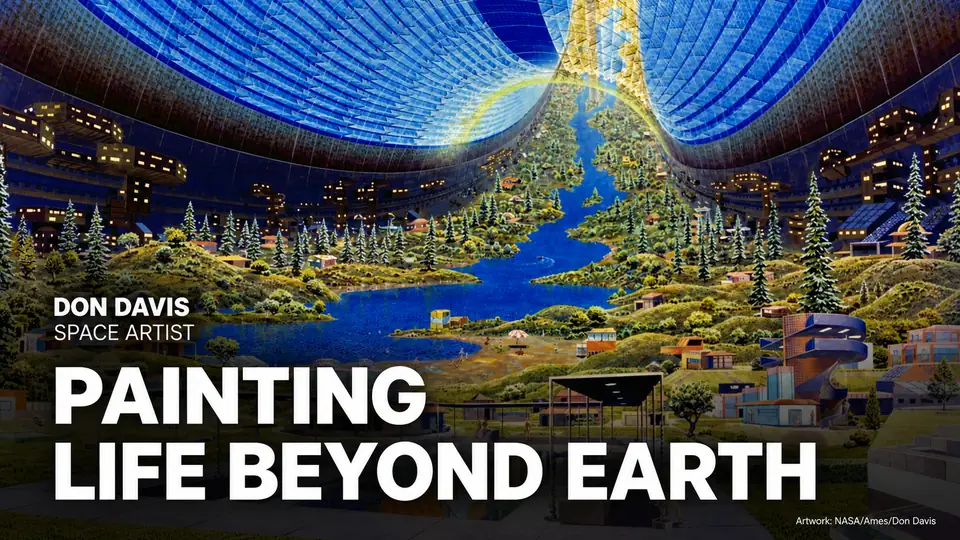
CAMERON WIESE: I remember one of the pieces I find most influential was Disney, the program he did with Disney, I called man in space and then you know the story as the story goes You know, they show it off and Eisenhower calls Walt Disney's I need to show this to my generals and then you know Disney sends him the raw prince and he shows it around the White House and then two years later NASA was founded and then the groundwork was laid for for the space race That sounds plausible. Yes. Yeah, but in the you know post post Apollo, you know post landing on the moon and then the Gerardo Neal trying to rally everyone on, hey, let's keep this vision going. Let's go settle space habitats. Your work is perhaps the most influential in actually helping shape people's concrete visions of what that might look like. And the image I wanna talk to you about and have you kind of tell us about is the image that you did in a space habitat that's similar looking to the San Francisco Bay Area. If I recall on your blog, you mentioned, you deliberately wanted to imply the challenge
CAMERON WIESE: of trying to transplant a workable ecosystem to a giant terrarium in space. Most other depictions are dreary mega shopping malls like structures filling the available volume. Talk to us about this piece and sort of like why it was important to show it as like, all imposed on the screen, green and lush with water and bridges. Like, why did this matter? And like, what was sort of the thinking behind this?
DON DAVIS: The idea of creating an artificial world, a miniature world with a closed ecosystem, we implies a great deal of understanding and knowledge that needs to be gathered about how ecosystems work and how to maintain a closed system in a smaller area. And that amount of knowledge that is still largely yet to be gathered is probably the biggest challenge, even as much as the engineering aspects of this. And the idea of transplanting some of the Earth, some of the light living cycles and such into a smaller environment, And it was always integral to the images that I had in my mind and what I extrapolated from O'Neill and others' writings there. So the idea of also kind of as a personal note enshrining or portraying the San Francisco Bay Area with the coastal green hills covered with trees, sometimes they have fog rolling over them. and the hills that overlooked the Palo Alto Menlo Park, Atherton, Stanford University area of the Bay Area. That's my, basically what I've always considered my homeland and that is a place that I wanted to portray and enshrine, if you will,
DON DAVIS: as a personal note in my portrayals. So that painting, well, I remember I asked O'Neill you know, his opinion of what a view inside of one of those giant space colonies should be like. And he talked about with a view from hills looking down on Sausalito and from that end of the and looking down at the cities and bridges and boats in the water below and such. And that was kind of the kernel of the visual inspiration which I drew upon when doing that painting. And that painting of the bridge and the trees and such and the gurgling creek, that is probably the most influential work I ever did. Unfortunately, that work seems to be lost. Nobody knows what happened to it. Yeah, because the original print disappeared, right?
SPEAKER UNCLEAR: The original painting is gone. Nobody knows.
DON DAVIS: I've got prints of it and such, but I'm actually working on another version of that. I've decided to replace it, but I'm doing a new version that has exactly the same view, but as if you switched on a wider angle lens. So the field of view is about almost twice what in the original. So it'll be a supplement rather than a copy, but that I gotta, I gotta kick myself
SPEAKER UNCLEAR: and finish that one of these days.
CAMERON WIESE: I mean, I think I'm painting fantastic. I think people would love to see it Because it's just like this is the most, because when a lot of people think of space settlements, they think of like living on the ISS. And the vision that's exciting and compelling is like, we can have beautiful, lush, green, human spaces with creeks and ponds and rocks and rivers and bridges and birds. And it just like, it like to me, now I was like, oh, space habitats. Interesting. But it was like this image and a few others that just like expanded my sense of like, what could be possible. And it was just like gives me chills like this is what we should be aspiring towards. And this is the like, this is the power of like art and like your vision by taking this sort of these ideas and putting them out into the universe because like this may be what we end up building one day.
DON DAVIS: It could very well happen. It's one of the options open to us in the future as long as we have that capability. Yeah, I think it'll take time. We're going to build habitats. They're going to be small modules, and then they'll steadily get bigger and bigger and roomier and such. It'll take time, but I think that will be a momentum that if we have significant human presence and space that and we gather a momentum toward that, I think it'll be inevitable.
CAMERON WIESE: Can you, I know you sent me the currently unpublished thoughts on the revised thoughts on the high frontier, but if you sort of contextualize that with the current sort of revitalization of the space industry with SpaceX and Blue Origin and now the cost per per kilogram coming down, like a lot of this stuff seems to be more like within the realm of possibility.
DON DAVIS: It's looking more and more possible all the time. There is a steady incremental increase in our space capability. And yeah, if Starship can get going, it's a big if, but we'll see how it goes. I have some faith in certainly in the determination of those involved. And it seems like a terribly clever, although risky, but we'll see how it goes. So far, every Starship launch they've tried has done a little better than the previous one. So that's a good initial trend. There's going to be some spectacular blowups ahead, but all rockets will almost all. The Saturn's actually never had one blow up on the pad. But the Peonamundi people and the others involved with their super engineering, they made sure that that didn't happen or the probability was extremely low. But yeah, the momentum does seem to be moving in that direction. The other direction where rocketry is evolving is NASA's space launch system, which is a very impressive thing. But unfortunately the launches are too few and far between to really provide a sense of the kind of momentum
DON DAVIS: that Apollo did where you had like two launches a year in many cases. We hopefully it'll be a good use for a rocket with that capability. But I'm afraid the future may well be with these reusable rocket designs that bypass the traditional methods and the shuttle legacy technology and such things. We got options. We have other countries are looking and reusable launch vehicles. And one of these days, if we can get the cost per pound down to $100 a kilogram, shall I say, to switch to metric, that'll probably be a benchmark, which we'll start seeing much more activity and passengers and such going up. And there seems to be a fairly steady curve of heading in a direction that'll make these things possible.
SPEAKER UNCLEAR: What do you think, if anything, can we learn from the past, from the previous space race,
CAMERON WIESE: the space era, the 70s space habitats vision and energy and movements that we might be able to draw on today to keep this faith and the energy active around human exploration of space?
DON DAVIS: There's always going to be a fan base of people interested in that and how much how vocal and how prominent they are able to make themselves is probably the determining factor. A lot of people were interested in a space habitat idea. And there were some people that were understandably skeptical about it. When Co-Evolution Quarterly, the whole Earth people, they published a magazine devoted to a solicited commentary on space colonization and a lot of them were against it and some of them were wildly for it. But it was interesting to see these different points of view and sometimes they articulated objections that made sense. But it was interesting just to see the idea of making the rounds and kind of being given consideration in a lot of places by a lot of people. If and when that such a push might happen again, who knows? We'll have to wait and see. Space matters are proceeding as they are, and as human access to space gets easier, less expensive, I think a lot of these things will just sort of germinate of their own accord as our options become clear.
CAMERON WIESE: Every good movement needs some energy, even like pumped into it. So, part of my deep dive into this is you and I talking and having conversations with the folks at SSI and such. It's like, can we revitalize? Can we help catalyze some of that conversation?
SPEAKER UNCLEAR: Maybe, we'll see. We will see.
SPEAKER UNCLEAR: We'll see.
DON DAVIS: There's people who try. I've got an idea for a planetarium show on the subject, but unfortunately, I don't have the funding. But if somebody were to do a show where people can be immersed in this vast idea of what such a habitat can be like, either a planetarium where you're sitting under a projected dome, or some kind of future VR type of headset, say, when those get good enough to be worth seeing. The potential already there, the idea has been seen in movies and games and such. So it's being kept alive and incidental scenes
SPEAKER UNCLEAR: and films like Interstellar and such.
CAMERON WIESE: Or even, it's funny, I just recently watched 2001, A Space Odyssey. Shame on me, you know, I've been fascinated with the space for a while, but just now, like, started to watch it and just like, like, oh, it'd be super cool to just take people into an environment where they feel like they're on that space habitat. You know, obviously, we wouldn't want to say, you know, all the outdated companies, you know, that are still, that were sort of like branded on there. I think Hilton is the only one that's still on.
DON DAVIS: Yeah, well, you know, seeing 2001, a space Odyssey in 70 millimeter, which I did like 20 times in the center, Emma theater in San Jose. And in those days, like the 70 millimeter prints were colored and timed and such, according to Stanley Kubrick's personal supervision. So we seeing his vision there on the screen. And the thing about 2001, it opened up new frontiers for me visually. It helped to validate the interest I had in space travel and such at the time and the magnificence of the vision and the use of music. That film opened up frontiers of music. Before 2001, it was like classical music was like static to my ears. It just wasn't something that I had taken much trouble to listen to, but hearing what the lay romantic music that was used in the film and those scenes, that just enthralled me and the use of the avant garde music of legetti and such that opened up frontiers, audio frontiers as much as visual frontiers. Very influential film to me.
CAMERON WIESE: Is there anything else like that, that like whether it was a book or a film that kind of shaped your, yeah, it kind of influenced your sense of like what could be possible?
SPEAKER UNCLEAR: personal, the conquest of space, Willy Lay and Bonnestell and such, those books were very influential.
DON DAVIS: There was an interesting book that Willy Lay wrote called Engineers' Dreams. Willy Lay, it was a great space and science writer and he had a column in Galaxy Science Fiction which he had a lot of interesting little vignettes about history. He was a very careful historian and lucid science writer. So his book, Engineers Dreams, shows a series of ideas of what could be done on Earth, mega engineering projects, and some of them not so mega like the channel tone. He writes about that and it seemed like forever it would never happen, but finally the channel tunnel exists. And so the idea of things like space colonies and such things that they may sit on the shelf of history gathering dust for a while, waiting for their time to come. But that was an interesting book as far as showing possibilities. It mentions also early ideas as a fifties book, but on solar and wind power and potential of other novel methods of gaining energy. and other ideas that might not be practical in today's world. But anyway, the idea of what the human mind can conceive of, what we can do and what we can plan on
DON DAVIS: for our collective destiny. Those are the threads that I found inspiring in various books that I had read. And there's only a little science fiction could I really call inspiring. I've read a reasonable share of science fiction, But in general, I found that I took the advice of Chesley Bonestell, who he read very little fiction. He found history, what really happened to be far more interesting and worth once while to absorb. With that said, you know, there's like the Martian Chronicles, by Bradbury, I have to say that was a early inspiration to me and just the power of Bradbury's writing his, his ability to bring us back to nostalgic areas of what the US was like before the First World War, as well as to project us into the future and questions of communicating with other intelligences and ethical issues and such. It was the fascinating thing to to absorb.
CAMERON WIESE: The Toy and Vek, one of Bradbury's short stories, the Toy and Vek in Vector is one of my all-time favorites. Are you familiar with the story?
SPEAKER UNCLEAR: I'm not, I am not, but I'll check it out sometime.
DON DAVIS: And I, and about, oh gosh, it would have been early 70s, I think. I have it written down on my website. I attended a talk that Bradbury gave at the Palace of Fine Arts and transcribed most of it. And you talk about a walking visionary. I mean, he practically sets the standard to that regard. One movie he pointed out to me, he turned me onto, actually true, I'd seen King Kong before, but he said, see King Kong on a big screen in a theater, not on TV. And I finally did that in the 70s. And what a revelatory experience. You're on the balcony seat seeing this awesome, terrifying vision around you. And yeah, there was no question about that. And then he mentioned a film called Things to Come. It's one of the first sound science fiction films. And it's technically a little hokey. The sound quality is awful. But every scene in that film seems to have relevance to today, practically. I think that would be a great film to do a remake of in a modern context. And it starts with the, you know, the world of pre-World War II. And the film actually did a fairly good job, surprisingly really good,
DON DAVIS: of prophesizing the Second World War with the bombing raids on cities. But then the war goes on forever, and then too long, and civilization decays. And then it resurges again with this giant underground cities being built and a spaceship being built to take people to the moon. And in that film, there are people who are against us going into space. They're saying, we shouldn't do this. And at the very end of the film, there was one of the very few times that I thought preaching to the audience worked. Usually I think it does. It looks stupid. But this last, you know, the last words where he talks about, you know, the vision of what we can do one day and looking up and going and doing new and great things rather than remaining riveted to the traditional laden dirt of the earth forever. That was something that he, the inspiration that he had about that film as a child, which carried with him all of his life, he transmitted that to a certain extent to me when he told us about that film when I finally looked it up and saw it.
DON DAVIS: So that's something that, although it's a rather stilted old film by today's technical standards. It still has some decent visuals in it and the music also is just very compelling. Anyway, those are a couple of films that I can think of offhand that
CAMERON WIESE: flip that bill. It's definitely on my watch list. I was reading about it and the story,
SPEAKER UNCLEAR: like how it sort of ends. It's very prophetic. We had people during the Apollo era saying we
DON DAVIS: shouldn't go to the moon and we should do this or that instead. And we have even today people saying that, you know, humanity shouldn't expand beyond the earth. There is no planet B.
CAMERON WIESE: So, Don, as we wrap here, what do you say to, like, what do you, what say you to those people who say, no, where is no planet B?
DON DAVIS: I think that, while they may be technically right, we will make our own planet B. We will create it out of the fabric of the planetary bodies around us with our imaginations and forethought to the future. And well, it's a part of our destiny that we can create. It's not they're ready for us. We're going to have to work for it. But for anyone to try to limit human potential
SPEAKER UNCLEAR: arbitrarily, they're asking to be laughed at by the future.
CAMERON WIESE: Beautiful. Never a better word spoken. Don, thank you so much for coming on. Where can people find your find more about your your work and I'll send in your website, I'll put some stuff in the show now. It's been anything you want to point people to.
SPEAKER UNCLEAR: Oh gosh.
DON DAVIS: I need to work on my online presence. I have a creaky old website that is almost a quarter century old that I have a new website that I haven't touched yet that I'm going. So I'm afraid I have very little to offer except the Google searches. Don Davis Space Art or Space Artists. There are some written essays in my pre-keel site, and if somebody wants to go through and then on desktop, it's not gonna look good on the phone, then that's a place to start. But I'm steadily gathering resources to create a book of my art. That's my big plan in my life, and my big goal is to have a book of my space art. So keep your ear to the wind. When something like that happens,
CAMERON WIESE: and so I'll spread the word.
SPEAKER UNCLEAR: Don, this has been awesome. Thank you so much. You're very welcome.
CAMERON WIESE: Thank you for having me. Hello, friends. Thank you all for joining us on another episode of Build the Future. Just to wrap, I figured I would read some of the closing words from H.U. Wells' The Shape of Things to Come, which Don just mentioned. Reading from Gerardo Nils, 2081. H.U. Wells prophetically warned us to expect such a struggle every time, and try to do what has never been done before. His screenplay for the Shape of Things to Con closes with a scene in a static world which become a little dull. A few people, both young and old, seek to break from the earth to the frontier beyond, and the scientist Cabal speaks for them. Quote, we have a right to do what we like with our own lives, with our sort of lives. His friends, Theotokopolis, who hates both technology and the change it allows, answers a language that was echoed 40 years later in the post-Apollo revolution against technology. Quote, how can we do that when your science and inventions are perpetually changing life for us, when you are everlastingly rebuilding and contriving strange things about us?
CAMERON WIESE: When you make what we think great seem small, when you make what we think strong seem feeble, we don't want you in the same world with us. We don't want this expedition. We don't want mankind to go out to the moon and the planets. We shall hate you more if you succeed than if you fail." The italics, quoting Girard in the other mind, but how accurately Wells foresaw the conflict still in Cagesless. Spokesman Cabal labels this a rational fear of the unknown. Quote, it's a fit of nerves, the thought of stepping off this planet and jumping into space. It's not a conflict we are witnessing. It's not the haves attacked by the have-nots, it is the doers attacked by the do-nots. Again, in a perceptive forecast of the risk-free society, Wells has Cabal to claim, quote, There is no happiness in safety. Our fathers cleaned up the old order of things because it killed children. Because it killed people unprepared for death. A revolution did not abolish death or danger. It simply made death or danger worthwhile. And when Cabal's friend cries out, is there never to be rest in this world?
CAMERON WIESE: Cabal answers as the film ends. Rest enough for the individual man, too much of it and too soon and we call it death. But for man, no rest and no ending. He must go on, at last, out across immensity to the stars. And when he has conquered all the deeps of space and all the mysteries of time, still he will be beginning. See you next week. Thanks for joining us for this episode of the Build the Future podcast. If you loved it, we'd be really grateful if you shared it with a friend or post a review on whatever you're watching or listening to this.
SPEAKER UNCLEAR: That's it from us. We'll see you next time.
CAMERON WIESE: Until then, go build.
More episodes
All episodes Rick Guidice — Art, Science, and Space SettlementsRick Guidice describes how architectural illustration prepared him to turn NASA’s space-settlement studies into vivid paintings.
 Isaac Arthur — From Physics to YouTubeIsaac Arthur connects everyday progress with the much larger futures he explores on Science & Futurism with Isaac Arthur.
 Geffen Avraham — CubeSats and a More Accessible Space EconomyGeffen Avraham on making satellite launches accessible and building connected systems in orbit.