

Build the Future Podcast
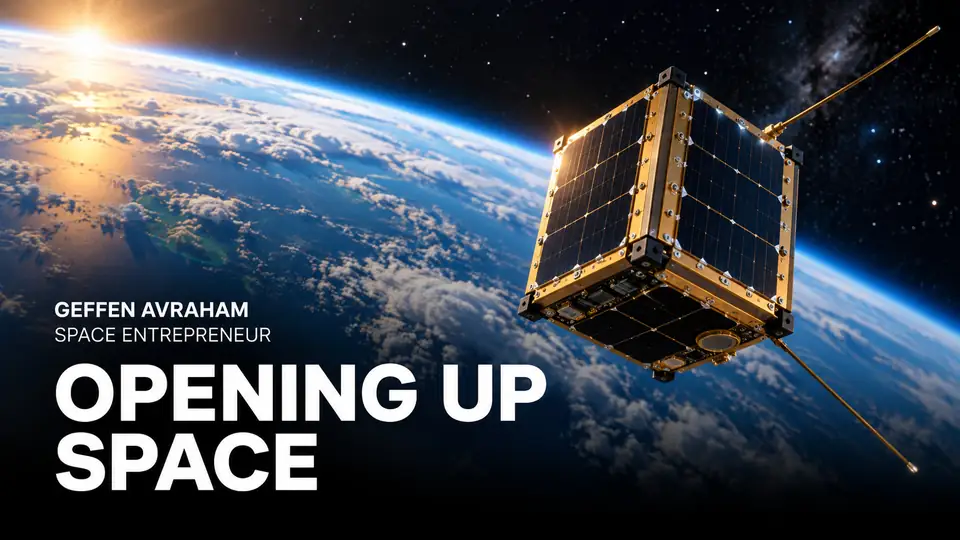
Geffen Avraham — CubeSats and a More Accessible Space Economy
Geffen Avraham on making satellite launches accessible and building connected systems in orbit.
February 23, 2021 · 43 min



About the episode
In this conversation, we talk with Geffen Avraham the CEO of Pandion Orbital. At Pandion Orbital, they're making it easy for anyone to deploy a Cubesat (personal satellite) and get involved in Space — the final frontier. We cover satellites, the future of space, city aesthetics, and more.
Links
Chapters
Times follow the podcast audio. The video’s timeline may be slightly different.
- 00:00Welcome and introducing Geffen Avraham
- 05:27Why space captures the imagination
- 09:15Pandion and access to orbit
- 13:29What CubeSats are used for
- 16:03Making launch easier to buy
- 20:06The next barrier: satellite hardware
- 25:13Interoperable satellite networks
- 34:06A decentralized communications vision
- 38:37Ideas beyond satellites
Read the conversation
Open the full transcript
CAMERON WIESE: Welcome to the Build the Future podcast. My name is Cameron Wiese and I'm your host. I've always been fascinated by the ideas and sentiment that drove American culture in the 1960s with the space race. A culture galvanized to dream about the possibilities of tomorrow, whether it's food, transportation, cities, biology, or anything else. It was this cultural mindset rooted in optimism that the world tomorrow would be better than the world today. A mindset where people were compelled to build things, and I quote JFK, not because they were easy, but because they were hard. It's this desire to build and to dream that seems to have been lost, and something we're here to bring back. With Build the Future, we're here to promote the ideas and stories of those who see how the future can be better and promote their plans to get us there.
CAMERON WIESE: It's our mission to get you to dream about the possibilities of tomorrow, to dream about the future that you want to live in, and inspire you to go build. Today, we're talking about Geffen Avraham, the founder and CEO of Pandion Orbital. At Pandion, they're building a future where anyone can launch a personal satellite known a CubeSat. In this pursuit, they're making space accessible to everyone. Let's jump right in. What is the situation going on right now in the space space?
SPEAKER UNCLEAR: I think it's the greatest it's been in 40 years, honestly. Our space program has been so dead within the living memory of everyone. Like you, me, I don't know when we're already born. 95. So you were born 10 years after the death of America's space program. Our space program has been dead, basically, since 1986, with the, it's been on life support since then. So, so what happened is, you know, we have these great achievements of Apollo, we have these great plans for how to move forward. And for a while, you know, we were using all this stuff from Apollo to do, you know, with the low budget, we were still doing cool things like, you know, we said that the Apollo Soyuz thing to meet up with the Russians in space, to go to the Skylab station out of, we literally just took the last Saturn V we had and instead of sending the third stage to the Moon, we just dropped it off in the orbit and hollowed it out and turned it into a space station. It's still like much larger than the ISS. You can go online and you can see like this guy running inside the space station like it's 2001. But, and the shuttle was supposed to be like this culmination of the grand in space travel, something that make it so cheap and normal for people to travel to space that eventually it can become mundane. And unfortunately it succeeded at the mundane part, but not so much as the former. And it was the hype, I guess, in the early 80s was kind of similar to the hype we're seeing now our own space act, like this shuttle, it's going to be the thing that's going to be really cheap. It's going to be so cheap. In fact,
GEFFEN AVRAHAM: we're going to get rid of all our other rockets. We're not going to have any rockets that took space shuttle. So every time you need to launch even like a tiny satellite, we're going to launch astronauts up with it, which is crazy. But that's the idea. They were phasing out all the other rockets. And I mean, they were building a launch site for the space shuttle here in California at Vandenberg. And it was this idea, you know, eventually the shuttle will be so good it flies twice a week. And you know, we're gonna put in the back module, we're gonna put in the passenger module, we're gonna build giant space stations and put hundreds of people in space. And they were all they had no idea what they were getting into.
GEFFEN AVRAHAM: It was just this temple of lies and wishful thinking. And when the Challenger exploded, the temple of lies came crashing down and we realized we have like a really sucky space vehicle actually. And we can't really do much with it after all. And that's why I say the space program is on life support doing basically nothing the next 30 years, 25 years. And it was only really when, you know, Columbia exploded that there was kind of jolt for the space program again. We don't have to stagnate like this. We can go back and do things. And of course, since then, politics have bogged it down, but, and NASA hasn't really been able to recapture what it didn't Apollo. The great thing is that companies like SpaceX, and SpaceX inspired so many other companies, including myself, of course, they've made it seem like space is interesting again, and space is exciting again, and space is something where things can happen again.
GEFFEN AVRAHAM: I used to think space is filled for 60 year old PhDs I don't want to work in space, you know? I want to work in startups, space, you know? So, so boring, so expensive and old-fashioned, you can't really innovate there. It's just an awful place to be in. And then, you know, I started seeing what Elon Musk was doing, and I was like, you know, this guy is showing that you can actually do stuff in space, and you can actually innovate. And that the fact that NASA is so horrendously, you know, bogged down by politics, it doesn't have to be that way. And space can be done better. And the tremendous success, each journalist, I think it's inspired an entire generation. We're in a way the SpaceX generation. And that's what convinced me to, you know, decide to come into this space myself.
CAMERON WIESE: What's exciting about space, other than it being, you know, kind of the final frontier, right? We grew up watching Star Trek and Star Wars and all these other sci-fi, seeing all the sci-fi media, but like, what do you think it is that's so alluring and appealing to people? I'm like, what is it gonna unlock for us?
GEFFEN AVRAHAM: Well, first of all, I think that space is just one of those things that is so far removed from the realm of our experience. It's practically magic. It's like none of us here, you know, have ever been to space, very few of us. And it's just something so far removed from our experience of space. with the laws, the fundamental laws of common sense from upside down. There's no gravity anymore. There's no air. It's just, in a sense trivial, but you could almost describe it as like an alternate dimension of magic, a place where magic is possible because it really is in a way. It's just, it's a place outside of our small and insignificant planet, a place outside of our, the mundane environment in which we live our everyday lives, a place that by common sense, but the common sense that governs their everyday life shouldn't exist. And yet it does. And yet it offers all these crazy, crazy opportunities. Think about it. There are other worlds out there, and you can travel to them. And this isn't a fantasy book. This isn't some fairy tale. This is reality. This is the real world. And I think that's incredible. Think about it. We could have been alone in the universe in the sense not of life, but in the sense of literally being the only planet in the universe. I mean, that's kind of what the flat Earthers believe, right? The moon and the sun and the planets are all just lights in the sky and we're just this flat surface and there's nowhere to go up there. That's so depressing, but honestly this is the common sense of you, like the common sense, Occam's razor interpretation of reality is that, you
GEFFEN AVRAHAM: know, we really are this flat plane and there's just lights up there, but the fact that we're a ball and like this orbiting another, you know, nuclear reactor of plasma out there and the stars. That's just, it's incredible. We can be sensitized to it, but it really is.
CAMERON WIESE: It's definitely a definitely beautiful thing. And it kind of affirms this idea that, okay, there may be something else out there. God, I couldn't even imagine how I would think about my position in the universe. If we're literally the only planet, we're just darkness in every direction. How would we kind of come to terms with with like the implications of that? I have no idea.
GEFFEN AVRAHAM: Well, you know, in reality, it's quite the opposite. We, this is what we assumed for so many years and it was very difficult for us to come to the implication of the reverse. Even Galileo, you know, he was like, he still believed, you know, maybe he still believed in like the alone in the universe thing. We were still, you know, the only actual planet out there that was still only one sun and the stars were just light. He just flipped the locations of the Thunder, but that's all he did. But Giordano Bruno, who came before Galileo, he was the guy who said, not only are we orbiting the sun, but those stars, they're not just lights. They're other suns. And around them are other planets, and on those planets are other people. And the church was like, you know, well, does this mean that on those planets there's other Jesus Christ, too, and there's another pope? We can't allow that. Burn him. So it's quite the reverse, you know?
CAMERON WIESE: Like if we had what we had now on Earth technology-wise, we could communicate like this, but there's nothing else out there. I don't know what people do all day. Nothing to strive for. Space gives us like something else to go explore. I want to kind of dive into what you're working on. Tell me a little bit about Pandian and the future you're working towards with it.
GEFFEN AVRAHAM: Of course, so Pandian is the first step in a future where every person, you know, not just Elon Musk, not just the administrator, ambassador, whoever, any person can really have their own space mission and explore space as they see fit. And the access to the final frontier is really something that is as easy as access to the internet, for example. That's the future I'm working towards. And I'll tell you a bit more about the grand plan. Pandian is really just the first baby, baby step, but it's just one that had to be done because you'll see how the industry is so broken today. But it's all leading up to this thing I call the internet of satellites, which we'll get to later. What is Pandian?
GEFFEN AVRAHAM: It's very simple. Pandian is the cheapest way to get your satellite into space today. So back in the day, if you wanted to launch a CubeSat, back in like, you know, 15 years ago if you wanted to do it, those were the only one way up. And that was, you'd have to buy some space on board. The NEPRA, which is the decommissioned Russian ICBM turned into a space launcher. If they were the only ones crazy enough to carry cubes apps. And back then it cost around $40,000 to launch a CubeSat, a one unit. And what happened is around 10 years ago, more credible launch companies, companies in the US and Europe started carrying CubeSats up on their rockets as well as ridechairs. And when that happened, also Nanoracks and you know, JAXA, actually JAXA started it, but Nanoracks made it a big business, started deploying CubeSats from the ISS as well.
GEFFEN AVRAHAM: And it started becoming a big thing around 10 years ago. And around that time, the price steadily increased. It went up to $50,000, $50,000, eventually settled at like $80,000. Yes, even though at this time, Elon Musk was landing rockets and all that, the price was doubling. And it was in fact slated to go even higher. So some of these companies that signed government service agreement contracts, they have to list not only the need of prices today, but their prices in the future. And the price in the future, like in five years from now, was going to be like $95,000. But it was only increasing, yeah. Why is that? A number of reasons. For one, the reason it was increasing in the first place is that these more legit launch providers were more spring into bed with their requirements for these keepsets work.
GEFFEN AVRAHAM: So it was just like, you know, just slop it onto this old Russian ICBM and more like, you know, we're a major United States defense law provider with strict requirements and you're gonna have to meet them and we're going to do a lot more testing and, you know, verification on our end. So it just became, you know, many, many more layers of bureaucracy and therefore more money. And eventually what happened is other countries in the world saw that people were willing to pay this price. And so it became a brace at the top instead of a race at the bottom. The anti-invisible hand. Visible hand? I don't think it works that way. Yeah, they were just saying, you know, these guys are selling for more. I can sell for more. And they're like, oh, look, people are actually buying this, even though we increased their prices. Let's see, can I charge more? Let's pay for it? Oh, yes, they can. And you can do this because an American launch provider, you can increase your prices pretty easily. Because even if the international competition is cheaper, lots of satellites will have to launch on an American rocket. Just because, you know, NASA does not launch their satellite on someone else's rocket, unless it's like, you know, maybe launch it unless it's like, you know, very well negotiated. But the bottom line is most missions launch on their own rocket, you know, again, there are exceptions to James Webb is launching an Arianne, but that's still a European rocket. It's not a Russian rocket.
GEFFEN AVRAHAM: It's illegal to launch on a Chinese rocket if you're an American. So even if it's cheaper, They legally can't compete with you. NASA has never launched on an Indian rocket as far as I know, and they're pretty cheap. Bottom line is, with an American, you have this luxury of just like a certain field, especially military, in which like no one could compete with you. And so you could even if you like you had lower cost competitors, you could charge those prices and those competitors, soft people were going to pay those prices. So they increased theirs to match. And that was kind of right to the top. We were saying it was a vicious cycle.
CAMERON WIESE: Can you explain real quick what CubeSats are? And then in this context, why were people willing to pay so much money to get them up into space?
GEFFEN AVRAHAM: Well, they were willing to pay that much money because even that much money is nothing in the big field. So what is a CubeSat? A CubeSat is a satellite in a modular standardized form factor, generally built in these units of 10 by 10 by 10 centimeters, AKA around a liter. And you can build these in any configuration you need to like. There's the standardized ones that are compatible with the industry standard deployers. But overall, you can have ones that are like 1 by 3, 2 by 3, et cetera, for different sizes. And the great thing about this is you can launch these interchangeably on any rocket as long as they fit the standard, because you can just put them into the dispenser or the deployer.
GEFFEN AVRAHAM: And if you fit the standard, it'll fit in any one, anywhere in the world on any rocket. A lot of the bespoke engineering that goes into like launch specific satellite on the specific rocket goes away when it enters this standardized modular form factor. And because they're so small, they're much cheaper to launch as well. So, a satellite the size of like a mini fridge would cost a million dollars to launch nowadays. And, you know, in comparison, even $80,000 is not that much. You can still do entire space mission for like under half a million dollars, even advanced ones. So that's an advancement in the industry.
CAMERON WIESE: What are the functions that these CubeSats are serving?
GEFFEN AVRAHAM: Whatever you want them to.
CAMERON WIESE: Okay. Can you give me some examples? Like who's sending these up? What are they using them for?
GEFFEN AVRAHAM: They started off as an educational toy, basically, you know, so a student could do that. built a space mission in their time at college and it would like begin when they entered and would be launched before they graduated. That was the original idea. Make this so small and simple that you can do that. Eventually people figured out they're not just toys, you can do actual stuff with them. So the more successful use of them is you know people like Spire Global who use like a fleet of 150 or so to track planes and ships and like weather around the world. Planet Labs uses them to take a picture of everywhere on earth every day. But again you can do anything you want with them. People do science missions with them nowadays as well. There's a company in Israel actually called Space Pharma that uses them to do biological and medical research in space. The possibilities really are limitless. They sent a couple of ones to Mars a couple years ago, you know.
CAMERON WIESE: So then at Pandion, you're working to make it easier for people to deploy. So you're telling me about your first step. Walk me through the master plan.
GEFFEN AVRAHAM: So let's start with Pandion itself. The idea of Pandion is step one, make launching a CubeSat as easy as booking an airplane flight. Right now you wanted to buy a CubeSat launch, you'd go to this broker and it would probably cost you around $80,000 and you have to like negotiate a whole thing through a bunch of bureaucracy, would not be fun. So in our case we started with this, we started with like how can we make this as low cost as possible. A lot of people think small rockets reduce launch prices. There were a bunch of news articles about this back in the day, which were really confusing to me because I could do the math and they were increasing launch prices. Launching a CubeSat on a small rocket is more expensive because of the scale-off.
GEFFEN AVRAHAM: Large reusable rockets are the way to go for an expensive. Falcon 9 is the cheapest. The game changer happened when SpaceX started selling ridechairs on the Falcon 9 directly to consumers without having to go through any middleman. So anyone can on their website, like really buy a spot. Problem is the minimum order is a million dollars. I'm afraid you and I don't quite have that. So a million dollars will get you around 200 kilograms on the Falcon 9, which is much larger than the CubeSat, which is like, you know, one to three kilograms usually, maybe seven. So it became obvious that the solution was like, just buy this minimum slot and see how many CubeSats you can fit onto there. And the more CubeSats you can launch in that 200-kilogram slot, the less each one will cost.
GEFFEN AVRAHAM: Now, some people have done this and they just put their normal, you know, regular old, well-over-16-unit CubeSat deployers, which can store, again, 16 units of CubeSat in there. And that's all fine and dandy, but that actually does not save you much money if you put this tiny deployer in the slot that can carry 200 kilograms. You're wasting 90 percent of your mass, basically, which is insane, you know? So we were like, just how much can we put on here? And the answer is how many units can we fit around close to a hundred? And I believe it's 98 we can fit in there. And so I started looking into different designs and as a study from IAC 2013, it was really influential actually. And I realized I came up with this design for the largest CubeSat deployer ever designed in the world.
GEFFEN AVRAHAM: Something that could carry 98 CubeSats up there and deploy them into orbit. And this thing could let you reduce the price of launch from like 80,000 down to 15,000, $15,000. So like around a factor of six production and launch costs. While also because the launches fly pretty frequently, it could let you do these launches again, pretty much as often as you want. You wouldn't be dependent. So you could like easily reschedule between different launch logs if you missed one. And we designed this thing and actually presented at the International Astronautical Conference this year. Right now, we're in the early stages of testing some of the components for it before we build a, you know, full scale engineering model, which would be followed by a flight model, which is the thing that's going to go up on the first mission.
GEFFEN AVRAHAM: And yeah, this is just really my first step. But the first step is make this as easy as looking at an airplane flight. And one thing that's going to be coming to our website, pandionorbital.com, in the next couple of weeks or so, is going to be the ability to book a slot, to space for around $15,000 just online. You won't have to talk to some broker. You'll just be able to do it online, just like you can book a flight. And this is actually cheaper than a first class flight to Dubai. A first class flight to Dubai, which you can book online, is $20,000. You get your own private cabin on like their A380 or whatever, gold-plated toilet seats. Well, launching a keepset is now cheaper than flying for its class to Dubai.
CAMERON WIESE: Okay, so then tell me where it goes from there.
GEFFEN AVRAHAM: Well, where does it go from there? Where does it go from there? It's now, and now that launching a keepset is easy, what happens? Well, not that much yet, because the keepsets themselves are still expensive. So the next step is to make the keepset cheap. This is something we haven't seen enough work done on, But it's something that's infuriating in how stupid market kind of is. So let me give you an example. You can buy it like a CubeSat computer today. They'll sell you, again, a CubeSat computer that is a shield for the Raspberry Pi to fit it into a CubeSat. The Raspberry Pi will cost you like 35 bucks. And the P3B to fit it into the CubeSat will cost $2,000. It's crazy. It's like they're selling you a Tesla, and then they're selling you the wheels for $100,000 per wheel.
GEFFEN AVRAHAM: But this is the reality. And this is considered cheap. This is considered cheap for a heat stat. They'll sell you these other computers, $4,000, and you'll get some 400 megahertz arm architecture from 2006, and a whopping 64 megabytes of RAM, too. It's ridiculous. You're buying a camera. They'll charge you $30,000 for a camera with 2.3 megapixel resolution. and that's what's in the selfie camera on my iPhone. And at first I was like, you know, what is the technical reason why it has to be this way? This is ridiculous. Why are we doing this? The EFO, how is it my iPhone is less powerful than this keeps at and it costs a hundred times less. That should be some kind of technical reason here. And at first I thought, you know, it's the radiation problem, right?
GEFFEN AVRAHAM: Space has radiation, we have to protect the components against radiation. Well, that's the biggest lie they've sold us because it turns out the overwhelming majority, like 99.9% of all CubeSats ever launched in low-Earth orbit are not radiation hardened at all. Radiation hardening is a process that you can do on components that makes them resistant to space radiation. For example, there's three main types of problems. There's what's called TID, which is the gradual degradation of the component until it eventually fails altogether from long-term exposure. And there's single event effect, which is just one little cosmic ray hitting it and causing some problem. These can be problems like a SEU, single event upset, which is when a bit flips like from one to zero, or it can actually cause a latch in the circuit which can fry your component.
GEFFEN AVRAHAM: But, and radiation-hardened components can be resistant to get this, but guess what? Cube sets in low-earth orbit don't use them because the missions they use only a couple of years and for spending a couple of years in the relatively low-radiation environment of low-earth orbit, you don't actually need it. So all these components on the market, at this $4,000 computer with 54 megabytes of RAM, for example, all these things, they're not radiation hardened at all. Because you don't really need it unless you're going to interplanetary space, like going to Mars or Jupiter or whatever. The actual radiation-hardened components for CubeSat, those are much more expensive, actually. They're $20,000. But only a handful, literally a single-digit number of CubeSat missions, has actually used radiation-hardened components. The hundreds that have been launched in the past 20 years, They've used completely normal electronics with only a couple of additional safeguards.
GEFFEN AVRAHAM: So you can implement some safeguards at the software level, as well as the hardware level, a few cheap circuits you can buy to depending on some of these reation effects. For example, you have a circuit that can detect single event latch-ups and, you know, power cycle the system. You can have one that if a computer crashes, it can reset it before it gets stuck. These are very simple things. It costs like five bucks to add to your system. These are not the sensitive radiation heartly component. So that was like the first thing I realized that this whole radiation thing, it's false. It's not applicable to almost all of these key definitions. Just kind of deflection and that most of these things that they're charging us tens of thousands of dollars for are really no different on a technical level than the stuff in your phone.
GEFFEN AVRAHAM: And the crazy thing is we're living in this universe where, you know, imagine universe where the Apple Mac was invented to challenge the incumbent. And then Apple decided, you know, we have this great Mac and we're not, it's so great, we're not actually going to sell it to you. The Mac is never going to leave Apple HQ. If you want, you can buy time to do computation on the Mac. But whenever it's selling you the Mac, you can't get one. And this is what happened. So at NASA, they were researching this and they realized this and they did the PhoneSat program where they literally disassembled phones and put them in CubeSats and launched them and they worked. And the people were like, wow, we can do crazy stuff with this.
GEFFEN AVRAHAM: We can launch hundreds of satellites at the price of one. And if they did, they went and founded Planet Labs. Because back in the day, there really wasn't a market for selling mass-produce and cube setup. So we said, let's mass-produce them for ourselves. And we will tell them, you can't get one. They're just for us and for our business model, which is selling images. And that's what they did. The technology has actually existed for a number of years. It's just that it's not available and it's never been commercialized. So again, we live in the age where the Mac never left Apple HQ.
CAMERON WIESE: Okay, so let's say we change that. CubeSats are cheap and affordable, relatively, and the cost of sending them into low-Earth orbit or into space has gone down. What's next? Or what are the implications of that? And then kind of how does that evolve?
GEFFEN AVRAHAM: All right, so I'd like to read you a little quote. The new space world consists of large numbers of small satellite produced the standard interoperable designs on production line. These satellites would be grouped into constellations, each owned by commercial enterprise of the global reach. The constellations would be linked in a peer to peer network, reflecting the enterprises value chain relationships. With inter-satellite links and substantial onboard processing power and source data source capacity. The network of constellations was formed in a space-based data grid. This is not my quote. It's actually a quote from 2002. That when no CubeSat had actually been launched yet pretty much, only like one or two. I think this is insane for a quote from 2002 from someone else. You know, it's just the kind of vision that no one saw back then, especially now for CubeSat.
GEFFEN AVRAHAM: But I think this is really the vision. So think about it for a second. What was the primary driver of the PC revolution? It was the fact that non-computing companies and non-tech companies were getting computers. You would have gone to a T-shirt printer in Florida in the 70s, you'd have told them to get a computer and he was like, a computer, that's a room sized calculating machine. What do I need one for? Nowadays, you know, there's no teacher printer in Florida who doesn't have one. So the future is a future where non-space companies have like large amounts of assets in space. And this isn't just a crazy idea. This is something that's already happening. If you read the tiniest bit, the writing is on the wall.
GEFFEN AVRAHAM: It started when, like the first kind of indications of what's happening was when this company called Gili, it's the largest car maker in China. They own Volvo. They opened up a satellite factory in China to build 2,000 satellites for a media constellation to get entertainment to their cars anywhere in China. And they're building satellites there right now. Then Xiaomi said, we're gonna build a satellite constellation tube to give IoT services for our wearable tech. And all of a sudden, this year, suddenly Amazon launches AWS satellite and space division. And you can say, well, they're just doing that because they're already building infrastructure for the internet constellation. And they're using that to support it, so might as well sell it just like AWS. But that's what happens.
GEFFEN AVRAHAM: The Microsoft Azure sees that, and now they have to compete. And so Microsoft Azure, which isn't building any satellite constellation of their own, they launched Microsoft Azure Space. and now Apple and now Amazon and Microsoft both have space cloud computing vision. So this is what I'm talking about. This is the first steps into non-space companies, companies that have nothing to do with space. Microsoft, Microsoft, that's one of the space company. Microsoft now has a space division. I think that that's the eye opener here. And the future is where any company that needs any data or any service or any assets in space can just deploy them as easily as can deploy assets to the internet as easily as buying a computer basically. For the price of buying a computer today, they can send a satellite to space in the future.
GEFFEN AVRAHAM: Once Starship becomes online, the launch cost price will go down by another factor of 10. So it'll cost around, say, $3,000, $4,000 to launch a CubeSat into orbit, something same price as a gaming PC, someone a normal citizen can do by themselves. We're going to have the first personal satellite. And these companies are going to use this fact they can deploy satellites as cheaply and easily. They can just, it'll be a kind of universal satellite platform, a kind of open platform that you can really run any app you want on and you can really like plug in any payload. And once you do that, any company can build their own constellation to provide them with whatever value they want. And these constellations as the link together in a peer-to-peer network, communicating information before each other, between each other.
GEFFEN AVRAHAM: So suppose I have a thought, a constellation that collects imagery from Earth, I can relay that to the constellation that provides internet and then communicate in space and then the internet constellation relays that back to my computer back home. So this is kind of advantage you get by these peer-to-peer communication. And eventually you can really decentralize the entire internet. Instead of it being the central servers doing everything, instead of it that we can all have our own nodes in space, which no one can touch. The NSA can't touch us. Whoever literally can't take it down. And we get a new, the new Internet of satellites where they all transmit information through each other and kind of peer-to-peer network. And that's kind of what makes this a bit more distinct from the Internet we have today. It's more centralized. This is going to be more decentralized, kind of like a torrent network in space.
GEFFEN AVRAHAM: I think that's the grand vision. Now, I think, you know, the non-space companies developing their own assets in space, that's something that's happening regardless of what, you know, I do. But I think if, what I feel like I need to accomplish is to make this a kind of universal personal open standard. So if left to their own devices, these companies do this, what we get is we'll get the fragmentation of space. Space will become a field where every company has their own proprietary satellite platform, their own proprietary software platform, their own proprietary communication network. So Apple's satellite can't communicate with Microsoft's satellite and they run their own software platform, so software written for one will work on the other. What we need is the kind of the IBM PC for space in a certain way and the Linux for space as well as the Unix for space.
GEFFEN AVRAHAM: So a universal hardware platform that you can obviously modify the hardware to your specific needs, but it's a common, you know, hardware concept that can run software from interoperably on all these satellites. And again, on the software level, you want something where something where you can really plug and play between satellites. And same thing with the communication protocol, an open communication protocol that allows all these satellites to communicate with one another. So it's really bringing that kind of decentralized open source, open platform, Linux mentality to space in a certain way. And so I think this is the world I want to live in. I don't want to live in the world of fragmented space where every constellation is proprietary. I want to live in the one where they all work together and a new decentralized internet and space emerges from them. And that's what we need to build.
CAMERON WIESE: So the only way we're actually going to get to that decentralized point is by subverting, you know, the existing infrastructure, which is at the root of it, it's the ISPs. And right now they're not, they haven't put their stake in the ground to steal what sort of traffic they're going to permit or not in the current context, but they might. And we're going to need new, not new ISPs, but new ways to communicate and move information around.
GEFFEN AVRAHAM: That's the most ironic thing to me that, you know, the same guy crying about, you know, censorship on Twitter is the one who repealed net neutrality. Like I just don't understand that, like by his own actions, there's nothing stopping, you know, any ISP from banning access to whatever, whatever he does, which is, you know, I think, I think what we might be seeing right now is kind of scary, which is the closing of the free and open internet. It's already happening, India and China, not China, India and Russia both want to close their internet more like China has. And so we're going to see the dream of the global internet was already thwarted by China. China has their own, the evil twin of our internet.
GEFFEN AVRAHAM: The foreign internet is Dr. Jekyll, theirs is Mr. Hyde. For us, the internet is like the set of services of tech stack and they use an entirely different stack, an entirely different stack of information. It's all in Chinese language. So we're going to see the same if things don't change in Russia and China. We're going to see Mr. Hyde Internets of Russia and India. And now we're probably going to see, I was hoping that the United States would be able to fighting against this. But now we're seeing the United States internet limited to two, which is even worse, you know, even worse than a shadow internet of China, India and Russia is to have the American internet split into two, you know, mutually hostile and inaccessible segments. And a house divided cannot stand. If America's internet is divided among liberal and conservative lines, the free and open web dies and the authoritarian regimes of Russia and China win. It's not simple.
CAMERON WIESE: What's our way out? How are you making sense of this and what should we do?
GEFFEN AVRAHAM: I think what we need to do is to some people think Starlink is the answer. I disagree. I love Starlink, but I think it can be an important part of the new internet stack, but I'm trusting our future to one company and one man. I'm Vork, I'm Reich, I'm Fero, not a good idea. I really do not want to see a SpaceX Amazon duopoly in space internet either. It needs to have the new space internet become just like the old except by different companies. That's just as bad, right? What's the difference if it's from space that it's as bad as the old ones? if these companies become as bad as the old ISPs, it needs to be fundamentally different. So to be fundamentally different, it needs to be one, for example, where if every person can have their personal satellite, they can have personal satellite nodes. And so, get what? They can't, companies can't, you know, deplatform you when your platform is in space. What are they going to do? Launch a missile at you? You have a decentralized platform where you have your own your own node or your own server in space that no one can touch.
GEFFEN AVRAHAM: No one can steal your data. No one can say, you know, give it to us receiving your data or, you know, come and take it. And you communicate through all these other satellites. So these, I think the most important thing is the decentralized cross-linking protocol. Basically the idea is all these satellites, no matter what their purpose is, can serve as byways for the information superhighway in space. So for example, you know, I have like in my satellite is here in orbit that supposedly over Uganda. I can't communicate it from California or whatever when it's over Uganda. So suppose there's like another, it can like chart a path, you know, relay its data. So its first it relays its data for this, you know, uh, Apple communication satellite.
GEFFEN AVRAHAM: And then it relays the data through that to this Planet Labs keeps at. And then it relays the data from there to the ground station in, like, you know, Spain or whatever. And so it can, like, it can be satellites conserved as, like, cryptographically secure nodes to relay the data through themselves. And your satellite will relay other people's data too. And then we can, you know, we don't need a ridiculous amount of ground stations like literally in every city, we can do this pretty much more easily. And we can, with more, we can transfer data between big satellite. So, you know, again, I want, you have a satellite that does super computing in space. Okay? You process data in space and like are kind of, that I can transfer, I can like literally process my data to you in space.
GEFFEN AVRAHAM: So I take a picture and you do the processing and then you can cross like that to the guy who downloads it to the ground. So that's what they mean by the constellations will be linked in a peer-to-peer network reflecting the enterprise's value chain relationships. So this kind of peer-to-peer universal platform personal satellite nodes of the internet of satellites as it is the space-based data grid.
CAMERON WIESE: Where can people find you? How can they support any calls to action for people?
GEFFEN AVRAHAM: So, several things. You can find me, as always, on Twitter. You can find me on, you can email me. I always love receiving emails from people. If you're working on something space related, I would love for you to hear from you, especially if you're launching a CubeSat or you want to build one, you want to build a constellation. If you share similar views with me, if you think we need a new decentralized internet and space, if you think we need to resist big space tech taking over space and trying to get into, just as, monopolize the regime with the old, we need to, if you want this new internet of satellites to be something, a space owned by us and not by the government and the billionaires, then I would love to talk to you. I mean, yeah, we are currently developing this. If you'd like to be a part of it, we want you.
CAMERON WIESE: So, pandianorbital.com and then your Twitter is, let's see.
GEFFEN AVRAHAM: My name, Jeff and Abraham.
CAMERON WIESE: Cool. And then last last question for you, Jeff. And outside of the satellites and space, space, what excites you the most? What do you what do you optimistic about?
GEFFEN AVRAHAM: Good question. Many times it would site me. The potential to build, you know, the potential of people here in Silicon Valley to disrupt the world order and build new nation states excites me. Like a lot of people talk about charter cities, that doesn't interest me that much. Like, I'm not interested in your libertarian utopias where we have no taxes, does it interest me? What interests me is new truly political autonomous, a world of small politically autonomous nations built in space in the sea, in Africa, on islands, wherever. I think there's enormous potential for that. The political elite uses the term destabilizing for everything that's present there power. Well, I say let's destabilize the political order. Not in the sense of start a nuclear war, but in the sense of, you know, give people freedom to choose their government, actually freedom to choose their government, not freedom to choose D or R, freedom to choose their government. And again, what excites me about this is the, I think like there's going to be a reactionary movement against things like decentralizing it against things like student advances in biotechnology, longevity, genetic engineering, et cetera.
GEFFEN AVRAHAM: and we will need to wield nation state level power to fight for the future of humanity against the interests of those who currently stand to lose from it. I'm sounding a bit anarchistic. I'm really not an anarchist at all, but I just want people to have options. If there's only one system on the planet, that's a terrible planet. People should have the options to, you know. If they think that they can do better, they should have the right. It is the people's right to try to build a better one. And that shouldn't have to be done through violence and through revolution, but just through going somewhere and building, right? Why should building a new nation have to mean violently killing people and overthrowing the old order?
GEFFEN AVRAHAM: I don't want to overthrow the old order. I'm fine with the US. It's a great country. But I just want the opportunity to try to do better as well. The other thing that excites me is the potential for AI to influence a new generation of media creation. This is something I'll talk to you another time and also not sure if it's safe to talk about this yet. If Disney finds out about this we will be a dark age of creativity but AI gives us the potential. I'll just be cryptic but I think AI will give us the potential to make making a film as good as any film production value of any Hollywood movie. It will become as easy and cheap as writing a novel and so imagine a world where we have millions of Hollywood-grade movies produced every year by every person who can, who has ideas and could create. I think that's how we, we save creativity from these. Hollywood studio, if you'll only know how to remake what smarter people did 20 years ago.
CAMERON WIESE: Love jamming with you. I'm glad we were able to connect. I very much appreciate you, your time, the work you're doing, and just kind of the way you, you present stuff. Yeah, and I appreciate So, cloud will be able to connect and thanks for coming on.
GEFFEN AVRAHAM: Thank you. Thank you so much.
CAMERON WIESE: Thanks for joining us for this episode of the Build the Future podcast. If you're building and want to get support, want to hear about certain topics or hear from certain people, shoot us over an email to hello at buildthefuturepodcast.com or follow me, Cameron, on Twitter at [unclear handle], and we'll see what we can make happen.
CAMERON WIESE: That's it from us. Until next time, go build.
More episodes
All episodes Laura Crabtree — Epsilon3 & Space ExplorationLaura Crabtree reflects on her time at SpaceX and explains why she founded Epsilon3 to support complex engineering operations.
 Justin Glibert — Factories on the MoonJustin Glibert imagines lunar factories that use local resources and eventually make their own equipment.
 Felix Ejeckam — Satellites and Internet Access for EveryoneFelix Ejeckam explains Akash Systems’ use of diamond in semiconductor thermal management and its 2020 satellite-communications plans.