

Build the Future Podcast
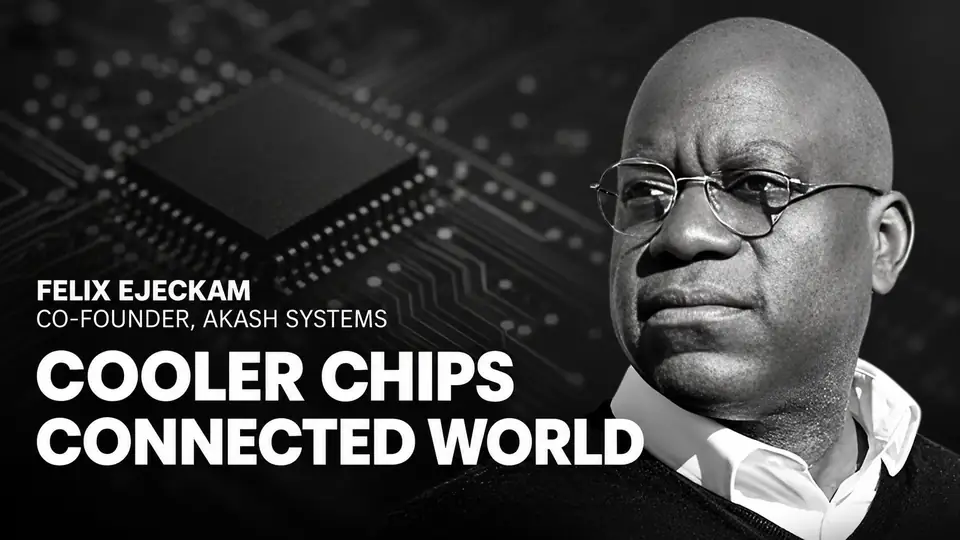
Felix Ejeckam — Satellites and Internet Access for Everyone
Felix Ejeckam explains Akash Systems’ use of diamond in semiconductor thermal management and its 2020 satellite-communications plans.
September 22, 2020 · 33 min



About the episode
"The limits of your imagination today define the limits of, of space tomorrow"
In this conversation, we talk with Felix Ejeckam, the CEO of Akash Systems which is developing and supplying the next generation of extreme bandwidth, hyper-efficient communications gear for space satellites to accelerate the world towards universal and low-cost access to the internet.
We talk with Felix about the revolutionary GaN-on-Diamond technology they’ve invented, what’s happening in the space space, and what it might look like to bring low-cost, high bandwidth internet to all.
Links
Chapters
Times follow the podcast audio. The video’s timeline may be slightly different.
- 00:00Welcome and introducing Akash Systems
- 01:17The goal of low-cost internet access
- 02:33Gallium nitride on diamond
- 06:13What wider connectivity could make possible
- 09:11How heat affects electronics and cost
- 11:52Applications beyond satellites
- 14:20From components to a broader satellite plan
- 15:13New opportunities in the space industry
- 25:14Why Felix took on this challenge
Read the conversation
Open the full transcript
CAMERON WIESE: Welcome to the Build the Future podcast. My name is Cameron Wiese, and I'm your host. I've always been fascinated by the ideas and sentiment that drove American culture in the 1960s with the space race. A culture of possibility with a mission to build things, and I quote JFK, not because they are easy, but because they are hard. It's this culture that seems to have been lost, and it's something that we want to bring back. With Build the Future, we're here to promote the ideas of those who not only see how the world can be better, but those who have plans to get there. It's our hope that these plans inspire you to think about the future you want to live in, and create plans to go build. Today, we're talking with Felix Ejecom from Akash Systems. At Akash, they're developing and supplying the next generation of extreme bandwidth, hyper-efficient communications gear for space satellites. In doing so, they're accelerating the world towards a future where universal and low-cost internet is accessible to all. Felix, thank you so much for being here.
FELIX EJECKAM: Sure. Good to be here. Good to meet you.
CAMERON WIESE: I want to start with the basics. Can you tell me about the future you're building with Akash? What's the vision?
FELIX EJECKAM: Sure. Our grand vision is we want to help extend the reach of the Internet to literally everyone on Earth and to do so at a very low cost. I think it's one thing to aspire to connect everybody. It's an entirely different objective, our objective, to do so at an extremely low cost of access. you know a dollar is still a very expensive thing around the world and there are billions of people around the world you know four billion who are unconnected or under connected in the u.s you know that number we have six to eight million rooftops in the u.s who are beyond the reach of fiber and they need internet you know fast internet too so i would say you know our goal in life our Our grand vision is to use our technology to democratize access, to extend the reach of the internet to everyone on earth at an exceptionally low price. That is our goal. That is our vision. We're taking all the steps that it will take to achieve that.
CAMERON WIESE: Let's talk about that, that technology and the steps y'all are taking to get there. Can you walk me through what that plan looks like? How are y'all going to go about providing low-cost internet access to all?
FELIX EJECKAM: Sure. So the first thing we've done is we've invented a new type of material called gallium nitride on diamonds. Essentially, we're using diamonds, synthetic diamond that we grow in the lab. Diamond is very interesting because it has a very high thermal conductivity. So if you were to hold a stick of diamond and touch an ice cube, the ice would instantly melt because heat from your hands would flow rapidly through the diamond stick to melt the ice. And likewise, your fingers would feel cold because the cold temperatures of the ice would equally flow rapidly to your fingers. That property is what we're bringing to the satellite, to the core of the satellite. The thing inside the satellite, chips that get very, very hot in space. And when you're in space without air, as we do have in space, in space we have perfect vacuum, there is no particle to propagate heat from these very hot cores of a satellite out into space.
FELIX EJECKAM: On ground, when a thing gets hot on Earth, the way that it cools down is it depends on particles around it, in some cases simple air, to move that heat from that hot thing to a cooler place. If you don't have any air, then you've got a problem. That device will die. And so we address that head on by using this exceptionally cool material, diamond, synthetic diamond, with the gallium nitride to make the cores of the satellites very, very cold. That in turn enables a tremendously large capacity data flow through the satellite. We're able to, for example, compare it to the next very, very best satellites out there, in some cases triple, in some cases quadruple, in some cases by a factor of 10, the capacity of data flow through the satellite. We're also able to do it at a very, very low cost.
FELIX EJECKAM: Our entire constellation is about 100 times cheaper than what others, the next best is able to do and we pass those savings entirely to the end customer whether the customer is going to be a carrier telephone telecom carrier in your country or whether that's going to be a plane where you get access to our our beams our services or whether you're going to be in a building that has a rooftop that has an antenna talking to our satellites you will see the cost savings wherever you are because of these magical materials that we use in building our satellites so effectively
CAMERON WIESE: the the gallium nitride on diamond it reduces the heat waste which is what allows all the internals of the the satellites to function a lot more efficiently right that is correct that is correct cool so to lower the cost of satellites i'm curious what what else becomes possible when we reduce this heat waste that wasn't possible before?
FELIX EJECKAM: So you mean what else is possible with now with ubiquitous access to low-cost internet?
CAMERON WIESE: Oh, I do want to ask that question, but yeah, let's go there. What is possible with the ubiquitous low cost of internet?
FELIX EJECKAM: Well, I think that much like you have in the United States and other Western industrialized countries, industries have come about because access is now low enough. It's fast enough. You can begin to do things on your smartphones that you couldn't do before. Well, imagine if that cost were made even more affordable by the other three, four billion people who can't afford the cost that we have today to get into the internet. Industries begin to become possible, and we enable new types of businesses, new infrastructure, the kinds of services that are only possible when access cost is the minimus. Whether it's a farmer in Kenya getting a customer to their beans in Dusseldorf, Germany, or whether it's a Peruvian farmer being able to sell their rice paddies to folks in India.
FELIX EJECKAM: There is a lot more commerce, a lot more trade, interesting trade that is now possible. Infrastructure platforms are going to be revolutionized because we no longer have this hanging overhead cost to access data. Yeah. Okay. And that's very exciting for, certainly for me. I think that around here in the States, you know, there are things that we can't do that we would like to be able to do. I think a lot of people would like to sort of high definition everything on their phone. People want to be able to start a Zoom call at a gate at an airport, not lose connection, going into the plane, staying on that Zoom video call, go across the country, land, not losing connectivity, get off the plane, still maintaining connection.
FELIX EJECKAM: And by the way, it's not like $10 a minute. It's some incredibly ridiculously low cost. That's an exciting thing that opens up a whole new world of possibilities. I think that data rates, the fast access that I think we would like to see, talking about having gigabits or even terabits potentially directly accessible to your smartphone, We can't imagine those things today because the gear, the infrastructure is not ready. But those are things that become more and more possible when folks like us are able to provide ubiquitous access all the time, anywhere, everywhere at a very, very low cost.
CAMERON WIESE: Yeah, I'm trying to connect the dots in my head, and I think I may be missing one of the steps. So you have the material that's reducing heat waste. Can you dive a little deeper on how that reduction in heat waste leads to the reduction in data costs?
FELIX EJECKAM: Yeah, so in electronics, in microelectronics, modern microelectronics circuitry, every device on Earth ultimately dies because of heat. if it isn't killed by catastrophic failure, so taking a jackhammer and smashing electronics, if you let it run indefinitely, it will eventually die. And if you get a forensic electronic surgeon to look at what caused the death, you will see degradation in the lines, in the copper lines, in the little nanocircuitry in the device, in the circuit. all of them will have moved to the point of causing shorts. And that's because of elevated temperatures in these devices. These devices, their cores can run as high as 200 degrees Celsius. So, you know, temperatures, 300, 400, 500 Fahrenheit are not uncommon. And so if you can reduce the temperature, then you can improve performance, improve efficiency, extend lifetime, improve reliability.
FELIX EJECKAM: Everything looks a lot better when you can cool electronics down. The more you cool it down, the more all of these metrics, whether it's reliability or power efficiency, all of these things jack up when you cool down the temperatures of operation. One of the things that really improves in a satellite system is the rate of data flow through that satellite. the rate of data flow is called the data rate and that data rate is strongly dependent on a parameter called the linearity of an amplifier the linearity of an amplifier is strongly dependent on the amount of power that you can push through an amplifier the amount of power you push through an amplifier depends on the efficiency of the amplifier and the efficiency of the amplifier depends on the temperature. So that cascade of dependencies is what connects temperature to speed of internet access.
CAMERON WIESE: Got it. Okay, that makes a lot of sense. And so this gallium on nitrate in satellites can pretty much enable a step change in the way that this technology works. costs get driven down things are more efficient less heat waste y'all are doing this in satellites i'm curious if this technology has implications in other sorts of hardware or devices it does
FELIX EJECKAM: it does um so applications like um actually there are plenty of amplifiers in your in your cell phone in your in your iphone or your samsung phone your smartphones they have amplifiers which can be improved by our materials. Cellular base stations use amplifiers that can be improved with our materials. Increasingly, cars today, most cars now have radar systems, micro-radars that allow cars to navigate traffic, the sense cars that are swerving around them. Those radar systems use power amplifiers, the kinds that we make. The power train inside an electric vehicle uses the types of materials that we make. They convert power from DC to AC and vice versa. Those are all applications of what we do. The converters or the inverters that drive wind turbines and solar panels, those all are applications of the kinds of materials that we make.
FELIX EJECKAM: So there's a pretty healthy list of areas where amplifiers are needed to be made more efficient, made more powerful, using less consumed energy. Because the thing is when you reduce the heat that is coming out, you're allowing the device or the circuit of the system to use those electrons in other more useful ways. okay so there's there's a conservation of energy in any system inputs have to equal outputs if one of the outputs is heat and you don't have as much heat then that means that you're going to have the input energy redirected to other more useful purposes in that system oh that's incredible
CAMERON WIESE: if i understand correctly you know we're starting with building the components for other satellites and have now seems to be moving into developing your own. Is that right? And then can you kind of walk me through the path forward?
FELIX EJECKAM: Yes. So, you know, our mission is to, as I said, extend the reach of the internet to everyone on Earth. We're starting by providing transmitters and radios to other makers of satellites. But we also have in our sites down the pike to actually deploy these end satellites and get the data out to the end user, wherever that user may be. And so, you know, that has inspired us to proceed to deploy our own satellites.
CAMERON WIESE: So there's a lot of activity in the satellite space, no pun intended right now. Can you kind of paint me a picture of what's going on in that whole realm? So what are the problems people are tackling? You're building stuff for satellites and internet. I'm trying to get a composite view so then we can zoom down in on the satellite component as well.
FELIX EJECKAM: Yeah, so you've probably seen some of the headlines. I mean, there's some very prominent companies that are trying to address the same problem of access to the internet and making it ubiquitous, making it low cost. And everyone is going at this with a different type of hammer, you know. So Starlink, SpaceX is probably the most prominent today. They have been amongst perhaps the first to really reduce the cost of launching rockets into orbit. And that's a big, big cost driver to everything. launch costs, you know, taking, carrying tremendous thousands of kilograms, hundreds of kilograms of payload into space and doing whatever with it. I think that that was a critical enabling element here for the entire space industry. Once SpaceX was able to crack that code, a lot of other companies were able to follow suit and that has opened up to a whole new era in in space and satellite communications.
FELIX EJECKAM: The second thing that has happened in recent decades, certainly in the last decade, is the miniaturization of gear. We now have what's called a CubeSat, very, very tiny little satellites that are the size of your toaster that can do so much. And so the satellites need not be, you know, 1,000-kilogram things like they used to be. They can be very, very small and still do a lot. And then finally, the third thing that has happened to enable the space race of late is the business case is now there. There's a plethora of applications that will pay very well for satellite communications and other space applications. So things like Earth observation, the imaging of the Earth, both visible and invisible. I mean, there is almost an infinite number of uses.
FELIX EJECKAM: Hedge funds are using data images that are gleaned from every corner of the earth to help them do what they do. Big agricultural farms are using infrared images to see how their farms, thousands of acres at a time, are reacting to different types of fertilizers. and you can take images every minute, every hour and see how, process that data and see how your farm is doing. Big construction companies want to see live how their towers are being put up in downtown San Francisco. They want to see it every morning, not just have to, and maybe not even have to drive there or maybe see it in Singapore the very same day. There is fisheries. Regulators in Asia are looking to control how fishermen are properly or maybe improperly carrying out their work. Are they letting go of endangered species they shouldn't be farming, shouldn't be collecting and putting them back in the water?
FELIX EJECKAM: that type of imaging you're starting to see some regulators make use of around the world. I mean there's just no end to the business use case. You're going to start to see a lot of IoT applications that are connected through space satellites and no longer dependent on a Wi-Fi connection or a cellular tower connectivity. And so these have been the pull for folks like us to come into the fray and say, okay, let's see if we can deploy some very cost-effective satellites to try and address some very big problems. And lately, a lot of companies have joined the marketplace in each of these sectors, whether it's at the end of the application of the food chain, you know, doing synthesis on the data, or whether it is at the beginning where they're making payloads or launching rockets or doing both, or in the middle, folks who are going to be operating assets in space to deliver data to folks who will use the data.
FELIX EJECKAM: And that's sort of where we fit in is we... are coming into the world with this new technology that allows us to close the link from your phone or your laptop to someone else's phone or laptop halfway around the world. We call that an RF link, a radio frequency link. And our mission is to make that link as low cost as possible. So you can do whatever you want to do without paying too much money.
CAMERON WIESE: awesome just to to jump back quickly you said there's lots of companies tackling this problem including spacex and starlink i'm curious how are other folks approaching it and what do you think
FELIX EJECKAM: they get wrong i don't i think that everyone is coming at this with you know everybody has a special superpower and um you know there's a lot of people on the rocket side that was a very very big problem for a very long time. And today, thankfully, there are probably, you know, five very serious launchers, you know, companies you can go pay money for, money to, and they will take your payload, whether it's a toaster or microwave oven or a big, a big, a big bus, literally, they'll take it up and put it up there. As long as you pay them, you know, what it will cost. And that number has been dropping, I think at last count, it was like $2 a gram to take a payload up, I think, roughly, depending on the company you talk to and depending on how many payloads you want to launch. So that's where SpaceX comes into the picture.
FELIX EJECKAM: And they're using that to go into other areas. I think you have folks like Kuiper, Jeff Bezos, company that's trying to do something maybe similar it's unclear details are not out yet as far as i can tell um but i think everyone is trying to connect people in general um there are other companies on the imaging side of things like planet i think their name is just a big ruffle labs a very very good company prominent company that's done a really good job at imaging the earth. There's still some amazing things that I think a lot of other newbies are trying to do. Things like, we don't really have a way to get cheap live streaming imaging of the earth all the time. And if you go to Google Maps or Google Earth, those images are pretty old.
FELIX EJECKAM: And you don't really know when those images were taken. And so there's an opportunity there for new companies to come in and be disruptive and offering around-the-clock imaging. And there's obviously a fine balance to be had in preserving privacy at the same time. You can't be snooping at people and looking at what they're doing with their personal lives in their backyard. But at the same time, people do want a lot of information. I mean, there's so much out there and there's already so many public cameras as in most cities around the world, that it seems like most people are comfortable with a certain level of lack of privacy, if you want to call it that. Because if you walk downtown San Francisco, there's probably 10 cameras watching you at any given time. And we seem to be okay with that. So I think there's a lot of innovation that's coming forth there. satellites that will capture information but still find a way to blur out personal information. Yeah, hopefully. Yeah, hopefully. We hope they're good actors and not bad actors.
CAMERON WIESE: I'm curious, what other opportunities do you see developing in this space for entrepreneurs who want to go be a part of building this future?
FELIX EJECKAM: I think in all... I mean, this is still frontier stuff. In every aspect of every part of the food chain, I think there are immense opportunities that are yet to be tapped. So if you're on the data side, I think that that is still a big, there's an opportunity there to, you know, to make use of all of this data. And so that's the analytics of it all. I think even taking rockets up, you know, it's still pretty, pretty difficult, pretty expensive. you know it's not it's not as low cost as i think it can be but you know there's a bunch of companies that are trying to be very clever about that i think that being able to make these payloads as cheaply as possible make them as small as possible those are huge opportunities they're not yet where they need to be and so i think i would say any aspect of space tech today is in still in desperate
SPEAKER UNCLEAR: need of disruption. Awesome. What inspired you to start working on this particular challenge? I know you've had a lot of other entrepreneurial ventures before this, and then this problem is very technical, very hard, and there's a long time horizon, it seems, to see it play out. What do
FELIX EJECKAM: you think is driving that for you? So for me, this is the intersection of so many things in my life. So it brings to bear a great need that has been there for some time, the need for data around the world at a very low cost. People are surprised when they travel to second tier countries, economies around the world, not quite industrialized, but not quite impoverished and they're at 2g or 3g and as soon as you leave their metropolitan centers that signal drops off so there is a big need that is just extraordinary today the other thing is i came up with this idea 17 years ago and you know whatever as a scientist or engineer when you come up with an idea, especially if it's a platform technology, you always, so we always write down the list of applications when you're writing papers, you open your paper by stating the different uses of this thing that you're inventing. And it's a rare honor and a privilege to be able to see an idea all the way through from the inception, all the way to the actual deployment of that idea.
FELIX EJECKAM: Most of the time, you don't get to see that in your lifetime. And it's very gratifying to be able to see that an idea that we had in the lab, we actually got to see it all the way to fruition, to make a difference in people's lives and change lives in some very meaningful ways for billions of people around the world. That's really, really inspiring for me personally. it also has in it a new industry relatively speaking satellite is sort of this is sort of the fourth incarnation of it but in this incarnation this feels different there's a lot of new activity in space there's a lot of this is sort of where the internet was in i would say 98, 99, you know, so there is the opportunity right now still to jump in and help define it so that the future is just limited by your imagination, by your hands, okay? The limits of your imagination today define the limits of space tomorrow. So you mix all of that together and it's very inspirational for me.
CAMERON WIESE: I love that. The limits. And so if we can remove the limits for people.
FELIX EJECKAM: Yeah, if you can really try to be, if you can really push the boundaries of your creativity today, then that's going to have a direct impact on the lives of so many people down the line. You know, in our company, we may be the only company I can think of that goes from the sand, dust, raw materials, to ultimately services that enable people to do things. That's a very broad and wide swath of activity, and it's pretty exciting.
CAMERON WIESE: Yeah, I know. It's cool that y'all are, in a way, like the full stack, starting from the materials all the way to the execution. And it's cool that the story's kind of taken place over 17 years and more time to go. Outside of space and satellites, what excites you the most about the future?
FELIX EJECKAM: That's a really good question. What excites me most about the future? I think broadly speaking, I would say that technology, one could say, is always at its infancy. I think in 20 years, when we look back, it will be very clear what monumental changes have taken place in the world and i'm always still in awe of technology i mean whenever back when we were flying in planes i it doesn't matter how many times i fly i fly a lot um every time a plane picks up from the ground i'm still like just absolutely just shocked that this thing weighs a ton tons so much is able to to lift up and fly you know 300 miles an hour it's just unbelievable and now we can even go and get out into space and at the same time we're doing amazing things on the ground we're we're able to we understand the human body so much more than we ever did. I think that I'm very, very inspired by where all of this is going into the future. And I'm never going to stop being surprised about where human creativity takes us. You know, I look back at the dawn when I was in grad school, I was making lasers with my
FELIX EJECKAM: colleagues and fibers were were the future you know we were imagining whoa just imagine if we could make data come to your your your handset your cell phone we called them at the time you know 10 times 100 times faster than than you could do now back then it was all like copper lines and twisted pair. And fibers was like so futuristic. And it was like, whoa, if we could take fibers to the home, fibers to the curb, fibers to the neighborhood. And now here we are, we're replacing fiber. Fiber is like too slow. And so fiber is too costly to reach everyone in the world. We have to take a little Wi-Fi box and put it up in space, which is basically what a satellite is. So I think that I am inspired by this experience, this human endeavor that is constantly evolving. And I hope that we do so in a socially responsible way, in a way that is not abusive to the planet and to people, especially people who often are not the first folks to benefit from advancements and technology.
FELIX EJECKAM: That's maybe the dark side that I'm not looking forward to. And I think there is much work for all of us to do in trying to evolve technology in the most mindful way, in the most social responsive way possible.
CAMERON WIESE: Thanks for joining us for another episode of the Build a Future podcast. if you want to learn more about Akash you can visit akashsystems.com if you're building and want to get support want to hear about specific topics or hear from certain people shoot us over an email at hello at buildthefuturepodcast.com and we'll see what we can make happen that's it from us until next time, go build
More episodes
All episodes Don Davis — Space Art & Humanity’s FutureDon Davis on painting space settlements, working with Carl Sagan and imagining life beyond Earth.
 Rick Guidice — Art, Science, and Space SettlementsRick Guidice describes how architectural illustration prepared him to turn NASA’s space-settlement studies into vivid paintings.
 Isaac Arthur — From Physics to YouTubeIsaac Arthur connects everyday progress with the much larger futures he explores on Science & Futurism with Isaac Arthur.