

Build the Future Podcast
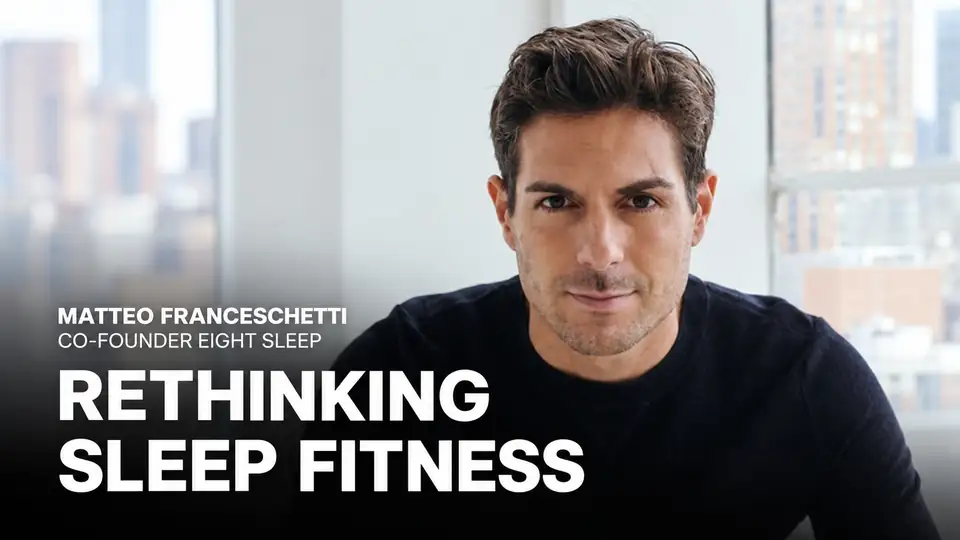
Matteo Franceschetti — Sleep Fitness and the Connected Bed
Matteo Franceschetti discusses Eight Sleep’s temperature-controlled bed products and the idea of treating sleep as part of fitness.
November 3, 2020 · 35 min



About the episode
In this conversation, we talk with Matteo Franceschetti, Co-Founder and CEO of Eight Sleep, about their patented sleep fitness technology. If you lack energy during the day because of the low quality of sleep you are getting each night, this is the episode for you. We will cover suggestions on how to improve your overall health with fitness, nutrition, and the proper amount of sleep. We will also discuss the two pillar vision and the technology that Eight Sleep has designed and is now available to improve your sleep.
Links
Chapters
Times follow the podcast audio. The video’s timeline may be slightly different.
- 00:00Welcome and introducing Eight Sleep
- 02:30What sleep fitness means
- 05:51The company’s vision for more efficient sleep
- 06:53Temperature and personalization
- 12:29The Pod and its temperature-control approach
- 17:01Imagining a complete sleep environment
- 19:01Why Matteo started Eight Sleep
- 21:13Future possibilities for health monitoring
- 27:30How feedback can change habits
Read the conversation
Open the full transcript
CAMERON WIESE: Welcome to the Build the Future podcast. My name is Cameron Wiese, and I'm your host. I've always been fascinated by the ideas and the sentiment that drove American culture in the 1960s with the space race. A culture galvanized to dream about the possibilities of tomorrow. Whether it's food, transportation, cities, biology, or anything else. It was this cultural mindset rooted in optimism, that the world tomorrow would be better than the world today. A mindset where people were compelled to build things, and I quote JFK, not because they were easy, but because they were hard. It's this desire to build and to dream that seems to have been lost, and something we're here to bring back. With Build the Future, we're here to promote the ideas and stories of those who see how the future can be better and promote their plans to get us there. It's our mission to get you to dream about the possibilities of tomorrow, to dream about the future that you want to live in, and inspire you to go build.
SPEAKER UNCLEAR: Today, we're talking with Matteo Franceschetti, the founder and CEO of 8Sleep, the first sleep fitness company. At 8Sleep, they're building innovative products to optimize human potential and build the future of sleep. Let's jump right in. Thank you so much for being here. Excited to talk to you about the future of sleep you're building. Thanks for having me. I'm super excited. I want to start with the basics. Can you tell me about the future you're building with 8Sleep?
MATTEO FRANCESCHETTI: What's the vision? Yeah, let's start from the past, right? So beds didn't change. If you Google beds or mattresses in 1800, you will see something that is substantially the same. So the future of sleep and the future of the beds is pretty bright because technology will be able to enhance our sleep quality. And we have a vision based on two pillars. The first one is to compress sleep. So what if you could sleep only six hours and get more rest than when you were sleeping eight hours? And the second pillar is because six hours is a pretty long amount of time, how can we get value out of that? and the way we will do it is by transforming your bed in a medical grade device that can scan your body every single night so what if going to bed was more valuable than going to your doctor for
SPEAKER UNCLEAR: a health checkup that's what we want to build yeah so and it kind of incorporates this concept of sleep fitness too right it's like how do you how do you optimize why does this matter why why is
SPEAKER UNCLEAR: is super important yeah so your health is really based on three pillars sleep nutrition and fitness workout however you want to call it and actually the the first pillar is really sleep because if you start sleeping two hours a night there is no nutrition and there is no no working out right there are plenty of clinical studies and there's plenty of medical evidence of how sleep can impact your longevity, how sleep impacts your nutrition, how sleep impacts your energy, which is what you need to then work out. But it has impacts on your blood pressure, on your heart rate, on Parkinson's diseases, on cancer risk. And if you think out of the three things, it's the easiest to manage, because you just need to sleep longer and try to have what's called a decent sleep hygiene.
MATTEO FRANCESCHETTI: So basic habits that you need to respect in order to improve your sleep quality.
CAMERON WIESE: Sleep seems to be one of the, like, it's like the thing that people focus on the least. They try and exercise a lot. They try and eat really well, but no one really kind of dwells on sleep. Why do you think that is?
MATTEO FRANCESCHETTI: I think there is this concept coming from the 80s where, in other words, these successful entrepreneurs that they were saying, oh, I sleep only six hours because I don't have time and I need to perform. but I think sleep deprivation is the new smoking. And if you start talking to a lot of entrepreneurs, entrepreneurs that use our products and they improve their sleep, one of the things they say is sleep is my performance hack. And when I sleep well, maybe I even sleep one hour longer, but that gives me so much energy and mental freshness that during the rest of the day, I perform 2x better and that hour was meaningless. So that is what we want to achieve now. And then in the future, as we were saying, we will let you save time. We will give you two hours back to you every single day by making your sleep compressed and more efficient. But for now, don't disregard the importance of sleep and your longevity and health.
CAMERON WIESE: Is it fair to say that probably the biggest change between the older perception of sleep hygiene and how people think about it now is that we just require so much more mental sharpness to do the work we do, right? Because there was a lot of labor-based work in the past 20 years, but now it's all online. A lot of it is online, so we have to really figure out how to focus and manage our time. And sleep makes all the difference, more so now than in the past.
MATTEO FRANCESCHETTI: Yeah. And I always call it sort of mental agility or brain power or brain IQ with my team, right? During the day, I really need to perform mentally more than physically. And so my brain needs to be sharp. I need to be able to recall data and information from the past. I need to be able to store new data and information that I will use in the future. And each of us, in particular in tech, we are really paid for our thinking. The quality of our thinking is what determines the success of the stuff. And if you are not sleeping enough, that is not going to happen.
CAMERON WIESE: I completely agree. Okay, cool. So let's dive into that eight hours of sleep into six. So tell me a little bit more about that. How are you thinking about it? What does that look like? How does that evolve kind of over time?
MATTEO FRANCESCHETTI: So let's open the fact is a very novel concept, right? There are very few people that are really exploring that. And I would say there is no company in the world that is really working on it in an active way as we do. And the whole assumption here is that the parts of sleep that really matter are deep sleep and REM. And then you have light sleep that more or less oversimplified is around 50% of the time you spend the sleep. And most of the light sleep is a sort of inefficiency of your body to transition in between the different phases. So if we can compress the part of light sleep, maintaining deep and REM the same, you could be able to achieve the same rest and recovery in a shorter period of time. That is the principle behind our vision.
CAMERON WIESE: okay so and then and then how are you going about helping people or like shorten that gap between
SPEAKER UNCLEAR: those phases of sleep yeah the way you you play with that is first you help them to fall asleep faster so as a first core concept is they spend less time in bed the time they spend in bed is really already asleep so that could you help them to get into deep sleep faster and you try to expand their deep sleep we do through thermal regulation so through temperature adjustment and for deep sleep cooling seems to be the one that helps you get more deep sleep while instead for REM is completely different and it's called thermoneutrality so it shouldn't be either cold or hot otherwise your brain doesn't let you get into REM phase and so being able to adjust all these all these phases through temperature already enhances your sleep performance and efficiency
CAMERON WIESE: and and so all this data that that y'all are seeing right now is kind of building up this what you all call like the sleep database, right? And so you can take this giant data set and figure out, okay, what is optimal for each individual, right? Can you tell me a little bit more about maybe what that looks like and maybe some of the interesting or unexpected things you've seen?
MATTEO FRANCESCHETTI: Yeah, we are building one of the largest sleep and health database in the world because we don't track only sleep, but we also track everything about your heart rate, including HRV, and also about your respiration. So in the future, we will be able to see snoring and sleep apnea. For example, a crazy thing that we have seen is that through temperature, in the middle of the night, we might be able to slow down your heart rate at rest, which as you know, you know that athletes, they have a lower heart rate at rest. Usually lower heart rate at rest is indicative of a healthier body and a more trained body. And the principle is pretty simple. If your heart rate has to do less effort to maintain, it's better for your longevity and for your health. And so it seems that through temperature, we are able to play with that. And so it's something that we want to experiment. And this is something we were not expecting because we were focused much more on the sleep side. The other big thing is through temperature, we see in a very evident way that we can make your sleep more restful. And so it's impressive how much we can reduce the number of tosses and turns that you get in the middle of the night and the number of wake-ups that you get in the middle of the night. And these are not just two single items. They are not valuable as just two single items and metrics, but the fact that you have no interactions and no wake-ups, it also helps your sleep in general because it does not
MATTEO FRANCESCHETTI: interrupt your sleep cycle. Your sleep cycle is usually every 90 minutes you restart. And so without interruption, that flows much better. And that has a consequence of your deep sleep and
CAMERON WIESE: your run. So that's one vector. And then the other one is mentioned kind of in the future, ideally going to sleep is equally as valuable as say going to a primary care physician. Can you
SPEAKER UNCLEAR: tell me a little bit about what that looks like? Yeah. So the beauty of what we do is the deposit is a bed, right? It's a smart bed. And so it's big. And we can embed a lot of sensors. We have plenty of space to embed sensors. And because the AOV and the price of the bed is in the $2,000 to $5,000, it depends what you buy. For us, adding sensors that might cost $50 is really irrelevant in the big scheme of margins, right? While instead a wearable cannot do that because a wearable is or the 200 bucks or 400 bucks. And so we have the room and we have the money to keep adding new sensors. And usually, you know, you spend a long period of time every single day on our device.
MATTEO FRANCESCHETTI: And that is optimal to track you every single day at the same time and see how, for example, you're aging. Just to give you an idea, your heart rate at rest today is different from the heart rate at rest you will have in three years from now. Right. But through machine learning and AI, We will obviously look at your pattern and we will be able to tell you how you're aging compared to similar peers of your age. At the same time, because we have space, we could introduce new hypostensors that could scan your body. So we have a couple of ideas of how we could, for example, scan your organs while you are asleep and maybe be able to detect early signs of cancer. So this is down the road, but the technology already exists. The space is there. And so it's just a matter of bringing this to mass consumer and being able to deliver to everyone in the world.
CAMERON WIESE: Looking further ahead, what are some of the other sensors in addition to organ scanning? What are some of the other things that you see that you would want to integrate into the mattress to help optimize for different components of people's health? What are some of those other things?
MATTEO FRANCESCHETTI: So without mentioning the specific sensors, that is something a bit unique we are looking at. The real concept to me oversimplified is how can we scan your body every single day to let you know in the morning if there is anything wrong with your blood pressure, with your heart rate, with your organs, if there is any sign of cancer or if we predict that you are getting sick. Because, for example, three, four days before you get sick, your hot food arrest starts going up. And so we have all your historical data. And at a certain point, we will be pretty accurate at predicting if you're getting sick and you are going to have the flu in three days from now. Things like that are going to happen 100% in the next five years, maybe shorter than that.
CAMERON WIESE: Yeah, hopefully shorter than that. I think we're at a point where everyone needs more visibility in their health, especially during this lovely pandemic that we are somehow still dealing with. Yeah, so you guys right now, can you kind of paint a picture of where things are at right now and then kind of how you see things evolving?
MATTEO FRANCESCHETTI: Right now, our hero product is the pod. The pod comes in two forms. One is a mattress. It gets shipped to your home. You install it. And now we will talk about what it does for you. The other option is what we call the pod cover. And so it's a cover that can be installed onto any mattress. It retrofits any mattress you have. And so you can install our technology on your current and existing bed. The number one core feature of our technology is thermoregulation. So we are able to adjust and change the temperature of each side of the bed based on your biometrics. This is really important for different type of people, right? There is people that sleep hot or cold. There are other people that they just fight with a partner because they have different temperature preferences.
MATTEO FRANCESCHETTI: 50% of couples, they fight around temperature. So it's a pretty meaningful number. And then there are top performers. Top performers that they want to recover faster or they want to enhance their sleep efficiency. So these are the three types of customers we have. In addition to thermoregulation, which means we can cool between 55 and 110 degrees, each side of the bed is a different temperature. We also track everything about your health, meaning that we track heart rate, HRV, respiration, sleep qualities, amount of time, sleep, toss and turns, wake up, almost anything you can think of. And then we have another feature that is one of the most loved by our customers that is a vibrating and thermoregulated alarm. So essentially, we start waking you up to a temperature and at the selected time, you will also start feeling a gentle vibration that completely wakes you up.
MATTEO FRANCESCHETTI: So this makes sure that when the vibration goes on, you are not in deep or light because through temperature, we already took you out of that. But you wake up without sound, which our customers always say is the most annoying part of their wake up routine. They don't want this sound to just go off while they're in deep sleep or while they're dreaming. And so we redesigned the whole wake up experience.
CAMERON WIESE: I guess the thing for me that I'm curious about is what are some of the implications of this technology and of the work that's doing that most people don't think about? Right. Because it's really obvious to me that, OK, better sleep is going to lead to better mental performance. Better sleep is going to lead to better health outcomes. Having data is going to provide me some insight into how my body's operating, what works for me, what doesn't, am I getting sick? But what are some of the things that wouldn't cross most people's minds that are really exciting about having this sort of access to better sleep?
MATTEO FRANCESCHETTI: I think so our aha moment with our customers is the first time they travel and because they miss their bed and they miss thermal regulation. And the interesting thing of this feature is that most of the people, unless they really had the pod, they never experienced this. And so the first time, yeah, it takes the first week to really find their settings. things. But then it's so natural. Imagine that it's like having AC and temperature control in your car. And now it's natural. It's there. It's obvious, right? Because you already have temperature control in your house, in your bedroom, in your car. Why wouldn't you have it in the bed? And so it becomes so obvious that it becomes natural and you just get used to that. But the first time you travel and you get into a dumb bed that gets hot or at the beginning it's too cold, you just almost you realize the importance of the picture and at the same time you start wondering how is it possible that we spend the past 300 years as human beings without this picture that is so natural even because your body temperature already changes during the night so what we really do through thermal regulation is not that we are reinventing the wheel we just enhance these temperature change in your body that is already happening naturally. And so your body will immediately miss it because it's like it is now missing coffee, right? And then they start feeling hot and cold and they keep changing the temperature. They move the blanket. And so they start having
MATTEO FRANCESCHETTI: terrible nights. And a lot of our customers, they keep asking us to develop a solution that is portable because now traveling is becoming extremely painful. So when I was talking with
SPEAKER UNCLEAR: Alex and you're kind of prepping, we kind of laid out the long-term vision that landed on this hyperpod-esque sci-fi idea. Can you tell me a little bit about that? So we want to control the
SPEAKER UNCLEAR: whole environment, right? That is how we will achieve sleep compression. And environment means obviously the temperature of the bed, but the temperature of the air, light, noise, humidity, air quality, and even oxygen. You probably have heard of athletes sleeping in altitude tents recover faster. We are going to be there. And as I was saying earlier, all these technologies, they already exist. There is just no company that was able to put them together with a mass consumer design and a mass consumer price and package in a way that makes them affordable for you to have them at home and use them every single day to sleep. So is this like in the movies where
CAMERON WIESE: they are hopping on a spaceship and they are going to rest for like seven years while they explore the galaxy. Is that kind of the sort of thing? I'm envisioning my bedroom just having a giant like metal pod that I just like a cryogenic freezer where I just like sit in it and everything's optimized. Is that kind of what's being worked towards here?
MATTEO FRANCESCHETTI: I would say the concept and the benefits are those. So it's similar to that. I think the shape we have in mind, the shape that is much more consumer friendly, that is much more couple friendly. and that can fit in any bedroom. So the benefits are the same, but the shape, it will be something that it will be much easier to relate to. And it's a space that you can share with your partner.
CAMERON WIESE: So what's kind of, how do we get there?
SPEAKER UNCLEAR: Step by step, right? So if you think of the pod like an iPhone or like an Apple watch, we will continue releasing new ones. And as we release new ones, there will be more sensors, there will be more features and the shape will start changing to a point where it will become a fully enclosed solution for maximum sleep performance. Love it. What excited you about
CAMERON WIESE: this problem? What got you into this? Why was this the thing you're like, you know what, I'm going to go optimize sleep for everybody and take this long-term view? What was that for you? What
MATTEO FRANCESCHETTI: was that moment? So I have always been an athlete when I was a teenager. And so I have always been obsessed with performance. Then I became an entrepreneur. I was even more obsessed with performance. And I started thinking, oh, can I cut my sleep? Why do I need to sleep? Who say that I need to sleep eight hours? And I started noticing that there is no real clinical reason to explain why we need to sleep eight hours. There are a lot of conjectures, potentially reasons, but there is no clinical evidence or there is no first principle proving that, oh, we need to sleep eight hours. And that is when I started looking into the opportunity to compress sleep. I started looking into polyplastic sleep. I tried that for some time.
MATTEO FRANCESCHETTI: I talked to some doctors that support sailors crossing and racing around the world, and they can sleep in instincts of 20 minutes. But I understood that that was socially possible because you would have to sleep for 20 minutes every couple of hours. And so then I started saying, but why is there no technology, right? Why Elon Musk is taking me to Mars? and here there is no technology. I live with an iPhone and I have no technology in my bed. And can technology accelerate my recovery, my efficiency? And the answer is yes to all that. And so I found that super fascinating. And with my co-founders, we started building the first product.
CAMERON WIESE: And that was back in 2017?
MATTEO FRANCESCHETTI: The first product was in 2015, which was a sleep tracker. And then in 17, we started developing the cooling because temperature is really the game changer. It's the biggest factor impacting your sleep quality outside certain type of sleep medical disorders. And so we knew we needed the money to build that device and that would be game changer. And so Consul Adventures came in, they led our round at the time and with the money we raised, we built the product and then Funders Fund came in and they doubled down and we're taking off.
CAMERON WIESE: Yeah, which is very exciting. Outside of the stuff that you're doing at eight, what excites you the most about the future?
MATTEO FRANCESCHETTI: I'm really into health. So I'm a small angel investor in as many health companies as possible. I'm really into this concept of predictive health. So to me, the thing that is unacceptable is that we don't know in real time what's going on in our body. And then I see maybe not the parents of friends just getting sick. One day they wake up and they discover they have cancer or they discover they have this disease. And to me, it's unacceptable now working in health and working in tech that maybe they started developing this disease three years ago and if they would have coated three years ago, now they would be alive. And for another thing that happened actually to a person in our team, she lost her bed because of a heart attack. And so how can companies like us start looking at your heart rate and see if there is any anomaly? And it's the reason anomaly to notify you so you can check it out. And so predictive health is what to me is the most important thing that is going to change the way human beings live within the next 10 years.
CAMERON WIESE: Just to have you kind of continue to elaborate on the point, why does that matter?
MATTEO FRANCESCHETTI: Because that is what will really extend our lives. So when you think about life in your span, there is the lifespan and the health span. Lifespan is really, okay, how many years are you going to live? So how can we move from 80 to 120? And that is through a certain type of behaviors. And that's the reason what is called healthspan. So for example, my grandma, she died when she was, I don't know, 95. But since when she was probably 75, she had a stroke and other sort of diseases. And so she spent 20 years of her life really sitting on a chair, right? And so that's not the point of living 95 years. And so that is the health plan to make sure through exercise, through predictive health, that you live a healthy, dynamic and energetic life until the last second. Because that is probably more important than living under 20 years if you spend 40 years sitting on a chair.
CAMERON WIESE: It seems like there's like a small community, small and growing community of people who are starting to be mindful of these sorts of things. How do we get more people to see the long term benefits of this sort of stuff?
MATTEO FRANCESCHETTI: I think there is a group that is growing of health and fitness enthusiasts. They want to take care of their body because they want to perform. They want to feel energetic. They want to look in shape. But I think if you really want to go mass consumer, the first thing mass consumers will understand is more the concept of health span more than lifespan. Because old school people tend to say, oh, I don't need to live 120 years. I'm probably with 80 years, so don't bother me. but I think a lot of these people they have seen their parents having a big delta between lifespan and healthspan and that is clearly not good because you don't want to leave sitting on a chair and just waiting for your last day and so I think that is where we should hammer them at the beginning and just say look by doing this first you will feel better you will feel more energized and secondly you will be able to enjoy every single day of your life whatever that is, it's 75, 95 or 120.
MATTEO FRANCESCHETTI: I'm European, as you can guess from my accent. And so obviously in Europe, I would say they are behind on this kind of concept, in particular on the concept of the 120 years. There is, I want to enjoy my life. This is my life. Don't even bother me with all this biohacking. But at the same time, one thing in particular in Italy, where I come from, I was there this summer and I was impressed by how many 60, 70, 70 years old people were exercising. So, for example, a lot of biking, road biking, a lot of swimming or playing tennis. And so I think things are changing. Here in the U.S., we see them from a different lens. It is really about performance and efficiency and biohacking with a lot of clinical foundation.
MATTEO FRANCESCHETTI: while instead, for example, in Europe is still part of the life enjoyment. They don't realize that by doing that, they are also extending their life or extending their health plan. And I think the other game changer will be the body tracking. Because until when you realize that something is trending in the wrong direction in your body, you keep saying, oh, no, I'm perfectly healthy. Don't bother me. I don't need to train. I don't need to do this. I don't need to sleep. But as devices like Eight Sleep or Levels, they get abducted by more and more people. And we will be able to inform these people about how their health and their aging is trending. That is what will scare them if something is bad. And hopefully we'll wake them up.
CAMERON WIESE: No pun intended, right?
SPEAKER UNCLEAR: Exactly.
CAMERON WIESE: That's one of the things that concerns me the most is that we just have so many people who don't care about their health. and they wake up and they're like, they have diseases that probably could have been caught earlier or they just run out of energy by the time they're in their 30s or 40s because they just didn't invest in taking care of themselves. Other than kind of giving people the data, what else do you think we can do to shift the culture in a way that encourages people to be more proactive about living healthy and active lives?
MATTEO FRANCESCHETTI: I think one of the issues that right now we have in the world is a lot of these actions, they cannot be measured. And as a consequence, the results are not evident and actionable, are not really measurable, right? And so if you start thinking of, I don't know, for example, levels, and you start monitoring what you eat, and you see that when you have a pizza or a certain amount of pizza in certain conditions, you have a spike of 170. While instead, if you have just a brand dino with some veggies, you are a 90. I mean, that wakes you up 100% because when you don't know, then is when you can invent and you can have your own assumption. No, I'm healthy. I eat healthy. I'm good.
MATTEO FRANCESCHETTI: But when you have hard data and the hard data clearly states that you are hurting yourself, I think more and more people will start changing their behaviors. Right now, you don't know. I personally don't know because I've been eating a burger from McDonald's since probably 15 years. But I don't even know what my glucose type would be. And most of the people, they don't. And so they say, what's really the difference between eating veggies and a Bernardino versus eating a McDonald's tonight?
CAMERON WIESE: It'll be interesting to see how we continue to develop in this direction and how we can get more people involved.
SPEAKER UNCLEAR: They need to see the results of their change, which if you think the closest proxy right now is going to the gym because you see the results, right? Your muscles change, you become bigger and probably if you care about that, or if you go running and you train hard, you lose weight. So those are the two biggest proxies. You have clear evidence and you have a payoff for your sacrifice. Right now, we don't have that with sleep and with nutrition except losing weight.
SPEAKER UNCLEAR: There's something that I dwell on, which is it seems like people aren't even optimistic enough to decide that going to the gym or eating healthy is actually going to make a difference it's like well what doesn't matter right because our inside people are playing video games they're eating lots of junk food so like i could go work out it's not going to get me anywhere i think that's that's kind of a cultural problem that we're going to continue to work with because i don't think there
SPEAKER UNCLEAR: is enough data to let you know so the the the data phase just recently started about our bodies right It really started three, four, five years ago. And so there is no historical data proving you that by training this amount for this period of time, you can extend your life by X. And so we didn't develop that education. but in the next 10 20 years we will have plenty of evidence that if you do heat x times for these lengths every single week you will be able to reduce your hybrid attack risk by x and you will be able to gain x years of life and the other big thing will be correlation which is one of the things our customers keep asking for and we are developing right now there is no correlation between there is no education between okay if i eat this at this time my sleep will change in this way where alcohol is gonna impact my hrv and my sleep quality very few people know these things but in the next couple of years they will become mass market and that for example will have probably an impact on how much you drink and what time do you drink so people are jazzed like hey you know
CAMERON WIESE: I want to take responsibility for my own health. I want to figure out how to optimize things. I want to get an eight mattress. Where can they go? How can they support you? And how can they really start to invest in this kind of future for themselves?
MATTEO FRANCESCHETTI: Yeah. So I actually tweeted about that today. And I said, look, if you want to live a healthy and longer life, you just need to focus on three things. Sleep, on nutrition, and fitness. So for sleep, buy an eight sleep pod because through thermal regulation, you will improve your sleep quality. Try to sleep between seven and nine hours of sleep per night, and that will overcharge you and it will risk you from certain type of diseases in the future. On the nutrition side, use a CGM, a continuous glucose monitor. See what is good or what is bad for you. For example, I discovered that ice cream is not bad for me. But for example, raspberries are as bad as a pizza in terms of glucose fights.
MATTEO FRANCESCHETTI: Try to have a Mediterranean diet. I'm on a keto, but I think the easiest thing to do is the Mediterranean diet is more balanced. You can eat a little bit of everything just in moderate ways and you eat a lot of veggies and fish. But everyone is different. And the last one is, as a minimum, try to exercise 20 minutes five times a week. And when I say exercise, it's try to keep your heart rate above 120 for 20 minutes five times a week. It's not that hard. It's basic jogging. As you get used to that, you will start raising your bar and you will start doing more and more and you will become a healthier person. So based on the Atomic Habit book, just start. Just show up. Do it simple.
SPEAKER UNCLEAR: you will start feeling better. You will start looking better. And that will drive positive energy to accomplish more from a health and longevity perspective. The only thing I would like to highlight is when you think about your health, think in terms of products and think in terms of behaviors. And the other big thing probably we didn't touch, and we can touch it quickly, but is one thing that is not obvious enough is in each of these three pillars, everything is personalized. One thing I don't like anymore is when I just read general rules. Oh, you should be on a keto or you should be on this diet or you should do this or you should do that. For example, I do fasting and I like fasting.
MATTEO FRANCESCHETTI: I fast 23 hours almost every day. If I don't do 23 hours, I do 16 hours. And my wife, when we started looking at her glucose level, she never fasted. She never liked to do it. She said, this doesn't work for me. I was pushing her, this is healthy, blah, blah. With these levels, we discovered that her glucose levels, they dropped below minimum during the day. So she needs to eat or that would be pretty bad for her health and would be dangerous. Without using levels, we would have never known and we would have had just this theory that everyone should be fasting every day. So health is personalized. You need to identify what works for you, how many hours of sleep, what you need to eat, and how much you need to train to live longer and help their life.
CAMERON WIESE: Yeah, I think that's definitely something that's often overlooked. Everyone's trying to be prescriptive. In reality, it's, hey, you need to do what works best for you, but that's not what you feel is what's best for you. It's like you need to get some data, track it, optimize, which is now, because of the work that you guys are doing, other companies are doing, it's easier to have visibility into, which is great. Thank you. Thanks for kind of jumping on here. I don't know. I think the future of giving people more tools, more resources to optimize their health unlocks all these other components of living a great life and living, really being, having the ability and energy to go, go to do the things that they want to do. Right. We're not going to live in a bright future if everyone is kind of complacent and sitting around not being healthy or active.
MATTEO FRANCESCHETTI: One exercise everyone should do, try to sleep one hour more per day for a week. That means seven hours. It's like gaining one night of sleep. and then tell me how you feel at the end of that week. You will have your own answer about the importance of sleep.
CAMERON WIESE: If you want to learn more about Eat Sleep, you can head on over to eightsleep.com. And if you want to learn more about Matteo, you can find him on Twitter at M. Franceschetti. Thanks for joining us for another episode of the Build the Future podcast. Lastly, if you're building and want to get support, want to hear about certain topics or from certain people, or just want to get involved in helping build the future, Shoot us over an email at hello at buildthefuturepodcast.com or follow me, Cameron, on Twitter at Cam Weesey. And we'll see what we can make happen. That's it from us. Until next time, go build.
More episodes
All episodes Josh Clemente — Metabolic Health and Real-Time FeedbackJosh Clemente explains how glucose monitoring and faster feedback can help people understand their bodies.
 Gonzalo Espinoza Graham — Building a Flying Car at WatflyGonzalo Espinoza Graham outlines Watfly’s approach to a small electric aircraft and its proposed recreational starting market.
 Garrett Scott — Pipedream and the Future of DeliveryGarrett Scott explains Pipedream’s proposed underground delivery network and its approach to scaling infrastructure.