

Build the Future Podcast
Manu Ignatius — Underwater Networks and the Future of Oceans
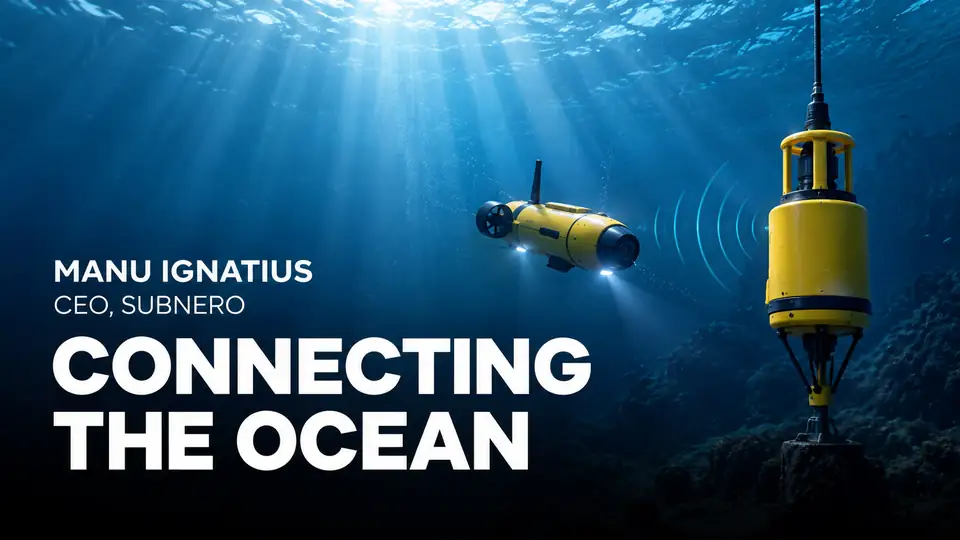
Manu Ignatius discusses the challenges of communicating underwater and Subnero’s approach to networked acoustic systems.
December 29, 2020 · 37 min



About the episode
In this conversation, we talk with Manu Ignatius, CEO of Subnero, about the future of underwater wireless communications.
In addition to talking about the work they're doing at Subnero, we cover: the state of underwater networks today, marine research, underwater robots, and the future of our oceans.
Links
Chapters
Times follow the podcast audio. The video’s timeline may be slightly different.
- 00:00Welcome and introducing Subnero
- 02:53Why underwater communication is different
- 05:05From point-to-point links to networks
- 09:47Connecting sensors for research and monitoring
- 15:42Software-defined underwater systems
- 20:41Underwater robots and their applications
- 28:15What else could be built on the platform?
- 29:20Ideas beyond ocean technology
Read the conversation
Open the full transcript
CAMERON WIESE: Welcome to the Build the Future podcast. My name is Cameron Wiese and I'm your host. I've always been fascinated by the ideas and the sentiment that drove American culture in the 1960s with the space race. A culture galvanized to dream about the possibilities of tomorrow. Whether it's food, transportation, cities, biology, or anything else, it was this cultural mindset rooted in optimism, that the world tomorrow would be better than the world today. A mindset where people were compelled to build things, and I quote JFK, not because they were easy, but because they were hard. It's this desire to build and to dream that seems to have been lost, and it's something we're here to bring back. With Build the Future, we're here to promote the ideas and stories of those who see how the future can be better, and promote their plans to get us there.
CAMERON WIESE: It's our mission to get you to dream about the possibilities of tomorrow. Dream about the future that you want to live in, and inspire you to go build. Today, we're talking with Manu Ignatius, the CEO of Subnero. At Subnero, they're building the technology to improve underwater communications, navigation, and sensing. In doing so, they're helping accelerate us to a future where devices underwater can communicate between each other just as fast as they do on land. Let's jump right in. Manu, thank you so much for being here. Would love to start with the basics. Can you tell me about the future you're building with Subnero? What's the vision?
MANU IGNATIUS: At Subnero, our vision is to be the de facto standard for underwater communication and in water sensing networks. So let me give you a bit of a background about this. More than 70% of all surfaces covered with water of some form. Sometimes it's most of it is ocean or sea water and a lot of it is glaciers and rivers. But we know more about the surface of moon or Mars as compared to what we know about our oceans. And one of the key technologies that you need to explore and to study is communication or efficient communication and localization like GPS or Wi-Fi and 3G. And that doesn't exist in current world. While communication in some form exists, it really is not available for the kinds of researchers or environmentalists where you want to collect a lot of data. And that's really what we are trying to solve by providing software defined modems where all of it is or most of the value is in the software and hardware is really depending on the user. And you can take that and do your do things like exploration or studies or things that help you understand the ocean as it is on a massive scale. That's really what we want to achieve by what we do at Sagano.
CAMERON WIESE: A couple of threads to pull on there, but let's start with what does this ocean technology stack look like right now before you guys came into the field? What's the problem with ocean technology or underwater technology?
MANU IGNATIUS: There are a couple of things. The key fundamental thing itself is electromagnetic waves do not propagate well underwater. So we in the land we use electromagnetics for everything. All of our wireless communications are based on electromagnetics. You put that underwater and it's going to get absorbed. You probably will get I don't know a couple of meters or a couple of tens of meters of range or if you blast with super high power you might get hundreds of meters but that's about it. It's extremely inefficient and that's where the fundamental difference comes. Most of most of all of the communication has to use acoustics as their physical layer and that right there is a challenge and potentially an opportunity because sound travels to 100,000 times slower than light or electromagnetic, which means you have a very specific delay even if you are communicating one or two kilometers wirelessly and sound travels 1500 meter per second. So there is like if you're communicating three kilometers, there is a delay of two seconds.
MANU IGNATIUS: So that is a big challenge. So that is a physics challenge and people have been coming up with more and more innovative solutions to work around that. So that's kind of fundamentally one of the biggest issues. And traditionally, if you look at this and their domain is very similar to our land based technology, the first kind of systems, wireless systems tend to be analog in nature. And then slowly it's moving to digital. And now in the land networking or internet is kind of, you don't have to think twice, it's there everywhere. But that's completely not the case underwater. People are still working with point to point communication. So at Sumnero, we really think that the next big thing would be network underwater communication solutions. And that's exactly what we are building.
MANU IGNATIUS: Most of the players out there, if you look at their offerings, are still based on point to point. And that's primarily driven by applications, traditional applications, where you have to just communicate from one point to the other point. But that big shift is happening where instead of you doing communication from one point to other, you really have the need for network solutions where things are just like internet. underwater.
CAMERON WIESE: Yeah, so can you tell me a little bit more about how you guys are at Subnero approaching that? So it's historically been this point to point transfer of information and you're building a network based version of what does it what does that look like?
MANU IGNATIUS: So the other good thing of being underwater is for wireless domain, terrestrial networks really push the envelope of what people are doing while we cannot adopt it the way it is. we can learn a lot from what's available in the land and try to work a build on top of that. So one specific example is internet. So we have all these networks like networking protocols like TCP IP on top of which the end-air internet is built. So we don't have to go and find something new but TCP IP still has a lot of assumptions in terms of speed which doesn't hold true for underwater because there is a huge delays in the case of watermark. So you can't really adopted as is at the same time. So what we are doing is we have built a network stack that is specifically geared towards underwater networks and that's called UnetStack and a bit of a history for it and this has been a project and this is still an ongoing project at the National University of Singapore where it's developed and maintained by a community of researchers.
MANU IGNATIUS: And it's free for download and it's free for academic and non-commercial use. What it does is It has this network stack and a collection of technologies and completely software defined. And that's there out there that anyone can download anyone who is intending to do research or teaching or educational purpose or can download and you can build your own hardware and hardware as you know is very cheap. Things like Raspberry Pi or even your laptops are not that expensive with the kind of power as compared to what was available in the NASDAQ. You can put this stack in your own hardware and then all of a sudden you have a network enabled underwater node that you can simply deploy and build your own networks. The key thing to notice here is instead of building first point-to-point links or physical layer in a network stack and then building on top of it when we build originally designed this UnetStack 10-15 years back even before the formation of company in the Subnero.
MANU IGNATIUS: We build all the way up to application layer from physical layer, looking at the end-to-end network stack holistically. So if a user is only interested in doing point-to-point communication, yes, they can use the devices as normal. But the real strength or the real value comes from the fact that it is out-of-the-box network enabled. So these devices can form networks and do routing and transport and all of that in itself. And that kind of offerings are not that common or almost inexistent in this domain from a traditional sense.
CAMERON WIESE: So we kind of, yeah, like you said, we take it for granted. We have on land. You can't go take like a four or five G, you know, data system and just drop it in the middle of the ocean. Everything worked. I'm curious kind of what are what are people using like underwater networks for? So who are the people who are using the point to point systems and what sort of things are they doing? And then what might be unlocked by the work he has doing at Subnero by making kind of this underwater network more accessible to more people.
MANU IGNATIUS: There are all kinds of applications but if I have to classify all of them into three or four categories, I will classify the big users. One of the biggest users of underwater, all kinds of things, communications, navigations, monitoring and sensing are academics and researchers. So these are the people who really like to learn or study how the oceans work. So Earth is such a big planet and a lot of it is surface is covered in oceans. And if you do not really understand it, you can't possibly think of finding a solution for things like global warming or climate change or how we are evolving into the future. And that's not just as a planet as a whole, a lot of times when how the changes of temperature of water is affecting local ecosystems like coral reefs and how marine mammals are affected.
MANU IGNATIUS: So a lot of these what you need is data. While in the case of terrestrial, like normal land, what we usually do is we can collect all kinds of data like temperature and pressure and sunlight and UV and all of that. In underwater, a lot of that is acoustics. So basically you record the sound and analyze and look for specific sounds. And then based on that, you can actually learn how things are moving, how things are changing. or for example, let's say there are these massive ocean currents that are in the ocean and then ocean currents can indicate how things change around weather patterns can change and then there is a device called ADCP that is acoustic Doppler current profiler and that is used to measure currents and these devices just sit on the bottom of ocean and collect data.
MANU IGNATIUS: Now, if you want to get this data out in real time, traditionally the people, the way oceanographers do is they deploy these comes with batteries and they deploy in the bottom of the ocean and then leave it there for, I don't know, one month, two month or however long your recording has to be. And then after that you go there using diverse or some kind of equipment, you retrieve it back and then you download the data and then you do the analysis. That is offline processing. That is great, but that still doesn't cut it because you might want to get the real information if you want to do it and that's really one of the use cases of where you might need wireless systems that you can get the data out. So there are so many similar applications you can you have these network of tsunami sensors that are deployed underwater to detect small movements in tectonic plates and again if you don't have an efficient wireless communication system you are not getting the data out. So a lot of the things at times what people do is you have the sensors and you have something on the surface of the water and they are wired, all the sensors can go up and down.
MANU IGNATIUS: And then from there, satellite comes. But the issue is, if there are things on the surface and if it's wired and you have no idea, there is a lot of shipping, it can get cut. And if the sensors go up and down, it can get lost. But if you can have a fixed sensors underwater with reliable communications, then that's the perfect case. So that's number one. That's the academics or researchers are interested in studying or pushing the envelope of what is possible. The second would be defence, especially for coastal nations like Singapore, coastal security and marine security has been of very high importance. And for that you need again the same thing. You need sensors, you need vehicles underwater vehicles patrolling coastal shores and these vehicles will need navigation or localization capability.
MANU IGNATIUS: And the vehicles, not only for defense, researchers use vehicles a lot, especially when you want to go and look for something. And GPS doesn't work underwater for the same reason. Any communication systems on land doesn't work underwater because it's EM. So you need a similar underwater GPS that are formed by these acoustic nodes. So traditionally, you have navigational devices, which are called USBL or LBL or SBL, which stands for ultra short baseline or long baseline. So these are acoustic nodes that send out beacons or pings. And if you know the location and if you know the speed of sound, you can triangulate where you are. And then you have the communication devices. But what we are trying to do is because ours is a software-defined stack and at the end of it, the hardware is exactly the same.
MANU IGNATIUS: There is no difference. You can actually have different apps or agents in the stack that provides different functions like localization. Yeah, you use the same hardware and localization function. If you want communication, you use the same hardware and use the communication function. So that's the second use case. And defense has been one of the traditionally, people who have started using underwater wireless communication the earliest. And it has been around from Second World War onwards. People have always been interested in communicating with the likes of submarines. And the third one, I would broadly classify industry or commercial where or subsea industry where people are interested in building processing systems or subsea factories underwater where if you are looking for oil and gas or some kind of natural minerals you probably don't want to take everything up to the sea up to the top and then refine or do whatever they do rather than if you can do at the bottom of the ocean it's kind of good because it's efficient plus less environmental pollution and things like that.
MANU IGNATIUS: And there are a lot of subsea structures, there are massive offshore windmills and a lot of the underwater part is under the water and that requires inspection and IRM inspection repair and maintenance on a regular scale. So these are the guys who will need those. So traditionally divers have been doing it so divers will need localization and communication but they use tethered systems so that's not much of an issue but as we go into the future people are more and more using autonomous vehicles and they will definitely need communication and localization. So these would be the three major ones the rest may be a bit of utilities like let's say there are sea water desalination plants or underwater massive catchment areas where you want to collect a lot of water quality data then they are also users of the tech. I'm sure there are other kind of uses I am just massively putting all, I mean, I'm just broadly putting all of them in this category.
CAMERON WIESE: Which works. Essentially, the thing right now is it's just so hard to communicate underwater and there's all these different implications. Like, can you have the researchers, the military defense, you have the industry, everyone's trying to do different sorts of things, but they don't really have tools that are best equipped for getting them the data they need or as quickly as they're used to having it. Because the rest of the world is operating or like above water world is operating on instantaneous speeds. I mean, we're what I don't know how many miles Austin, Texas is from Singapore, but thousands of miles away. And we're having like a one on one conversation. And you know, if we were underwater, this definitely would not happen, obviously, but it's cool. Because like, I don't know, I'll get a bit sci fi here.
SPEAKER UNCLEAR: At some point, I mean, everyone wants to go to the moon, and people want to build different landmasses. But there's this concept of like, Oh, what if we build like cities underwater? And I don't know how feasible that is. But it's definitely not possible without access to the rest of the world through like cellular communications. So one, we're gonna need something like that or something like Subnero to help us help enable that sort of communication. I don't know what else kind of maybe sci-fi or not sci-fi gets enabled by making it easier for people to communicate underwater or for business to be able to like get the data faster. So good question.
MANU IGNATIUS: In fact, the way things are going, if I have to draw a parallel to our terrestrial world, so long time back we had analog telephones, telephone lines where we use lines and then we have digital telephones but still using wired combs and then we had the hardware-defined mobile phones like the kind of lights of Nokia's where you can just do one function or two functions that's about it and now what you have is completely software-defined platform of the phone smartphones that we use are mostly pieces of computer hardware with one function being the ability to call home, call someone. So that's really the way I think we are going in the case of underwater. Some people are at the forefront, some people are catching up. But so currently we are at the realm of digital communication, digital wireless communication.
MANU IGNATIUS: A lot of the people, our competitors do digital. So analog is almost not there anymore. However, current state of the world, if I have to say, is more like hardware defined. So you have custom built hardware for doing specific things and we are one of the first who are going to the software defined world. And once this is done, the other major thing I hope that, I'm sure, I'm pretty sure that we will start seeing is the deployment of massive networks. So I'll give you some examples. So Singapore has a massive port and at this currently how people manage the port is completely manual or from the top side from terrestrial. So you have all kinds of people looking at all kinds of systems. So you have the AIS for the ships. There are ships coming in and going in and you have to have a very efficient port management system for that. And when the ships are on the anchorage, you need to clean the ship and currently people still do use diverse, so diverse literally jam in the water and then do the cleaning.
MANU IGNATIUS: So let's take that as a typical example and it's going to change and already there are multiple communities here in Singapore who are trying to use autonomous underwater vehicles to clean the ship hull and automatically generate reports and so on so that we can reduce the length a bit more on manpower mostly for primarily for safety reasons because going underwater and doing this is kind of a very dangerous task for a human. So how these are all of these things. And there are that means underwater cleaning robots will be an asset underwater. And then there will be like what I was saying, there will be the coastal defense. And people are not going to run a submarine in a coastal area. So it's mostly going to be underwater robots.
MANU IGNATIUS: And there are all kinds of underwater robots built for all kinds of purposes, just like what we have in land. We have a room bus or vacuum cleaners that goes around house to house to clean. At the same time, we have massive robots that does industrial automation and things like that. So there are all kinds of robots. And all of these robots, once they are underwater, it's just like autonomous driving cars. They will need things like localization and they will need things like communication and they will need things like handover. So at the moment, what we actually have deployed and our customers, what they are using are networks, but they are localized networks. But what we are going towards is our massive networks like 3G or 4G, where there will be like if I say, for example, if you take a couple of ports in Singapore, all of those will be equipped with networks, just like 3G or 4G and nobody will have to think about how I am going to deploy or how am I going to get it.
MANU IGNATIUS: There'll be a telecom operator or underwater telecom operator from where you can subscribe plans and these vehicles can use that for communication and navigation and they can do their own job. So one of the next very exciting things I think will happen in the next five to 10 years will be deployment of coastal underwater cellular-like networks. And that's really, really exciting for us because we think that we are in the right time to start doing such things because there are so many applications at the moment, the way people do is, whoever is the operator who are, let's say, underwater hull ship, hull cleaning, the operator will have to get their own robots and operator will have to get their own localization solutions. So that's a huge investment for them. But if there are someone who is providing the service, then they just, all they need is just take the robot and go there and deploy it and they will use existing 3G or 4G systems underwater.
CAMERON WIESE: It's essentially like what you guys are working on is going to unlock the next wave of like underwater, essentially underwater robotics and anything tech driven or that needs a cellular connection currently is challenged or it's very expensive to do that underwater right now because the infrastructure isn't there. But through the work you guys are doing at Subnero, they have these access points and and the information kind of flow between devices just like it would above water. Do I have that right? That's awesome. That's super exciting. Where do you think there are, so we mentioned like shiphole cleaning and I feel like there are probably applications in fishing and kind of coastline management. What are some other like underwater robotics that we may see? Like some of the cooler cool things that you're excited about that can then function as a result of having these networks.
MANU IGNATIUS: So underwater robots are really, really an exciting and exploding field. They are being used for all kinds of applications ranging from marine archaeology to search and rescue to aquaculture and coastal security, something I said earlier, and exploration and ocean bed mapping. So traditionally all of these applications used to be done either by a ship or by divers or by submarines. And now, and they are like extremely expensive. Now what people are doing is you have this fleet of autonomous underwater vehicles or companies that provide services with a fleet of autonomous underwater vehicles. so you can actually get services from them and you can say okay this is the area at CEI I am interested in I would like to know the the seabed I would like to map so most of the seabed around the world we do not have very high resolution maps we know roughly what it is but that's about it and then these companies will go and deploy the AUVs and then do the survey the other setting one would be aquaculture so aquaculture in itself is a massive industry as with any massive interstitial, you really have to deal with things of big scale.
SPEAKER UNCLEAR: So one example is, during offshore aquaculture farms, which are huge cylindrical kind of farms where there are fish, you have like lots and lots of fish in there and you really need to monitor them constantly to make sure you know, they don't die of some diseases or there are no poachers or other issues. like, you know, if there is a natural calamity, like a, like a cyclone or something that doesn't really affect them. So that's another area where they use underwater robots a lot, where to make sure all of it is good and well and managed properly. I feel like the underwater robotics
SPEAKER UNCLEAR: is somewhat connected like underwater, like exploration, right? Do you have any, do you have any thoughts or I mean, is that something you spend in time thinking about? Like what, what exploring our oceans may look like and what that may entail? It is, I think fundamentally human
MANU IGNATIUS: beings at some level are explorers and that's why we have grown to space and explore in our remote worlds. At the same time there are so many people and so many agencies for whatever reasons whatever applications some people out of just sheer curiosity would like to explore underwater worlds and like I said only so much 5% or less than 5% of oceans have been explored. We still have no idea what are some of the you know secrets that the oceans hold and applications why there are so many applications by understanding our oceans. First one would be how oceans and ocean currents affect the climate of our planet as a whole. Then the next one would be food security. The third would be understanding where we came from.
MANU IGNATIUS: Because if you look, there are places under water where deep sea thermal vents, where scientists thought nothing can exist. These are some of the extreme environments in the planet. And they started exploring and they found these places teeming with life. and understanding how they live on their anatomy, that kind of helps us answer some of the deep questions that we always had, like where did we come from or why earth or why there is life only on earth. So these are like much bigger questions than just, you know, any of any of the things that we are talking about. So really understanding and learning about oceans help us answer some
SPEAKER UNCLEAR: of these questions at some level is my sense. Yeah, no, I love it. It's super exciting. And factors like one of the things I was super excited to have you wanted to share is we're all looking upward at the stars. Like, oh, how do we go to Mars? I would the moon, but there's this whole world is hit only 5% has been explored around us that hasn't been touched. And I think it's if we can kind of excite people about the ocean being a possible like additional frontier result of cool, cool things we may learn. But it sounds like the reason we haven't is just because it's it's expensive and it's hard to go get the data. And like you can't go, you can't send autonomous vehicles down to, it's way too expensive to send them down like Mariana's trench and have them like poke around, right?
MANU IGNATIUS: Exactly. So it is, it is expensive. And the technology was traditionally, there was a high, much higher barrier of entry for people to get into the space and start doing things because this is not something that everyone's exposed to on a day to day lifelike. So that's exactly what we, I personally am really excited to see like really the democratization of tech. So that a lot of people have access to the technology that we are building and they can start doing things. So in fact, we have already been seeing things while we are in traditionally, we are at the core of communication, navigation monitoring and sensing kind of company. We have had people download or use our software defined modems or even just the software and doing things that we never really thought is possible.
SPEAKER UNCLEAR: So that's the kind of applications that we are looking at. So I'll give you an example. So one of the researchers came to us and said, okay, we would like to buy one of your devices. Then we are like, that doesn't make any sense to communicate you need two devices because there's no point. And then we started asking questions of what are you trying to do? And he was like, see at the end of the day, what we have is a device electronic, software defined hardware where you can transmit arbitrary signals. So he was trying to convert this device to a sonar to do mammal counting. So what you would do is you would transmit a signal, a specific signal that they develop and wait for the responses or wait for the reflections and do data analysis or signal processing on that and try to count fish from it as an abnormal, not normal fish, things like sharks or whales and this traditional sonar that needs to be, that someone needs to do something like this would be like 10 times the cost of what our equipment is and they are like they are like okay look this hardware has this really good software which user can develop on top of it it's really user friendly. So let's try this and once they started doing it first one they bought was mostly for testing and they started having really good results and their institution other department started taking that hardware and we want this to do this and they came back and had repeat orders with us.
MANU IGNATIUS: And so those are the kinds of things that we, that really gets us excited. Yes, you can do communication, you can do localization and monitoring and sensing and all of that. But at the same time, we want to give access to this tech, to people who really want to do things with it that they can do applications or technology, they can develop technologies that are not thought of or we have not thought of.
CAMERON WIESE: Well, that kind of begs the question, like what are some, so you guys are building the platform that enables people to build on top of this. You said there are a lot of things that you haven't thought of that people kind of creatively come up with. Are there some things that you would love to see people build? Like there are opportunities that other entrepreneurs or other researchers could go get involved and be like, hey, I want to go build this or that on top of Subnero.
MANU IGNATIUS: Yes, for sure. So we have talked about the kind of things that people can do, which we may not be able to do because we have resources and time constraints and all of that. But there are so many things that I personally would like to do. That's one part of it. I can talk about that a bit, but more important than that, what really exists is when someone builds something that we haven't thought about, to be honest. And that I can't really say because I haven't really thought about it.
CAMERON WIESE: Yeah. If you had to pick like two or three things that you would love to see that you're kind of time constrained or resource constrained to build? What might those be?
MANU IGNATIUS: So a couple of things would be exactly what is like the example that I was telling you about is things like Sonar applications where you can use software defined hardware to transmit and receive arbitrary signals, not just predefined communication signals and do processing on top of that to identify or detect things. The other, so almost all of our hardware, actually all of our models by default come with ranging functionality because you can measure the speed of sound and you can find the range. But there are a lot more you can build on top of it because once you have a network of these systems, you can do things like localization because you can do different things or you can transfer from different of these devices and then get the responses and do localization. And that's something that we hope we can build at some point in future. But that's the kind of applications. Again, Enablers not really final applications like localization and communication related ones.
CAMERON WIESE: Outside of the work you're doing at Subnero, what excites you the most about the future?
MANU IGNATIUS: In fact, I've been thinking about it. I usually try and read up and think about this for a bit. But if I am talking about really, really futuristic, I would say personally singularity, where humans probably can move our conscience to non-biological system. You are not really limited by the limits of a biological human body, but that's way too
CAMERON WIESE: futuristic. We can play in that territory. What is it about that that excites you? Is it this ability to live forever? Do you build lots of different projects?
MANU IGNATIUS: In a way, yes. As in when you start doing things like this, I actually ended up kind of I didn't really choose this domain. I came to do my master's in this university and I met the professor who was doing the research in underwater domain and my interest has always been in communication networks and I thought I used to think that terrestrial networks are bad or challenging and then I heard about underwater networks and it's super challenging so it's very interesting right and the more moment you start doing things or you learn about new challenges you realize there are like a lot of things that you can do that excites you. Personally, there are so many things that excites me to do on a day-to-day life or a long time that you simply do not have the bandwidth or time to do it.
MANU IGNATIUS: The current way usually people do is we build a team of people who have similar interests and make sure you keep doing it. Once you get into a domain that is really exciting, you always will have like 100 or 1000 times the things that you really, 1000 times that to what you are doing that you really want to do. And having something like that would really help, you know, keep doing that and then seeing the results. So what we are doing currently are a bit futuristic and this domain has been traditionally a bit more slow and application driven. So the results of what we are doing might take a couple of years, like really futuristic things like what I was saying, like huge networks of the covers and their span of oceans It might take a lot of years to be around to see that kind of technologies would be cool.
SPEAKER UNCLEAR: That's my personal message.
CAMERON WIESE: So let's say, okay, we have the singularity, you have infinite time, you build Subnero and have this underwater network and everyone's able to communicate with their devices underwater, above water. Like that's that problem solved. What might be another area you want to tackle?
MANU IGNATIUS: I'm sure there will be still a lot of challenges. just again, maybe the time frame of limit of my time frame has mostly been constrained with all the problems related to oceans. But I'm pretty sure, so personally, I'm a scuba diver and I really like being around water and being around oceans and I like going on trips or sailing and I don't sail, but being on a sailboat or boat. I really like being around water. So I think even after we, let's say achieve all of that, I will still find some things related to underwater technologies to work on. That's my guess.
CAMERON WIESE: Yeah, it's kind of an unfair question because the world's changing so quickly. I don't know what the world's going to look like in five years, let alone like, it takes 10 years to say it's 10 years to build this out, 15, 20 years. We may hit the singularity at that point.
SPEAKER UNCLEAR: Who knows? We'll see. But yeah, it's a fair question because and that's something that I can think about, I don't know, in the couple of, coming couple of days or something like that, because I've never thought about things like that. And questions like this is really what changes people's thought process sometimes.
CAMERON WIESE: Yeah, yeah, yeah. I think that's me. Even, even in this conversation, I've thought about like, my mind's trying like, Ooh, the possibilities of autonomous vehicles underwater and like just going off into the, I was gonna say going off into space thinking about that, but I but I couldn't come up with like a counter analogy to like diving, my mind is like diving into the possibilities.
MANU IGNATIUS: Now that you have said about space, I can tell you something interesting. So there has been a group of NASA engineers who have built robots for space and they were starting a company and or they were working on space related robotics. And somebody asked them, hey, you guys think that space is hard, just go build a robot for oceans or seas. And that's even going to be more challenging. and then they started looking at it and they built a company and it's called Houston Mechatronics, maybe you know it's near to your place and they build robots underwater and you should take a look at them and we work together on some avenues and I think what they are doing is really cool and from what one of the talks that was done by the founder CEO he was saying the same thing that he thought building robots or building technologies for face is hard but he started looking at oceans and that's
SPEAKER UNCLEAR: even more challenging. Well, it's cool because it's like through this conversation and through the work you guys are doing, there's gonna be more and more opportunities. We're gonna have more and more conversations about ocean tech. And I think we'll see a lot of a lot of cool innovations in the coming decade. I want to just wrap up here where where can people find you? How can they support Subnero? And as any any asks you may you may have for for listeners or for anyone who kind of wants to support or get involved. Specifically
MANU IGNATIUS: for Subnero maybe nothing much to ask take a look at our website and but our website is mostly about products and things like that but what I really would like to encourage people is to look into what are the things that are going on in the ocean related world because that's not something you know on a day-to-day like people will look into because we are never exposed unless someone tells you to do this and there are a lot of organizations or communities so IEEE has this chapter called OES Oceanic Engineering Society I am a member of that and they I believe do a really good job in getting this news or ideas or vision to a lot of students that oceans are a big area and there are a lot of unsolved problems there and a lot of technologies can be used or new and upcoming technologies can be used to solve some of them and take a look at what are some of those problems in places like IEEE, OES website or general ocean related news.
MANU IGNATIUS: And that might give you ideas if you haven't thought about, you know, maybe sometimes some of these technologies can apply on land or maybe some of the technologies that you have been doing or things that you doing at land can be applied and the ocean domain. So that's that's one thing I would say.
CAMERON WIESE: If you want to learn more about Subnero, you can head on over to subnero.com. Then if you want to follow Manu, you can find him on Twitter at ManuIgnatius and on Instagram at dfly underscore modded. Thanks for joining us for another episode of the Build the Future podcast. Lastly, if you're building and want to get support, want to hear about certain topics or from certain people, or just want to get involved in helping Build the Future, shoot us over an email at hello at buildthefuturepodcast.com or follow me, Cameron, on Twitter at camwheezy. And we'll see what we can make happen. That's it from us. Until next time, go build.
SPEAKER UNCLEAR: you
More episodes
All episodes Rahul Rana — Making Moonshots and Building the FutureRahul Rana on ambitious founders, Making Moonshots and the work behind difficult technical projects.
 Gabriel Luna-Ostaseski — Braintrust and the Future of WorkGabriel Luna-Ostaseski explains Braintrust’s talent-marketplace model and its proposed approach to user ownership and governance.
 Michael Levin — Regeneration, Xenobots and the Software of LifeMichael Levin discusses regeneration and the idea that biological systems can be understood partly through information, goals and control.