

Build the Future Podcast
Gary Sheng — Civics Unplugged & Politics
Gary Sheng and Cameron discuss leadership, institutional trust and the incentives that shape how people work together.
October 8, 2021 · 40 min



About the episode
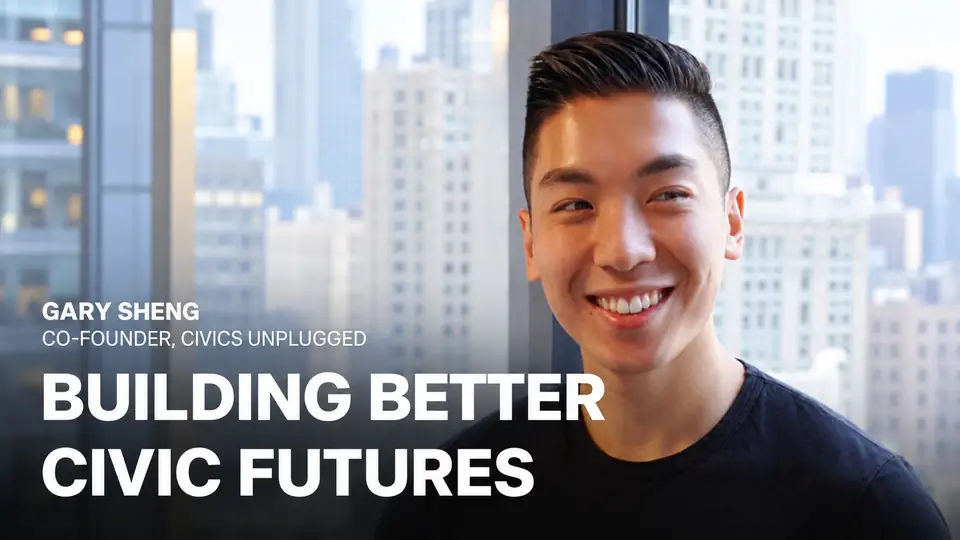
In this conversation, we talk with Gary Sheng, the co-founder of Civics Unplugged. Gary and I connected over our shared belief that this decade, the 2020s, is a make or break for humanity and that we have a lot of exciting work to do. On his end, Gary's working to train a new generation of leaders, committed to universal human flourishing.
Links
Chapters
Times follow the podcast audio. The video’s timeline may be slightly different.
- 00:00Introducing Gary Sheng
- 00:36Independence and speaking up
- 02:24Workplace politics and leadership
- 05:11Institutional trust and cohesive teams
- 07:51Career incentives and long-term thinking
- 11:46Large companies and startup innovation
- 14:01The leadership and coordination gap
- 16:49Networks, cities and coordination
- 18:48Cities as governance experiments
- 20:31Experimenting with a Civics Unplugged DAO
- 21:47Transparency and nonprofit incentives
- 23:50Donor engagement and tracking impact
- 26:31Local projects and visible contributions
- 27:52Motivation and civic participation
- 29:19Public input and voting systems
- 31:54Civic engagement and social expectations
- 33:55Reputation and contribution records
- 37:08Voluntary participation versus coercion
- 39:00Where to find Gary
Read the conversation
Open the full transcript
CAMERON WIESE: Welcome to the Build The Future podcast, where we host conversations that promote positive and exciting visions of the future. Today, we're talking with Gary Sheng, the co-founder of Civics Unplugged. Gary and I connected over our shared belief that this decade, the 2020s, is a make or break for humanity, and that we have a lot of exciting work to do. On his end, Gary is working to train a new generation of leaders committed to universal
SPEAKER UNCLEAR: human flourishing. Let's jump right in.
CAMERON WIESE: This seems to love how to quote, there's only one thing more addictive than heroin, it's a monthly paycheck. Like if you are employed, you have to make sure that what you say and do is not conflict with like your job security because losing a job and not having a source of income is like very scary for a lot of people. So those who have financial independence or whoever kind of make it on their own are not tied are not like as constrained with what they can do and say. And I think COVID unlocked kind of a new new wave of these sorts of people, people who can kind of work remotely, or they can switch jobs relatively easy because they're no longer like tied to a specific job in a specific city. And so part of this kind of like counter culture-less centrist for being simplistic group is kind of emerging out of this like, oh, wait, I actually can say, like, I can speak up now because I have the flexibility to because I'm not tied to my employer in the same way that I once was.
GARY SHENG: Yeah, and of course, there's other, you know, trends that are, are contributing to why people are more comfortable speaking up now, including that the extremes have gotten so extreme, is becoming very hard to like almost like intellectually and morally justify being tightly associated with one side or another.
CAMERON WIESE: Playing off of that, I think it's becoming dangerous not to speak up as well. People are realizing the consequences of where this extreme polarization leads. And inaction is actually contributing to the problem to a certain extent. And so there's certain people who, like Jamal for David Sachs, who have positions in platforms who go talk about the stuff, feel comfortable doing so, actually feel obligated to do so because they see what's going on and where it leads.
GARY SHENG: Yeah, you see how like a lot of CEOs have taken stances about like, we are not a political workplace. Have you seen like Coinbase released a memo that got a lot of press? I don't know, maybe it was a year ago. And base camp did as well. And a similar thing. So this actually ties into the whole current events magazine fiasco as well. Like political extremism, fanaticism, people's addiction to talking about politics, making it like a big deal of in every part of what they do, it actually affects the ability for organizations to achieve their missions. What I sense is that people like Brian Armstrong, of Coinbase and Basecamp CEO, they probably don't have a huge problem with people being like, I'm sure the people that are the loudest were like progressive activists within their organizations. I'm sure they're okay with them doing that outside of work. But just from my experience, and as someone that was very much in that world, progressive activists can make everything about progressive activism.
CAMERON WIESE: So then the mission of the company ends up being like co-opted into a political faith versus like the objective mission of your organization, also.
GARY SHENG: Right, and think about why the CEO has to make, take a stand, right? Because you don't wanna have to make employee spend their social capital saying, hey, John, let's maybe not talk about this activist thing, like when we're trying to get this project released. You don't want like the low level person who is just trying to like build good relationships with the fellow employees and trying to like climb in the organization to burn bridges, just for trying to keep the peace or keep people focused on the mission, right? So, and I think this is what good leaders should do. And I think Coinbase is doing very, apparently doing very well. If you look at their stock price, leaders need to take heat. So I take, I give a lot of respect for those that are willing to do that. in this age where, you know, the base camp guy got so much heat, like Harris, Whisher, et cetera, for banning political speech within his, within his company's company Slack. And whether it's a good player or not, I'm actually very curious, whether it helps or hurts the company's bottom line, I'm actually very curious.
GARY SHENG: But overall, I really do respect leaders that recognize that they have to take on what kind of how politics affects their company.
CAMERON WIESE: We've been living in a world where our institutions at large political, academic, media, corporate have been in control of like the narratives and they've been running the show for the last several decades and COVID revealed like these institutions are actually not well-equipped to navigate the territory of the digital economy in the 21st century. And so they're slowly starting more rapidly, in some cases starting decay, and trust in them is being completely underbought. I think we're seeing that with, there's been some stuff about the corporate training programs at Amex and a couple of big corporations. There's so much infighting and politicking inside these companies that the ship has not sunk, but it's on its way there.
SPEAKER UNCLEAR: Right?
GARY SHENG: I never thought of...
SPEAKER UNCLEAR: Wow.
GARY SHENG: Very few people talk about these controversial employee trainings in a way that as it relates to the long-term integrity of the organization. And I think that's such an interesting thread to pull on. For many reasons, I think the future will be built by small teams of very cohesive people that basically don't waste time fighting with each other, like, you know, political, ideological battles. I think, especially when it comes to software companies, it's never been easier to just have like a group of like five to 10 people and build amazing stuff that millions of people use. And I just think about how Coinbase has gotten to probably hundreds of employees. But like, if he didn't deal with that situation at this stage, he would be really screwed when it could, thousands, right? Because I think he made this like game theoretical analysis that he can lose 10% of his employees by making this decision, right? But it's like the earlier that he made the decision, the better, right? Because then he can just only recruit people that are able to see a difference between politics,
GARY SHENG: inside of work and no politics inside work, right? And so when you think about like a company like Amex, massive global firm, imagine if they took a hard stance against employees like being civically engaged and bring their politics to work. I don't know. I don't know how they would do that without having some kind of really unexpected long-term damage to their employee morale.
SPEAKER UNCLEAR: I don't know, what do you think?
CAMERON WIESE: Well, I think it's interesting because the financial incentives from the market would seem to want to push them in this direction, where it's like, take a stance, otherwise your organization's going to not be functional. But I don't think people are taking a long-term view, and there's so much infighting or so much not wanting to step on other people's toes, because in that world, long-term job security seems to be one of the most important things. If you're at Amex, if you're at Coca-Cola or any of these Fortune 500s, you've probably been there a long time. Or you're choosing to go work with those companies because it provides some sort of stability versus going to work in NGO or a startup or on some sort of frontier. That narrative shifting or that kind of stability thing is shifting. People go work at Uber, they'll go work at Google, they'll go work at Facebook. book, but if there's some something about like, graduate college or go to school, get a degree, go get a corporate job and like stay there, that has not completely permeated like
CAMERON WIESE: the zeitgeist. So people still think that's a viable option. So they go to these companies and expect to stay there and they don't want to put they don't want to step on toes because they don't want to lose their jobs. And like, okay, that kind of got like diverted a little bit.
GARY SHENG: It's interesting, right? Because even if there's two type of person that wants to just pure careerist and just wants to make more money every year, get promoted at a giant corporation or horizontally hop between different corporations. Both are not really incentivized to step on people's toes. This is the problem with giant corporations that almost none of these people actually feel like a deep attachment to the 10-year trajectory of 10, 20. Let's say 10, 20, it just seems crazy in this day and age. But 5, 10-year horizon, how many people are that invested and
SPEAKER UNCLEAR: that compensated to speak up? They're not. I think that's the thing. You could make a case that's not
CAMERON WIESE: really true in tech companies or even startups, but maybe there is a sense of mission there that people are able to latch onto a bit more so than the corporate realm.
GARY SHENG: So I think if the startup hasn't had its like unicorn explosion yet. And if you see that, I don't know if this would be the case in many situations, but like, if you see like a weird employee training preventing you who, let's say you have like 2% of the company or 0.5% of the company and you could get paid to millions if things go well, you are incentivized to speak up versus a random Google employee or even a manager or a pretty high up person. Google's not randomly going to 10x in terms of the stock price. Actually, your salary will multiply faster if you just don't step on too many people's toes. If you're just like a corporate ladder climber, your best bet in making money for yourself is kind of just playing the game, right? Being friendly with everyone that could write nice reviews for you, right? I mean, we already know what, like, I mean, to use Google as an example, James DeMore, James DeMore got fired, right? I don't know what payout he got from that, but I don't think that he was game theoretically
GARY SHENG: thinking about, hmm, I can make more money, like suing Google, and then like, no, like, the base case is that you get, you just get fired or you stagnate at a big corporation for speaking out and saying uncomfortable truths.
CAMERON WIESE: I think that if we, if we can zoom out and think about like the broader implications of this, back to the institutional decay, there's a lot of like uncertainty about big companies like continuing to make decisions that are negatively affecting the rest of the world. It's been this way for a while, but not to like pull too many threads here, like the recent case in Afghanistan, the veil was pierced. It's like, oh, oh, this, this incompetence runs way deeper than anyone thought. And it's like, oh, it's not just our government. It's not just our like academic institutions. Corporations are dealing with the same thing or like the fortune of 500s. And so, while it's not like an immediate rapid decline, people are realizing that that ship is not necessarily worth jumping onto and that there are better ways to go make a difference or have some more of a real impact. And then those companies, like the new companies are being built, will eventually override some of the digressions that these companies have made, or they'll fade into a plane.
GARY SHENG: Yeah, I think there's an interesting relationship actually between these giant corporations like Google, Apple, et cetera, and that maybe they're not innovating nearly as much as they were when they were just in the first few years. But the argument that they provide an incentive for startups to innovate so that they can potentially be acquired is an interesting one to think about because maybe these giant corporations have shifted in the role to society in that way. because like an interesting startup that works in the, let's say, team productivity space, right? This is an interesting acquisition for Microsoft, Google, potentially Facebook. You can really just say any of these, like big corporations. And that boosts the valuations because everyone's competing for the acquisition if it's actually a cool company. And thus, it really incentivizes entrepreneurs that really want to get a payout. So just something to think about that, you know, even if innovation is relatively slower at these big corporations,
SPEAKER UNCLEAR: maybe that's not even the role. Yeah, I think that's an interesting way to think about it.
CAMERON WIESE: While you're saying that, I was reminded of your friends, the All In podcast. There was a conversation that a few weeks back where they were talking about the space race, they're talking about this perception around Bezos and Musk and Chamath, he put forth this idea that the issue in the world today, we don't have an issue of capital. Capital is not a constraint. The constraint is intelligent and effective people who are taking responsibility and being
SPEAKER UNCLEAR: a position of leadership.
GARY SHENG: I completely agree. I love that bit. I listened to it a few weeks ago, I think. I totally agree. And this is why this could sound kind of like bullshit, but it's not like if I had a lot more money, I would still probably be doing something very similar to what I'm doing today. Because I generally speaking, I think there needs to be a lot more extremely competent, ethical, blah, blah, blah people that are working on really hard problems. And there are far more hard problems, then there are people that are willing to do that, willing and able to do that. And so I'm trying to like, play a small part in addressing that gap of people we need and people that we have. Ironically, that itself is a wicked problem, how to address the leadership crisis. But capital is
SPEAKER UNCLEAR: not the issue, which is I don't, I don't think that's not obvious to most people.
GARY SHENG: Right. It's not obvious to us. A lot of people just think it's a matter of pouring money into projects and things will be solved. No, it's like, to me, it's like there's serious talent issues and coordination issues. I think those are thought experiment, right? You have a bunch of leaders that are really awesome people. They think really clearly, let's say they're terrible at coordinating with other leaders, right? There's going to be clear deficiencies in our ability to address the modern crises that are so interconnected. So it's not just like we need better individuals, it's like we need better ways of coordinating those individuals. Let's call them one problem. We need to create a global network of leaders that are really able to solve hard problems together. And I think a lot of people are trying to figure this out, but in my experience, it's been being in those sort of circles. It's like people over their 50, like over the 50s, very, very male and very white. I am very cautious of adopting like a very pathological identitarian mindset,
GARY SHENG: but truly the lack of investment in young people to be thinking in this way is terrible.
CAMERON WIESE: One bright light in all this, and I want to have you kind of expand on like how about the addressing of the development of the next generation around this theme. But the question on coordination, you know, 10 years ago, how do you start to do this? But, you know, technology breeds solutions and it breeds problems. Twitter has caused lots of like interesting challenges, affects lots of people's mental health in an initial way. It makes us like all very, at least a lot of people very anxious, but it enables the finding of your tribe And finding people who share some ideas of some more values, you can tap into these networks. You can begin to kind of coordinate solutions to these problems. Vologee, Freedom Boston has a bunch of like writing on this, particularly when it comes to like how to build like a network, like the network state, and how that affects the development of new cities moving forward, people can coordinate online, people share their values, They can use that group as leverage to then go get a city to be willing to accommodate that group of people.
CAMERON WIESE: So they do all the coordination happens online on social media through these centralized protocols and then transfers from the physical world. So it's like the physical world is like the last piece of this puzzle of how do you actually build a new city or build a new country. And then in those places, we can kind of experiment with different sort of governance mechanisms, policies that, at least in my opinion, are going to be the unlocking mechanism. The mechanism unlocks the next wave of innovation. Because given the state of the system right now, the incompetence that we're seeing across the board in our institutions, we just can't get anything gone. And we have to override that somehow, it seems like, local level coordination may be the trick.
GARY SHENG: Yeah, I mean, so throwing out some concepts here, you know, charter cities. Yeah, like Mark, Mark Lutter's work on charter cities is interesting. I just think that like, in theory, we have a lab. America is a laboratories of democracy, where all these cities are competing with each other for citizens competing about what ideologies and like practiced ideologies work better. Ooh, this is interesting to talk about. It's like, why hasn't that really been that effective? Because our political discourse is so grossly like noisy. noisy and anytime a city has some success. The reasons for that is there's so much noise explaining what there's constant propaganda, right? But you can't really make sense of why a certain city or state succeeded. It's very challenging, right? And, but if there's a charter city that no baggage of its history. And it produces all these innovations and whatever they define as a quality of life, it's hard to deny that you should listen to those people that lay that foundation. I think crypto and blockchain is incredibly important for the future of civilizational
GARY SHENG: development because so much of why we are not able to coordinate effectively is because there's not a lot of transparency about how decisions are made and people don't feel like they have sufficient amount of power. It feels like it's not clear that the people that have power have a good reason to have power. We haven't gotten enough opportunities to rapidly experiment with different types of governance structures. And so this is why DAOs are really interesting because there is no one way to run a DAO, it's just code. And so we're actually, one thing that's really exciting about what we're doing the rest of the year in Civics Unplugged is running our first experiments with a Civics Unplugged DAO. We're working with some of our friends at the Ethereum Foundation and thinking through how we can help our community of practice that runs decently without this sort of governance coordination, accounting support that is afforded by a potential DAO, but we wanna see if this can just supercharge our ability to do what we wanna do as an organization and help our individuals in the organization
GARY SHENG: achieve their goals. And the reason why this is interesting to our friends at the Ethereum Foundation in that space is because crypto has so far been dominated by people that, it's basically a way to get lambos, right? It's just like how many DOWs are really just, the vast majority of who they serve are just people that want to get paid for something versus-
CAMERON WIESE: It's like hyper-financialized right now, but I think what we're seeing, kind of what you're alluded to is like, there's actually a lot of like greenfield here to experiment with how organizations run and how we incentivize organizations to actually achieve specific outcomes. There's a lot of nonprofits like alleviate homelessness or whatever, and they actually don't have an incentive to go do that. But if you set up the organization to be structured a way where the reward is based on the outcome that was set up, there was a strategy like, oh, maybe we can get there. That's perhaps
SPEAKER UNCLEAR: a pretty complex example. But...
GARY SHENG: No, I think it's a good one. And I can see that in the coming years, hopefully, thanks to a lot of experimentation and thought leadership of Civics Unplugged, etc., there just becomes a new standard for what types of organizations donors donate to. So think about, I'm idealistic about this idea that we can really improve the whole nonprofit space by creating organizations that are so much more transparent and effective than and other organizations because of certain tools, platforms, processes that they use, that donors come to expect this as like a given or they won't give them money at all. I think that this goes for most technologies, I would imagine, organizations that are really comfortable with a certain stack, don't wanna change the stack that they use unless they're kind of forced to because the market or in the case of nonprofits, donors are saying like, if you don't adjust to this, I'm giving all my money to civic supply.
CAMERON WIESE: Yeah, this is sweet because it means that once again, this transparency and these new mechanisms of financing will unlock a new wave of innovation in nonprofits. So more work will actually, more problems will get solved because the organizations that are comfortable with the status quo, with their stack, they don't want to change, are going to go away because people are going to stop giving them money.
GARY SHENG: The vast majority are just going to go away. Look, I didn't know anything about nonprofits three, basically two and a half years ago. And I've gotten to know a lot of program managers and former program managers at different nonprofits. A lot of nonprofits don't do Jack. I think, look, Civics and Plug can do a lot more than what it's doing right now, but like we're trying, right? We're actively like we can do better and this is why we're gonna experiment with a DAO to help us coordinate and track things a lot better incentivize people more. But COVID really, there's probably already like a massive graveyard. I'm not like celebrating this, but this is what happens, right? COVID was a huge disruption to so many nonprofits who were not able to adapt. And a new generation of nonprofits already that were able to survive the pandemic are kind of raising the bar for nonprofits. And I think maybe one of the next standards for nonprofits was related to how transparent the organizations run and how engaging it is to be a donor. So imagine like your activity as a donor is tracked on chain.
GARY SHENG: It's like your donor membership resume is tracked on chain natively. And so just ideas that we're throwing around for our DAO is kids are proposing projects that they want funded. What if the way that you fund it is like an NFT exchange? And it's like, you're not doing it for the NFT, but the NFT is just a way to track that you believed in this young person before everyone else, right? So a great example that I like to bring up that my co-founder brings up is he knows like a dozen people that apparently threw Obama's first fundraiser. So think about if it becomes a common expectation that donors at like dinner parties and stuff are comparing their like donor like resume. And so you're collecting all these NFTs from different forward thinking nonprofits that know that this is inevitable, this is the future. And that, you know, just one-off stories, oh yeah, I was an early backer of this nonprofit. It's like, show me the proof. So it just becomes like a common expectation.
GARY SHENG: Exactly how the culture changes very fast, it's really unclear, but I think it starts with nonprofits creating such a next-level experience for the donors that they're just like, whoa, why these other nonprofits I'm on the board of, like, you need to step the fuck up. Otherwise, I'm going to spend a lot more time in Civics Unplugged.
CAMERON WIESE: It's interesting because then it becomes a status game for the contributing nonprofits is already a status game for like ultra wealthy. It's like, oh, I'm giving this.
GARY SHENG: It really is like you're trying to one up each other at the dinner parties.
SPEAKER UNCLEAR: Yeah.
CAMERON WIESE: And if you can like prove, if you can give people like more and more insight or granularity into like the people that they support and your organization's support and the outcomes of those organizations, it's a lot cooler to invest in or to like support or back Civics Unplugged because you guys are doing X, Y, and Z versus Meals on Wheels in San Francisco that hasn't been doing anything different for the last 50 years. I'm just saying this and I'm not saying that's not something fun.
GARY SHENG: But also if Meals on Wheels really adopted new age technologies and you could see your donation actually impact, you could see exactly what people that were fed. you can see the tree of your impact from your donations. That would be really addicting.
CAMERON WIESE: You can set up organizations in nice little prizes in a way to just incentivize solutions much better than you can now. Imagine XPRIZE, but for your local community, like, hey, this street is messed up, like this sign needs to be replaced, boom, hey, community is gonna gather, everyone's gonna put $5 in, and whoever wants to fix this can go solve it, like, it's a proof of work, right?
GARY SHENG: Right. And so it's kind of funny that this is not as common as it should be. The CFX on Plug team is very blunt about human nature, very clear right about human nature and what donors want. And a lot of this is through trial and error and being like surprised or disappointed in, you know, some like, well, we thought so much about like, in an idealistic sense, oh, what would a young person want to do? It's like, okay, yes, they want to who develop themselves, blah, blah, blah. They want to be part of something cool. They want to have fun, right? And that also actually applies to donors. They want to be part of something cool, fun, and that they can name drop cool people that are part of it. This is like base level instinct. So you gotta speak to that. So if there's like a pothole that needs to be filled, and if I donated like whatever amount of money and I get to have a part ownership of this NFT or something that was related to filling the pothole. That's cool, especially as adoption of crypto explodes, where it just becomes commonplace
GARY SHENG: to put in your link tree or whatever, like your NFT collection, or maybe especially your civic
SPEAKER UNCLEAR: NFT collection. Then we see re-engagement of local civics, especially when you pair them with
CAMERON WIESE: microtasks. It's like people can on local street money and prizes to go like fix things and solve things. For example, or even like voting, right? Imagine like what a new like voting stack might look like for a city where they want to experiment with like, hey, we want to do a digital voting platform. Everything's on chain. Like what's preventing cities from like actually implementing something like that and enabling their citizens like track the policies that they vote for and like the outcomes of such policies. There seems to
SPEAKER UNCLEAR: a huge gap in that space as well. That is super interesting. So there's practical reasons why
GARY SHENG: voting for elected officials will stay paper ballots for a while, at least. I think so because majority opinion about distrust of also a lot of experts are very sketched out about entirely internet-based voting. You can almost jumpstart. I totally agree, right? So also, like, if you create platforms that help policymakers make better choices, like in Taiwan, they have all sorts of, like, civic voice engagement platforms. So, for example, when they wanted to figure out exactly how they wanted to regulate Uber, they asked the public. And so they, then they were able to to figure out where public sentiment was and have actually like interactive comment periods. I'm really like simplifying this, but the public was very happy with their ability to shape public opinion. And the policymaker was grateful because thinking about it from the policymaker side, theoretically, policymaker should want to get reelected by being a good representative, like a authentic representative of the people. Also, if you are able to point to how you made the decision
GARY SHENG: in that it was based on people's actual opinions, like a representative group, no one can blame you for just listening. You know what I mean? Think about just a leader of like a startup. If I personally disagreed with the leader of that, I was an employee, I disagreed with the CEO's decision, but I knew that most of the company was on board with that decision, I would be less annoying about it. Because I'm just like, you know what I mean? But I think that sort of data that, and also ability to share your opinion about a lot of different things, which is beneficial for the constituent and the policymaker or the leader, the fact that there's not more opportunities to help both sides is kind of
SPEAKER UNCLEAR: ridiculous.
CAMERON WIESE: Oh, I think this is like we're in a moment in time, which is very, very special because like nobody cared about who their their mayor was or their governor was up until COVID because they're realizing implications of like their state government. And I'm hopeful that people are going to be willing to get more involved, the more engaged on their like, in their community politics, because yeah, they actually was like others, it does actually matter.
GARY SHENG: I think it's hard for people to intellectually disagree that local politics matters. Again, going back to being very blunt about human nature, I think there just needs to be a way for your local civic engagement to be tied to your social status. Honestly, something related to your reproductive success. I'm being super blunt here. But why do a lot of people put their crypto punk as their profile picture? Social signaling. I'm rich. I'm in the in-group. I'm forward thinking. If it becomes a common expectation that anyone who's anyone, anyone who's anyone is collecting all sorts of NFTs that are associated with real helping local communities, and you didn't check that box. I look at your civic NFT collection and it's like, Bear, I don't want to work with you. It may not be that I don't want to work with you, but I don't want other people to know
SPEAKER UNCLEAR: that I'm working with you.
CAMERON WIESE: Because there's this transparency that gets revealed around how you contribute to your community and to your company and to the organizations you're a part of. And then it's like, because right now there's not a lot of insight into it. You're like, oh, hey, I worked at this nonprofit. I worked at this company if I did this thing in politics. Nobody actually knows what you did, but if you can anchor that to concrete, I work on this project or this thing, then people hire you based off of that. It's like the new credential. It's like the projects you've been involved in,
SPEAKER UNCLEAR: they're tracked on chain.
GARY SHENG: Right. I think a lot of people, what a lot of people don't admit or maybe they don't fully realize is that they probably don't really trust what people say about themselves on their LinkedIn. I think we are just like we're going to expect a lot more from nonprofits and how they report and how they track their impact, right? I mean, an individual is just like in its own way, like a corporation, right? Like if you're looking at like five different people that you could be co-founding a company with, and almost everyone has adopted this new best practice of tracking their civic and otherwise contributions to the world on chain. And another person looks impressive on paper, but they could be embellishing the hell out of it, you're probably gonna go with a safer bet that the other options, right? So this is really cool because what are some kind of insights from those conversations. Some of them include like, let's be blunt about human nature and design systems. And it's not just best practices. It's like a common expectations.
GARY SHENG: Right? So like, it was sort of like an unspoken thing. But like, but, and I haven't been on the dating market, but like, it's really hard to date without a good Instagram. I'm not going to define what that means. But if you're a dude, girls will look through, I think probably both ways, I'm not saying it has to be just man to woman or, you know what I mean? Just people that are dating, young people are dating, are looking at your Instagram. Often they're looking at your LinkedIn. And again, human nature, this social signaling for reproductive success. And it's like, at the end of the day, like subconsciously you're so influenced by that. We're not gonna create this like critical mass of local civic engagement through just intellectualizing about it. Cause I try that, everyone's trying it. What the last 200 years or just ever since America's founding, people have been writing books about the value of locals of engagement. It's not a matter of like listing out like, bulleting out reasons why it's valuable.
GARY SHENG: It has to be like a common expectation that anyone that you associate with that claims to be high value is tracking their contributions on chain and they are, they have, it looks sick because of just how frequently they are contributing to their communities. and how it really explodes is people competing over how much good they're doing. Right now, that's not happening. Right now, it's happening in very perverse ways. It's happening in ways that like you're tweeting like extremely divisive stuff that may get tons of retweets, but it's contributing nothing to like collective sense making. It's contributing very little to, if at all, to people's human flourishing.
CAMERON WIESE: We can do another one. He's very riff on the inverse of this concept where this is like, how are you engaged in your community is almost like a social like credit system. And what are like, what's like the opposite? What's the inverse of this look like? Cause it's like, Oh, that sounds sick. But it's like, Oh, wait a minute. This is, this is tracking everyone's contributions.
GARY SHENG: Why don't we touch on that briefly right now? So there's, I love this cause you're pulling out things that I've just at various points in the last year and a half I've been thinking I've thought a lot about. So I'm optimistic about America's future if we continue to be a country that centers on liberty and volunteerism. Just like where you're not forced to do something, right? It's it's like culture that is shaping people's behavior. And ideally the culture is getting better and better at incentivizing people to support their own flourishing in the flourishing of the world around them. The other model is a state directed like social credit system where you're actually, you're not able to ride a train if you didn't pick up trash every week, something like that. And so yes, we should be afraid of systems that coerce people into doing things. But I also think that that's just long-term that it's a lot easier for a corruption to infect top-down systems, I think history is littered with examples of that, right? Versus what we wanna see in the Liberty American side
GARY SHENG: where systems are, it's more like giving you credit. Oh, sorry, well, social credit. No, it's like, it's in the same way that you would just voluntarily adopt using Instagram instead of like being forced on you.
CAMERON WIESE: comment, where can people find you when you want to plug TikTok, website, Twitter, Instagram?
GARY SHENG: You can go to my website, GaryShing.com to learn more about me. On my website, I say, feel free to connect with me on LinkedIn. If you want to just like, stay connected so we can be aware of each other's journey, and maybe work on something together.
CAMERON WIESE: This is awesome. Thanks for coming on.
GARY SHENG: Awesome conversation. Dude, thanks for, thanks for making the time and excited to see what
SPEAKER UNCLEAR: we do together. Thanks for joining us for another episode of the Build the Future podcast.
CAMERON WIESE: If you want to support the show, please share your favorite episode with a friend. If you want to get updates on the events we're hosting, new podcast episodes, and follow along as we build the new World's Fair, you can follow me on Twitter at C-A-M-W-I-E-S-E. Until next time,
SPEAKER UNCLEAR: go build.
SPEAKER UNCLEAR: you
More episodes
All episodes Aaron Slodov — Atomic Industries and the Future of ManufacturingAaron Slodov and Cameron discuss how policy influences the adoption of new technology and how AI might support public decision-making.
 Laura Crabtree — Epsilon3 & Space ExplorationLaura Crabtree reflects on her time at SpaceX and explains why she founded Epsilon3 to support complex engineering operations.
 Pat Riley — Bitcoin & FreedomPat Riley connects his interest in Bitcoin with questions about freedom, community and the kinds of futures people want to build.