

Build the Future Podcast
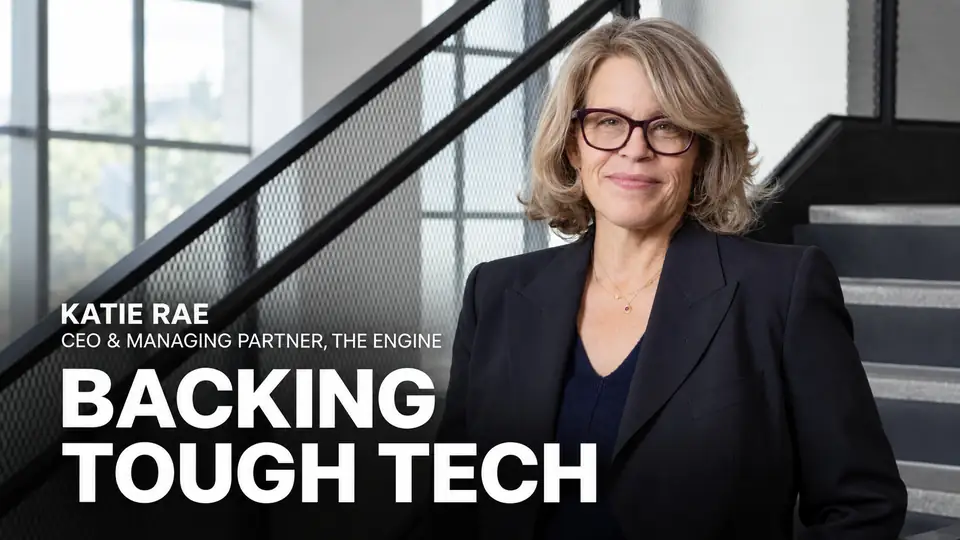
Katie Rae — Building an Ecosystem for Tough Tech
Katie Rae outlines The Engine’s 2020 approach to supporting tough-tech founders through patient capital, shared facilities and community.
September 29, 2020 · 28 min



About the episode
"So the question was, could we create a community and a venture capital fund that would inspire people to stick to these really important. But tough technologies, right. Ones that could stand the test of time, but take capital and know how and deep knowledge in order to be able to actualize."
In this conversation, we talk with Katie Rae the CEO and Managing Partner of The Engine which is a venture fund in partnership with MIT that's building an ecosystem to support the development of tough tech companies.
We talk with Katie about building a tough tech ecosystem, science vs. engineering risk, and whether or not Katie agrees that we're in a period of stagnation.
Links
Chapters
Times follow the podcast audio. The video’s timeline may be slightly different.
- 00:00Welcome and introducing The Engine
- 02:18Why create a home for tough tech?
- 04:56Labs, partnerships and a founder community
- 09:18Engineering risk, science risk and patient capital
- 13:19Are we really in a period of stagnation?
- 15:49Optimism and making progress
- 18:53How communities nurture founders
- 21:05Helping founders grow as leaders
- 24:36Technologies and people worth backing
Read the conversation
Open the full transcript
CAMERON WIESE: Welcome to the Build the Future podcast. My name is Cameron Wiese, and I'm your host. I've always been fascinated by the ideas and sentiment that drove American culture in the 1960s with the space race. A culture of possibility with a mission to build things, and I quote JFK, not because they are easy, but because they are hard. It's this culture that seems to have been lost, and it's something that we want to bring back. With Build the Future, we're here to promote the ideas of those who not only see how the world can be better, but those who have plans to get there. It's our hope that these plans inspire you to think about the future you want to live in and create plans to go build. Today, we're talking with Katie Ray, the CEO and managing partner of The Engine. The Engine is a venture fund in partnership with MIT that's building an ecosystem to support the development of tough tech companies, i.e. companies truly building the future. I'm excited to have Katie here with us today. Katie, welcome to the show.
KATIE RAE: Thank you so much for having me.
CAMERON WIESE: Can you tell me about what's going on at The Engine? What's the future y'all are working towards? What's the vision?
KATIE RAE: Yeah. So we were born out of MIT and the president of MIT and the whole leadership team there was watching PhD undergrads coming out and feeling like they could not start the kinds of tough tech companies that they'd studied and worked so hard for because there was a lack of capital, a lack of a community. and so that a lot of hopes and dreams were dashed. And I think everyone sat around and was like, that is an exceptional tragedy and we got to fix it. Because, you know, if you think about, you know, the world's leading chemical engineer grads or biological engineers or physicists going to code, for ad serving, that is like the most depressing thought you could ever have, right?
SPEAKER UNCLEAR: I know. It breaks my heart.
KATIE RAE: It breaks everybody's heart. It's silly. So the question was, could we create a community and a venture capital fund that would inspire people to stick to these really important, but tough technologies, right? Ones that could stand the test of time, but take capital and know-how and deep knowledge in order to be able to actualize. So things like true cold fusion, or how do you grow more food for the world with less resources, or how do you solve these really big disease states? You know, how do you create infrastructure that doesn't need carbon, right? You know, all the energy companies are, or how do you decarbonize almost all our industries? These are really important big things that don't just get solved with software. They require a real knowledge of the fields that you're coming out and often a convergence of multiple fields.
KATIE RAE: And so the engine is a home for top tech founders. It's a place where people with incredible ambition and knowledge that want to grow a company that could take one of these worldwide important problems or opportunities, however you want to see it, and transform it and transform an industry with their creation. or product. And it is more fun than I've ever had. Challenging, fun, meaningful. And our aspiration over the next 10 years is to back hundreds of these types of companies that are inspirational to the world, inspirational to the next generation of people coming up, inspire them to learn, and really dive into STEM, but also society, right? How do we make society better and bigger and the world more connected in a positive way? A cleaner planet, you know, other, it could also be like that we know how to get to other planets. That would be fine.
SPEAKER UNCLEAR: Yeah, it'd be great.
KATIE RAE: Yeah, it'd be great. But let's do things here that are important. And so that's what the engine is up to.
CAMERON WIESE: Incredible. Not big things at all. Can you tell me a little bit about how the ecosystem is set up? If I understand correctly, you have the fund, and then there's the network, and then there's the infrastructure to help these founders prove out some of the engineering or the technical risk. Can you just talk a little bit about that sequence?
KATIE RAE: So this beautiful partnership that the engine has with MIT, I think the thought that went behind before we even launched was, what are all the things that if you could cluster a group of tough tech founders together, what are all the things that would either accelerate the timeframe to market or reduce the capital needs for the entire group of startups? You know, what could we do in this partnership with MIT? And MIT is a pretty unique place in the world, right? So what we set up, what we decided was they needed a place to actually build the product. So you need labs, makerspaces, et cetera. You know, wet labs, either bio or chem, benches to assemble, all that's electronic labs, blah, blah, blah, right? All that stuff.
KATIE RAE: You cannot do these kind of projects without a convergent set of labs. Then, because that reduces the cost for everybody, it also puts a group of people working in close proximity on very different companies where they can all help each other, right? So that's kind of infrastructure. Reduce the cost, increase the knowledge base in the space. The network is both this huge MIT alumni base, but also a set of corporations that have deep interest in collaborating with startups, lots of different government agencies that also want to see these pieces, these companies commercialized. And so we try to bring a very dense network of investors, collaborators, experts, and government people that could all pave the way to establish these new industries.
CAMERON WIESE: it's great because you're you're providing the community providing the resources and i think the other thing that people often overlook is the the value of the corporate partnerships because those institutions have capital but they're they're constrained to their their quarterly earnings reported to their shareholders but they want to be playing a role in fueling the future
SPEAKER UNCLEAR: of whatever's being built that's right and and often they have deep expertise within their corporations. And it's exciting to work with a startup, right? I mean, it's a different energy. It's a different way of looking at the world. Who knows? They might invest. They might have a joint venture. They might buy the company. I mean, there's all kinds of things that come out of that. But I think it's good for both the startups and the corporations. We try to set up everything so that it is mutually beneficial. Yeah. Especially now that we don't have the,
CAMERON WIESE: like in the 60s, 70s, you had like the corporate research labs that we've kind of seen dwindled away. And it seems like the engine is almost like a external research lab that
SPEAKER UNCLEAR: these companies can support and get involved with. You know, I hear you. I would characterize it slightly differently. So we back people that want to found and run their companies. That's one of the things that we think is so special about the people that we've backed. is that their ambition is enormous. And it's not to say that they'll all end up as an IPO. I'm not saying that. That's statistically probably not sane for me to say that. But we definitely want to back people that see themselves someday running an enormous business. Because if they do that, they've probably had the impact that they want to have. And so that's just how we see it is like, we want to build their capabilities, connect them to the right people and see them grow
SPEAKER UNCLEAR: into world leaders, basically. Love that. Love that. I want to dive into a little bit more, but quickly. Two of the main questions that come up when people think about funding these sorts of tough tech ventures is like, where are you getting the capital from? And traditional venture capital has a fun length of seven to 10 years, which means they need to have returns with a certain window. If my understanding is correct, there's two unique things that y'all do. One is set up milestones that kind of help prove out that like reduce the technical risk, and then allow for these companies to then go take on follow on capital. Once things have been proved out a experiment and explore without the pressure. And then two, the fund length at the engine is 15 years. It's longer than venture capital, right? Yeah. It's 12 years with possible
KATIE RAE: extensions from there. Yeah. So a longer time length, up to 18 years. Not that we want all the companies to take 18 years and they won't all take 18 years. But if you don't have the time for a super ambitious play, then you're never going to back a company like that. So you have to have a slightly longer time frame. And you also have to think about, is, you know, we can only back things that could be enormous companies. And so those are the kind of swings that you have to take. and but I think everyone funds to milestones I think and you know when we think about companies that we're going to back you know everybody thinks of it as moonshots or you know oh it's just experimentation it's just R&D actually it's not that happened at MIT or Harvard you know that happened in the lab at the university. What we're backing is the difference between the university benchtop and engineering. So we are funding engineering risk. So they've proved something at the university scale, and now we're going to try to engineer it. So like with Commonwealth Fusion, they theoretically proven with the material that they were going to use for the magnet that it would work. That is the point in which now you're funding engineering risk,
KATIE RAE: not science risk. And that's the point that we jump in. And because we think the universities are really good at the scientific risk, the US government almost always backs scientific risk, right? That's the role of government. But we can start to back engineering risk. And then your second part of your question is like, well, where do you get this capital? Who And there are a lot of, we call this the capital stack. Like what's the capital stack around what we think of as tough tech ventures? And it's not exactly the same as software ventures, right? Because you have a much deeper bench of government, corporate, and even philanthropic backers at points. So someone like the Gates Foundation or the Schmidt Futures, right, really might look at backing some of these companies early because they meet the goal of where they want the world to go. And so you have this confluence of types of capital and there's other venture capital funds. So, you know, there are only a few that will back technical risk, but then we continue to partner with venture after that.
CAMERON WIESE: Ah, very cool. Those are good clarifications. Thank you. I want to make sure I have a proper understanding of how the model works, how everything's going on over there.
KATIE RAE: Yep. I wouldn't expect you to know all that. How could you? But I just thought I would clarify.
CAMERON WIESE: No, no. I appreciate it. It's good. That way I've updated my mental model. One of the friction points in founders deciding to go start these tough tech projects is not necessarily having an ecosystem that's supportive to them. If we zoom out though, there's a lot of discussions in certain tech circles that in the world of atoms, things have slowed down and there's people attribute that to, you know, low-hanging fruit's been taken, there's institutional and cultural decay, there's reverse incentives, there's regulation. I'm curious, do you believe that we're
SPEAKER UNCLEAR: in a period of stagnation around these sorts of things? You know, from my seat, no, not at all. I think we are in one of the most incredible times of true innovation, true change. It's disruptive. Like, just look at COVID and climate change and, you know, all the stuff that's happening around race and equity. And we are churning on five different levels right now. But in that is a massive opportunity to change society, to change who has access to big dreams, who gets to dream, who gets to execute on those dreams. We are going to be pushed to deploy technologies in ways that will save cities and change how we live. Like we must decarbonize our atmosphere. Like there's just like, we don't really have a voice at this point.
KATIE RAE: We got to do better than slow things down. Or think about, I mean, the extension of human life. We're already living that, but we also live with a lot more disease because of that, because we don't just drop dead. so extending how well people live and how long they live another super important thing right and and our connectedness matters too right how we get information to each other and do we do that in ways that help us solve big problems or do we do it in ways that are selfish this is this is we have this moment right now where these things are all tossed up in the air and let's go at it.
SPEAKER UNCLEAR: Let's create that future we want. I completely agree. What do you think people are missing? Is it just this popular opinion to be pessimistic? Well, it's really interesting. I think it's
KATIE RAE: confirmation bias and tribalism, right? So if you just look at how people talk to each other today, right? We all want to talk to people that we agree with. And, you know, this is playing out in politics. And that, in my mind, sets us in these negative cycles where we don't move forward and we just fight each other. It's kind of this equal fight that just stops all progress. And so when I think about the entrepreneurs that cut through that, they don't let that stop them. They say, great, how does the world need to shift so that I can make that happen? And I think when it's framed in a positive way, where it creates a better world, creates jobs, creates security, creates all kinds of things.
KATIE RAE: I think people get on board and it's, you know, it becomes a movement to get that done, right? And so that's what entrepreneurs do. This is why I spend my time with entrepreneurs working on really big problems because they do get the world to draft behind them. And that is the purest form of leadership, right? And so that's what breaks the logjam and pushes us forward. And I think in these really tumultuous times, leaders are born from that. So that's, I mean, we're watching it on all kinds of levels. And so that's why I'm super optimistic. Even though like, you know, I could spend my day looking at like, oh my God, San Francisco has a red sky and it's two in the afternoon and fires are raging and COVID is everywhere and everyone's dying. But that really would just stop me from actually trying to make progress. So you have to set your goals and make progress to them.
CAMERON WIESE: Yeah, absolutely. There's this belief that I hold, which is if you're trying to do something impactful or something big you have to shed that which does not serve you and so does it really make sense to worry about the sky being red at 2 p.m no because it's out of your sphere of influence like you can't control that what can what can you control oh i'm going to show up i'm going to i'm going to go make those calls or i'm going to send those emails or i'm going to do this research i'm going to go take this plan this definite plan that i have created and i'm just going to execute on it Dandran, you're wanting to fund the next 100 companies and hopefully more. How do we get more founders to go build tough tech?
KATIE RAE: Yeah, I mean, I think there are a lot of founders. I think it's incumbent upon the communities that they live in to both nurture and push them, right? to lead with yes and honest feedback, right? That's the trick in all of this is that, you know, any entrepreneur gets a thousand no's to every yes. And, but the communities that nurture the great entrepreneurs, there's a lot more yeses. They get a lot more yeses and they get a lot more people who can, ask hard questions, not answer the questions, but ask the hard questions that push them further. And in their thinking, but it is born in optimism that that set of humans could get that done, right? And so that's, it doesn't take that many people in a community to shift it from being naysayers to builders. And so I think it is that mentor community or those that have built before to nurture the next generation. It's imperative. That give back is imperative. And, you know,
KATIE RAE: if you talk to entrepreneurs, that is so natural for most entrepreneurs to want to give back because somebody gave to them. They feel it viscerally. And so it is that cycle that you try to tap into. It's why places like MIT are so incredible, right? There's generations of great tough tech founders who are professors or alums and they will continue to help the next generation.
CAMERON WIESE: Yeah, really contribute to the ecosystem that's going to drive everything forward.
SPEAKER UNCLEAR: That's right.
CAMERON WIESE: When you talk about the work that the engine is doing to help support those founders, you mentioned building their capabilities and leadership is one that I think is very important. Can you tell me a little bit more about the way you go about developing people and helping them grow into the leaders of eventually these big world changing companies?
KATIE RAE: Yep. Number one way, believe in them. Believe that they have the ability to grow. I mean, that's just a period, end of story. And that is so fundamental. But I think so often people get worried and they get, you know, there's a lot riding on the line, right? There's your reputation, oh, you back this person. And that gets us all scared and nervous. but I think the right thing is to believe in them. And again, be super direct when you need to be about what you see. But I think that it's what I expect in all my close relationships, right? I expect that of my best friends. They're going to love me, be my biggest cheerleaders, but also tell me exactly what they think and give me feedback.
KATIE RAE: That's exactly what you do with all the founders you back. And I think the tricky part is when can somebody hear feedback? And that is hard. There are many ways that you go in and have to go in because people listen in very different ways. and so we just try to have skill in being able to have the conversation uh and by the way no one's perfect at these conversations but the the primary thing is believe in them the second is really have conversations about it their team building how they're doing who they're reaching out to how are they building their network what are they learning? What do they think their flat spots are? How do you build into those flat spots? How do you get, there's no silver bullet here. This is all intention of building them into big leaders.
KATIE RAE: And so we do a lot of stuff around how do you pitch your vision even bigger, right? Of course, these are, there's nothing new in that, but we try to put time into that and really help our founders be able to project what could happen if they succeed. And that work's important. It's storytelling, it's inspiration, which helps them find employees and investors. And you're always inspiring. That's how you build great companies and change in the world. So that's how we think of you.
CAMERON WIESE: Yeah, you have to paint that compelling vision of what things could look like. the CEO of Boom Aerospace, Blake Scholl, has this great, great line where he's like, what would you build if you were guaranteed success? I think it's a beautiful way of framing it. It's like, oh, I should aim bigger. Oh, I should aim much bigger. And then I should aim bigger than that because if it's going to work out, I should take as big of a swing as I can, which I think is just really like a cool framing of the problem.
KATIE RAE: It's an awesome way to see it. Because you just free yourself of all the anxiety. You know, it's like, just imagine you're going to succeed.
CAMERON WIESE: What are some of the high impact projects that you're most excited about that people are currently working on?
SPEAKER UNCLEAR: Well, I mean, I'll just give you a few that I work on very closely. So Commonwealth Fusion, which I mentioned before, they are doing, you know, a next generation Tokamak system for doing net positive energy production, zero carbon net positive energy. Bob Mumgard's the CEO there. I think he's one of the most exciting entrepreneurs out there. He has pulled together an incredible team. and they are executing every day at very high levels. It's extremely inspiring work. And so that's one. Another one here at the engine is called Seleno Bio. Nabiha is a force to be reckoned with in the world. She's a physicist by training, PhD physicist by training. she's building a company that I think will be transformational to all different types of disease and combining biology and physics basically and what are some that you may want to see started so there's a there's a lot of hope around carbon capture we haven't backed one yet there but we definitely would we think there's a bunch of stuff in agriculture to make it much more efficient I'm not just talking about meat. There's all kinds of ways that we can feed the world better
SPEAKER UNCLEAR: and more efficiently. And so we look at many different areas there. We look at, I mean, we have barely cracked the code on biology, right? We're still in early date. And so there's so many exciting areas there that we look at. But I think the good news for me is that I'm surrounded by some of the world's smartest people who are thinking about what are the big areas to crack. So I don't have to be the inventor. I just have to back them.
CAMERON WIESE: Support them. Yeah. What's your last question I have for you? What's your why? Why are you excited about the work
KATIE RAE: you're doing. Why am I excited about the work? It's all about the people and what their impact could be. So for me, why do I get up in the morning? It's because I'm motivated to help the entrepreneurs way back. I think it's fun. I think they're doing extraordinary things. I think they deserve to be supported in an extraordinary way.
CAMERON WIESE: Thanks for joining us for another episode of the Build the Future podcast. If you want to learn more about the engine, you can head on over to engine.xyz or follow them on Twitter at enginexyz. Lastly, if you're building and want to get support, want to hear about specific topics or hear from certain people, shoot us over an email at hello at buildthefuturepodcast.com and we'll see what we can make happen. That's it from us. Until next time, go build.
More episodes
All episodes Rahul Rana — Making Moonshots and Building the FutureRahul Rana on ambitious founders, Making Moonshots and the work behind difficult technical projects.
 Ian Rountree — Venture & the Near FrontierIan Rountree on backing hardware, biology and technologies at the edge of commercial possibility.
 Rohit Krishnan — Investing in the FutureRohit Krishnan explains how he approaches venture investing when data is sparse and the future is uncertain.