

Build the Future Podcast
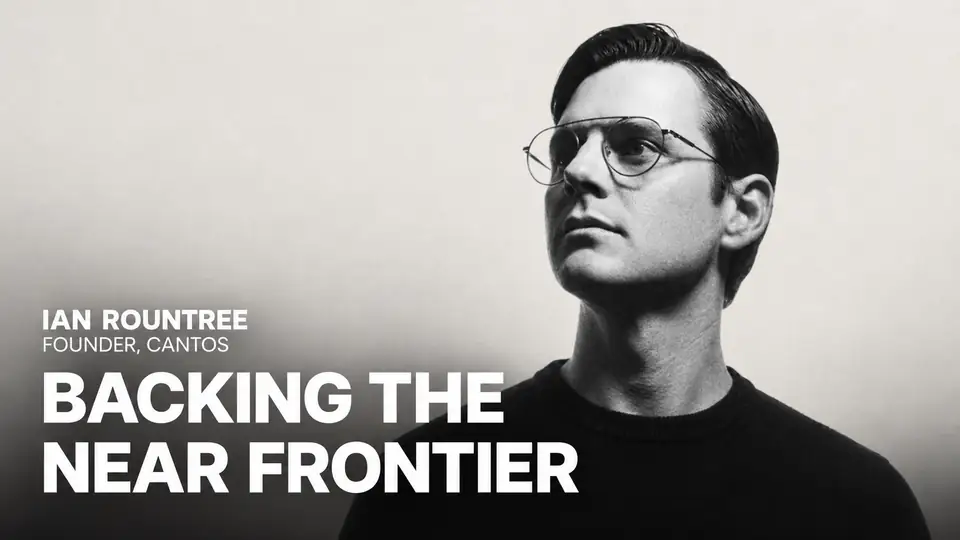
Ian Rountree — Venture & the Near Frontier
Ian Rountree on backing hardware, biology and technologies at the edge of commercial possibility.
November 5, 2021 · 46 min



About the episode
In this conversation, we talk with Ian Rountree the founder and partner of Cantos.vc, a venture fund investing in near frontier technologies that will change the world. In this conversation Ian and I cover the changing landscape of venture, financing the future, and bounce around quite a bit between the various facets of the future that are being built right now.
Links
Chapters
Times follow the podcast audio. The video’s timeline may be slightly different.
- 00:00Introducing Ian Rountree and Cantos
- 00:35Raising and deploying a venture fund
- 01:43Institutional capital and emerging managers
- 05:18What should venture capital fund?
- 07:29Defining the near frontier
- 08:55Hardware and the history of venture
- 11:03What draws Ian to frontier technology
- 13:21Energy abundance and constraints
- 16:40Affordable and cleaner energy
- 18:54Renewables and nuclear power
- 22:51Capital requirements and reactor startups
- 25:33Finding capital for deep technology
- 29:14Long-term investors and post-phone computing
- 31:17Biotechnology and longer lives
- 34:09Longevity, learning and social change
- 37:16Mobility and cultural exposure
- 39:15Social media and access to information
- 42:31Education in an information-rich world
- 44:33Where to find Ian and Cantos
Read the conversation
Open the full transcript
CAMERON WIESE: Welcome to the Build The Future podcast, where we promote exciting and positive visions of the future for those who are helping build it. Today, we'll talk with Ian Rountree, founder and partner of Cantos VC, a venture fund investing in near frontier technologies that will change the world. In this conversation, Ian and I cover the changing landscape of venture, financing the future, and bounce around quite a bit between the various facets of the future that are being built right now. Let's jump right in.
CAMERON WIESE: What's going on in your world?
IAN ROUNTREE: I planned a few investments and so finalizing those and then kind of switching back into fundraising mode for like the back half of the fund because I closed some money, made some investment, it causes a little more money, made a few more and now it's like, all right, I got to raise the rest of the fund so that I'm not just dual tracking forever.
CAMERON WIESE: How does that work? Is that like a typical or atypical way to do it? Because my understanding is that it's like you raise the fund, they need to pull the capital, and then you raise the fund, they need to pull the capital, but it is not that clean in practice.
IAN ROUNTREE: Historically speaking, it's atypical. It is more common for like newer funds, emerging managers, smaller funds. You know, like when Sequoia raises money, it's like, you know, One phone call, one close, it's all done. And then they go invested. But most managers have to take, even people are like, you probably are like, oh, they're such an awesome VC. Probably still take like the better part of six to 12 months raising what they want.
SPEAKER UNCLEAR: So what does it actually look like to raise money
CAMERON WIESE: to like deploy into the future? How do you fund the future, Ian?
SPEAKER UNCLEAR: Yeah, that's a good question. You just like call up some homies and they're like,
CAMERON WIESE: hey, go give me some money. And then they're like, here you go, here's some money.
IAN ROUNTREE: Yeah, I'll speak in general due to SEC regulations can neither confirm or deny if there's an open cantos fund, but I'll speak to the process in general. So, you know, if you're a long standing fund, you can kind of just snap your fingers and do a close and you've had relationships with the institutional asset managers, be they university endowments, pension funds, large foundations, and they're kind of ready. They're used to giving you money. They trust you. They want to give you more money. And so that takes the first priority of the institutional asset managers. It's kind of a struggle for new investors because I talked to friends and I hear this all the time that they'll go out and pitch LPs and then the LPs will say, oh, well, our existing managers came back faster than we expected or they're raising bigger funds than we expected and we've got to participate in those. So it's hard for us to add a new manager. We can only add one or two this year and I get it, right? Because I have to pass on opportunities to invest in startups all
IAN ROUNTREE: the time that I think are amazing startups because I have limited bandwidth or Cantos has limited capital and or maybe I've just made too many investments that quarter and their pressures from above to not be too fast in deployment and it doesn't mean it's a bad opportunity, it's just there's exogenous factors. So I kind of get it from the LPs perspective, particularly because they're allocating assets not just across venture but across every asset class and have to balance those and that's difficult. Adventure has been so wild and technically has expanded due to companies staying private longer that things are in the venture bucket if they're like, you know, like Stripe is in the venture bucket technically for an endowment. Whereas, you know, typically a hundred billion dollar company would be public and that would be in your public equity's portfolio and it wouldn't get called venture. But that's so skewing some these big portfolios toward venture that they're like, whoa, I got a pump of breaks because like,
IAN ROUNTREE: we're overexposed to venture. And there's an interesting report that came out last week or the week before, and forgive me, I'm forgetting where it was, but search like endowments or university venture capital. And it was about how a bunch of the endowments are like crazy high percentages of venture capital because of all these huge IPOs and stuff, like 40, 50% or they're putting up numbers like 50, 60% returns in the past year. It's quiet, but venture capital has in a sense been a victim of its own success because now they're like, well, we can't do more venture, can't do a new manager. What that means is that it's more difficult for younger managers to start their funds or raise capital from those sources at the very least or for there to be more diversity in venture or to invest in new areas, which is a real shame because we're like, you know, SASS and Fintech are a hell of a drug. And I'm a little concerned that we are
SPEAKER UNCLEAR: currently overdosing on them. So right now, it seems like the topic of the day is,
CAMERON WIESE: we have these venture funds, they are now operating more like private equity funds, where mass grading is venture because venture is supposed to be new, it's like experimental companies, like new ideas, new frontiers. And then private equity is like, okay, like what do we know? What playbook can we run here? What do we know that works? How do we run this over and over again, just pump like capital into it. It seems like venture capital has become bastardized into this, oh, we're just going to fund a bunch of fintech and SaaS because we know the returns, We know the timelines, we know the playbook. I think there's a place for that, but it's tricky when it's muddying the waters for all
SPEAKER UNCLEAR: of VC.
SPEAKER UNCLEAR: Yeah.
IAN ROUNTREE: I mean, look, I got my start in tech at SOFI. I was super early there, as you know, and started investing when I was making angel investments in FinTech. And then I was like, oh, well, tech is eating the world. It's obviously eating FinTech. let's invest in software for other big industries that matter, like healthcare and logistics and agriculture. That was my angel investing in early Cantos 1. What is that thing? There have been some really interesting successes there, and it would have been very tempting to keep focusing there. But my interest in continuing to move the world forward, are doggedly pursuing the edge of the innovation curve and that near frontier, and also wanting to be a little different. My personality type is very much like, to a fault, wants to be different than others, but it also works to be contrarian and all that in investing so that things aren't overbought. So I was like, okay, I'm hearing from a lot of investors just categorically that they won't invest in hardware and they won't invest in bio. And I used to say that because it was kind of like,
IAN ROUNTREE: oh, what a lot of smart VCs I knew said. And then I was like, well, wait a second. If all of them were categorically saying that they don't invest in these areas and there's anything interesting in these areas, there might be a lot of opportunity there. And so I started experimenting toward the end of fund one and then with Cantos two and three, which I'm investing out of now. It's been all deep tech, frontier tech. I like to use the word near frontier to emphasize that like, We're not investing in basic research. These are doing to be companies in the near term. So I say near frontier. But that has been viewed as an outright new asset class by many institutional investors. And just sort of coming around to venture at all, which is shocking because it has like 60, 70 years of proven fat tail distribution, power law driven returns. that you can look at numbers over a huge backdated portfolio, then it works, but it still isn't viewed for some reason.
SPEAKER UNCLEAR: It's sort of exotic. And so they're like, all right,
IAN ROUNTREE: now we understand venture, but to them venture is like SaaS and fintech and maybe a little consumer social.
SPEAKER UNCLEAR: Right. So they're like, whoa,
IAN ROUNTREE: you're investing in hardware and bio?
SPEAKER UNCLEAR: Like, I don't know about that.
CAMERON WIESE: But I think, I feel like we've had a couple of wins in the past few years. I mean, what was like desktop bio or desktop metal went public. I think that they do more the machinery.
IAN ROUNTREE: And Astra and Zyrgen and Ginkgo and not public yet, but SpaceX and Tesla. And let's go back further. Genentech, heck, Maderma is about that. And this is the most infuriating part is because like the reason Silicon Valley is Silicon Valley is because during the space race, and after Vannevar Bush convinced the administration to start the precursor to DARPA, there were these deeply technical research projects often geared toward the military, but with the idea that investing in military technologies pays dividends to the general populace. And then this was a thing that a democratic capitalist society needed to invest government dollars in. Then things got to the point where there were some business spin-offs of some of that research and the early Silicon Valley venture capitalists, who were not the first venture capitalists, like a couple partners from like Venrock or NEA moved to the West Coast and were thought of as crazy, or like Bill Draper's dad even, I think that's the first West Coast from DGA.
IAN ROUNTREE: They were seen as outliers, but they started funding these DARPA projects, which were literally space tech. We think of space tech as new and venture capital is like, oh, I don't know about that. And I'm like, our entire industry was originally funded by space tech. It came first,
SPEAKER UNCLEAR: venture capital is the new. It was like all the military research work done as part of the space
CAMERON WIESE: race. That then is like, oh, we have all this stuff. How do we continue to fund it? And then how do we commercialize it? And then how do we get the capital to commercialize it? And it's like, Oh, now we have VC. Oh, then what do we do next? Oh, semiconductors. Awesome. Then as the story goes, here we are 40 years later.
IAN ROUNTREE: Totally. If anyone's really interested in that, there's two books that cover different aspects of it. One is Loon Shots by Safi Bakal, which deals with more like Vannevar Bush's background and how he convinced the government to start investing in and things that became DARPA, and a few other stories of innovation. And then the other is a VC perspective called VC and American History, I think is the subtitle. And it makes you realize that investing in hardware and bio is not new to venture capital.
CAMERON WIESE: When you think about the frontiers of those two spaces, how do you see them playing out? Or what sort of feature do you want to see created as a result of the investments you're making in both of those? What is the future of bio that's being built right now? Likewise, super exciting to you.
IAN ROUNTREE: I was originally interested in technology because I thought it was a way to democratize finance or gain efficiencies in healthcare. It was very much like a business finance software viewpoint because I studied political science, wanted to go work at WHO or something, did a stint in a nonprofit in Central America for a year, and then worked in healthcare consulting in the patient accounts offices, not in the clinical side. And I still believe there's a ton of value to be created there for society, but then you start looking at things where it's like, oh, we think we can cure cancer, or we could mitigate climate change, or in some cases outright reverse it, or we think we could commercialize space and have a lunar colony and eventually a Martian colony. And that cure rare genetic illnesses or manipulate the genomes of single-celled organisms to plants to sequester more carbon or provide more renewable lumber or, heck, I've just learned that phyomining is a thing, which is using plants to mine metals from soil that
IAN ROUNTREE: would be too low density to make sense for a mine. That stuff is intoxicating. And once you realize you can have that level of impact with technology, I honestly think it's at the best, it's ignorance to be completely focused on SaaS and fintech and consumer social. And it at worst outright cowardice to not invest in these things if they have this type of impact potential.
CAMERON WIESE: It does seem that like when you look at the possibilities of features that could be created, the idea of the optimization or efficiency questions become far less interesting than what could we do with something new. One of the things that's top of mind for me right now is like the energy question. Matthew and Galicia I think had this piece this week on like America has an abundance issue. Like we have like an issue with our narrative and energy where we're We're like trying to make everything way more efficient, where our washers and dryers are, they operate better like today, but they're not actually, you know, cleaner clothes faster than they take more time. And we're doing this because we have this weird narrative. We're like, oh, we have to conserve energy. Instead of just like, wait, no, we should flip this. Instead of like, imagine what a world of energy abundance
SPEAKER UNCLEAR: would look like. What could we do?
CAMERON WIESE: And we're, we really don't have a choice because, you know, our computers, our phones, our headphones, everything we're doing is dependent upon our ability to convert energy into, it's dependent on our ability to convert energy. So the faster we move to a world where we're like, we don't actually have to worry about that constraint, the better off we're going to be. And so it's like, let's stop making washer and dryers, 10% more efficient. Let's feel like what we would do if we didn't have to spend our time optimizing these things.
IAN ROUNTREE: It's interesting to put it that way because embedded in that, the assumption behind that that makes it functionally true today is that our energy mix is too carbon-emitting. And of course, economic concerns, right? Like it is cheaper if you're a foot in the bill to be more efficient. But we get to a point where we're completely renewable or we actually embrace new nuclear technologies which would fairly rapidly solve all of these problems and make energy abundant, then the price comes down. You don't have to feel bad using more energy. And you're right, it totally flips this script.
CAMERON WIESE: Would you consider energy to be the main constraint? If we're going to focus all of our energy on winning one war or one battlefield, if we're going to focus our energy collectively as Silicon Valley or as people who want to build the future, obviously, when you invest in lots of different areas, but it seems like energy or the nuclear question perhaps is maybe the bottleneck here in terms of making other things more accessible, more affordable?
IAN ROUNTREE: Yeah, yeah. It's, it's really interesting book if you want to go down the like history of energy called the prize by Daniel Yergin and I think there was a docu-series that was really somewhere on it. It's a tome. It's like 800 or 900 pages or something, but it kind of tells the history of oil through all these characters and like narratives that were part of it. And he more less makes the case that oil is the reason the dollar rose to prominence. The units of energy were fundamentally more important than units of monetary scarcity. This is the whole petrodollar narrative. It's a commencing case. I'm not deep enough in it to have a very strong opinion one way or the other, but you could see how it could at least be partially true. It's probably changing today with energy mix changing and the shale boom effectively making the US energy independent, though more carbon emitting. But it would be interesting to think of the implications of monetary policy and currencies if energy became completely disjointed from a certain nation state or group of nation states.
CAMERON WIESE: Based on what you're seeing, you talk to founders all the time, you're keeping a pulse on these things. What would you say the goal is in the world of energy? How do we, based on what you're seeing, what it looks like the pieces are that are going to get us there? Again, what world do we want to live in? What does the future look like when it comes to the energy question and then what's happening right now that's going to get us there?
IAN ROUNTREE: It's important living in our coastal tech, high society world to remind ourselves of the realities of most individuals on the planet. And we have a tendency to say the primary important is self and climate change or mitigating carbon emissions becoming renewable. And that is critically important. But for most people, it's just getting what they need affordable enough. enough. And they don't have a luxury of thinking in terms of, you know, green or climate consciousness. And they're like, I don't know, maybe a few hundred million people that think about climate in their day to day decisions. And that's great. And that's growing. But, you know, there's close to eight billion of us at this point. And most of those people either aren't going to or don't have a luxury of considering climate in their decisions. And so primary of our importance is creating abundant energy that is affordable enough for people. Secondary to that and perhaps corollary with new technology is making it more renewable or less carbon-evading. That is what I focus on, which new technologies solve both problems?
IAN ROUNTREE: Technology is this way to solve debates or solve paradoxes or apparent dichotomies where where you think, oh, it's either cheap energy or it's renewable energy. And technology is a way to say, no, we can have both and move forward, not be stuck in present. And that's like the fundamental thing that draws me to technology investing is to hopefully solve those debates or paradoxes or be lie apparent dichotomies.
CAMERON WIESE: What are you seeing right now that's helping solve that tension? I'm sure you talked to certain founders and there's some stuff that you'd be like, oh, these people work on this thing. Not in the specifics, like, oh, there's this company, that company, but conceptually, oh, there's these small scale modular nuclear reactors that are being deployed in Idaho that are in nuclear review commission status right now.
SPEAKER UNCLEAR: You don't even need to get that exotic.
IAN ROUNTREE: Look at the price of solar panels per unit of power over the past 20 years. and it's been like it's followed something close to Moore's law. Like it's incredible how much costs have come down there and the industry moved from like you know needing subsidies under the Clinton administration being hated on by one party and you know seen as completely impractical because it would need so much government subsidy and didn't work economically to now it's just a given that solar is part of the next because it's in many cases cheaper than the coal or natural gas. And wind, I don't think it's been as dramatic, but wind power has gotten a heck of a lot cheaper and more practical. And it's not necessarily a climate decision anymore. It just makes economic sense in many cases. The reason that we can't rely entirely on solar and wind is because we live in a dynamic planet and those are necessarily bound to wind currents or or cloud coverage or lack thereof, and conditions that create black swan events like we saw in Texas slash winter. And those are only going to get more common
IAN ROUNTREE: and they're sort of inevitable, right? Because if you're using solar and wind, you know, solar spikes during the day and wind is, you know, a little more mercurial but there could be a case where you have cloud coverage and no wind or ice has covered both the turbines and the solar panels and you're kind of screwed. So then you move to spike your natural gas, sometimes your coal use, natural gas is just, it's easier to turn on and off. So it's typically used to solve that base load problem. And you can refine that a bit with fuel sales. There's a big trend right in the clean tech one point out invest in fuel cell companies like Bloom Energy, which are sort of a halfway solution, but I've been so focused on nuclear because I'm looking at it and I'm like, wait, we've solved this problem. There are new companies that are using technologies that aren't even that new. Initially, I was like, well, fusion's new, right? But there are fission companies that are much cheaper, much smaller, essentially meltdown down proof and in some cases outright meltdown proof,
IAN ROUNTREE: easier to clean up, less radioactive, don't produce as much waste. And I'm like, oh, it's great. These are new technologies that people are inventing. And then I start looking into it and I'm like, oh my gosh, most of these things were invented in the late sixties and seventies. And we just never adopted them. Like that is infuriating to me.
CAMERON WIESE: It pisses me off too, man. Like why are we having this like 1960s futuristic conversations? Or like, where's our flying car? Where's our new like clean, abundant energy? And like, where's our space travel? Like, let's please solve these problems such that we can do all the crazy shit that happens beyond. Like we can't even imagine right now. I mean, you have blimp cities. Like if you have like energy that, I mean, if you have nuclear energy that can be modularized, like you can fuel planes, you can fuel cars, you can fuel airships, you can fuel like submarines.
SPEAKER UNCLEAR: Like boats.
SPEAKER UNCLEAR: Oh, it's like all this stuff.
IAN ROUNTREE: It's like, for a long time, all our aircraft carriers and submarines are nuclear powered.
CAMERON WIESE: And somehow we're like, yeah, we're stuck having these conversations.
IAN ROUNTREE: It's because it's been this assumption that it's too capital intensive. And in some cases it is. Look, like I have some, for all my talk about the near frontier, we have some pretty tight parameters at Cantos around how much CapEx is going to be required if we're going to invest in the company, what sorts of gross margins they can get to a certain timeframe. And we really have to do that because the fund is relatively small. We can lead a pre-seed round, maybe co-lead a seed round. But if we're investing in something that's gonna need a billion dollars, we're reliant on so many other larger, different thinking asset managers that that sort of stretches our even considerable risk-taking ability. If there's something that could bring a nuclear reactor to market with a hundred million dollars, We have enough companies in our portfolio that have raised those sums of money, it is a little easier to take that back. Many of the initial fusion projects were, look at the first raised tri-alpha energy, it goes by TAE, it's been around since 1997 or 1998, and has raised, I think, close to
IAN ROUNTREE: 2 billion at this point. That's not the sort of thing that you can't just get invested in. And hats off to Benrock and NEA for backing that company. Although I'm sure it's a reason that those firms aren't making more nuclear bets. And the technology is advanced enough that, especially with these small modular reactors, or in some cases micro reactors, because small modular reactor is a technical term that you and I might not think that these things are either small nor modular, but you take a you know a startup we're talking to it's been relatively stealthy but a company called Radiant Nuclear down in LA a team out of SpaceX is designing a micro reactor where the entire system would fit in a shipping container.
SPEAKER UNCLEAR: That's what I'm talking about.
IAN ROUNTREE: So that sort of thing you know they could reasonably bring that to market with maybe 50, 60 million dollars and some government grants. And that sort of risk we're totally willing to take. And my hope is that as these projects get smaller and cost comes down and there are more proof points of these types of D tech companies being profitable, that more capital comes in because that has been the constraint.
CAMERON WIESE: Oh, the capital's been the constraint.
SPEAKER UNCLEAR: Absolutely. Yeah.
IAN ROUNTREE: Because if every VC is so addicted to software that they're like, oh, we don't invest in hardware or we don't invest in bio, then some of the most important projects in the world aren't going to get funded.
CAMERON WIESE: Yeah, and then any of the founders, the people who do want to go tackle these problems, not feeling like the timing is right. You're like, oh, if I want to get capital, I have to go. Like, there's too much friction there to go do it. But if they see, oh, oh, my friends left SpaceX and they're just building a flying car company, or they're building a fusion company. Oh, this capital, oh, I think I can do, I have ideas for how to do that better. I think they're doing it wrong. So I'm going to go raise some capital and take a swing at it differently.
IAN ROUNTREE: And you very quickly, I see this all the time, because there's only like probably less than 10 firms that embrace hardware and bio that are willing to lead a series A or even a big seed round. You sort of run down the list. And if none of them are interested or they've already made investments in the space, so they're conflicted out, then these companies are often going to investors that you and I haven't heard of or they're talking to private individuals, family offices, many times foreign investors. I see foreign investors to credit, being more willing to back projects like this. You've seen move on to ventures in the arm of Abu Dhabi's investment office, invest in a lot of bio and deep tech that you've seen, investors out of Hong Kong and Singapore, sometimes China investing in these things, where Santel Road is for the most part timid about it.
CAMERON WIESE: But again, it feels like that's starting to change is there's more companies being funded, there's more proof points. And I think that the appetite for some of these things is also growing because you have like lowercase car or lower carbon capital, where they're like, that we're just going to fund these sorts of projects. And I think they're probably relying on personal funds to kind of backload a lot of the, how much
IAN ROUNTREE: there is. I think they're like some like 30% sacrifice money, which is a big percentage, but it's not entirely is. Yeah, it took one of the most legendary VCs alive to make a boatload of money, retire, and then come back and say, I'm going to be entirely dedicated to climate tech going forward. I mean, that's tremendous respect for Saka and like an interview he did with Kevin Rose way back in the day. It was like the thing that inspired me to put my consulting job and move to San Francisco. But like, that's not a sustainable model. Like if you if you're reliant on billionaires to completely have a change of heart and switch of focus entirely to this, then that's sort of moving us in the right direction. But we got to get the institutional asset managers to embrace this more. His first fund is and probably always will be the highest returning venture capital fund of all time on a cash and cash basis of all time. Depending on who you talk to, it's somewhere between 100 and 160X fund.
SPEAKER UNCLEAR: That's crazy.
SPEAKER UNCLEAR: It's wild.
IAN ROUNTREE: Yeah, I mean, Grenadiers wrote that it was small, still. The point is, you need people with a lot of assets to have a paradigm shift.
CAMERON WIESE: But I think maybe the thing that's wrong here is there is now an example. Someone has taken a leadership position and said, hey, I'm going to take what I have, and I'm going to go deploy it in this sort of way. Then other people, now it's someone that others can point to be like, hey, if you care about this, if you're talking about it, why don't you go do what Sakka did?
SPEAKER UNCLEAR: Or to his credit, Vinod Khosla has been doing this for a long time, right?
SPEAKER UNCLEAR: Yeah.
CAMERON WIESE: Who else would you say is in that echelon of funding these projects, taking the long-term view of the future and just being like, hey, I'm just going to fund this stuff for guys
SPEAKER UNCLEAR: for how long it takes?
IAN ROUNTREE: Well, those still investing that have been added a long time were the first, to my knowledge, to embrace what's now known as Deep Tech, where Vinod Khosla, Steve Durbotson, Tim Draper
SPEAKER UNCLEAR: to a certain extent. And then there were a couple of partners at bigger funds
IAN ROUNTREE: that were more focused on it at times or in part, like John Doar through the early 2000s. Like if you go back and listen to his interviews, like all he could talk about were clean tech and smart TVs that like the television was gonna replace the computer as the dominant interface.
SPEAKER UNCLEAR: That's fine.
CAMERON WIESE: Didn't quite pan out that way, but we got, I mean, I guess we got our TVs in our pockets.
SPEAKER UNCLEAR: He didn't see the like mobile smartphone coming.
CAMERON WIESE: Do you have a take on kind of what may be coming post smartphone?
IAN ROUNTREE: I have the take and investment there, so I might be a little biased at this point.
CAMERON WIESE: Can you talk about it? I'd be curious to hear what you think.
IAN ROUNTREE: The company's humane. They've announced funding that they've raised and sort of the ethos of the company. They are not publicly discussing what they're working on yet. But you'll know fairly soon,
CAMERON WIESE: I hope so. They've done a good job of adding some mystique to what they're doing. Now that they had
SPEAKER UNCLEAR: that launch probably a year ago, maybe two years ago? There was a past company article last year
IAN ROUNTREE: saying that Bethany and Emory had started their company and then they announced some funding earlier this year and you will probably see the product soon. But you're excited about it,
SPEAKER UNCLEAR: Obviously. I'm excited.
IAN ROUNTREE: And I've seen the demos and that, you know, it's, they're not making stuff up.
CAMERON WIESE: So none of this magically nonsense.
SPEAKER UNCLEAR: It's not on your face. I can say that. Amazing.
IAN ROUNTREE: It's part of the reason I was interested in it. I don't think people are going to wear something on their face.
SPEAKER UNCLEAR: We'll slide over that.
CAMERON WIESE: I'm very curious to see what they come up with. Next time we can talk about it in detail. Just to go back to the bio stuff, like how are you viewing that past of the future? What does the future look like as a result of all the work that's being done in this in-bio space right now?
IAN ROUNTREE: So the crazy thing is about bio, and we can probably parse it out between human and non-human bio. Sometimes people say, send bio for the non-human bio stuff, technically synthetic biology applies to both, but we can use it interchangeably. It's the interesting thing about life sciences is that due to the regulatory process, that is cumbersome and sort of needs to be, there are definitely efficiencies to be had there. we've seen through COVID that we can move a lot faster when we need to. And you sort of have to balance the benefits with the risks and the normal FDA processes like will tolerate absolutely no risk. And I might push back a little bit on that for certain conditions, but because that's the way it is today, you can sort of look at clinical trials to see what's coming out of the pipe. There are clinical trials where we have results that are incredibly promising. People being cured of sickle cell anemia with gene therapy, people's ostensibly incurable cancers being sent into remission through immuno-oncology and treatments like CAR T.
IAN ROUNTREE: We're just getting to the point that now we got to, now that we know there might be some efficacy there, we gotta do all the tests and make sure that it's safe, there's no off-target effects that certain people don't react to it and that process just takes a while to reach full FDA approval. But we're not even talking about the future here. People are being cured of cancer and genetic diseases today.
CAMERON WIESE: Obviously, there's stuff being done today. How does this keep evolving? This is the curiosity on my part from your perspective.
IAN ROUNTREE: It is inevitable that life spans increase, that quality of life for those with chronic conditions improves. That has societal implications that we're going to have to wrestle with, but the implications are to save lives and cease suffering. It is worth any societal cost we need to absorb, whether it's rethinking the social safety or, you know, extending, you know, pushing back the Medicare eligibility age or whatever it is, I think we're going to have to deal with those sorts of things. With how Medicare is funded, Social Security is funded. If people are living, you know, you stop working at 65 and start growing in Social Security then, and people are living until 120. Yeah. We might have to think of that, that it rethink that age.
CAMERON WIESE: The other interesting implication of longevity is like, how does that affect like our relationships? Like when it comes to like having families, right? Because the technology is there for people to have, like start families later. That will continue to be a trend if people can be healthy, you know, into their 40s, into their 50s, and then start having kids at that point. And like that the shifts on our education system, on our health systems, on. It's so crazy to think about all this stuff. It's super exciting too. The world of old is so like dissolving and the world of new is being created. Like what does it look like when we have abundant clean energy and we have the ability for people to live healthier longer lives and when we're curing all disease and we're exploring the galaxy? It's the craziest time to be alive, man.
SPEAKER UNCLEAR: Totally.
IAN ROUNTREE: Here's a funny thought experiment though. What if people lived to be 150 and a large voting bloc in America fought on the wrong side of the Civil War or was part of the establishment that enacted the Jim Crow laws? What if they were still voting today? You think that their thoughts would modernize as they got older? or like many of our old family members, do they have a tendency toward inertia? Would our society be as progressive if people lived longer and an increasing percentage of the population was older and older? I don't wanna be ageist, but like that's kind of a weird thing to think about.
SPEAKER UNCLEAR: Okay, yes.
CAMERON WIESE: But this assumes that people are not gonna continue to learn and develop new skills, like into old age, right? I don't feel like there's like, you live in a world now where around 30 or 40 people's kind of ideas and beliefs tend to ossify. But if we shift into a world where you can't function, you can't make it in this world, if you were not continually learning new skills, such that, you know, you have like adaptive AI systems, teach you like, okay, cool, you do a certain job, that job is no longer relevant because the world's moving so quickly, now you have to learn a new thing. We may hit a point where people are learning and they're like having these different life experiences later into the day. The other thing actually on this is I would argue that the reason that people have those kind of ossified beliefs is because they don't have any new inputs. They don't have any like new experiences. Like if we take the Civil War example, it's like if you're in the South, you're in the South, you're not
CAMERON WIESE: meeting a variety of people. You're not kind of your worldview isn't coming up against like barriers or forcing you to kind of reevaluate and rethink things. And we live in a world today where you can already kind of tap into whatever information streams confirm your existing view and that could continue to kind of be the case in the future. But I think exposure to new ideas, new backgrounds and new like different types of people, if perspectives may only just continue to grow.
IAN ROUNTREE: Totally. I mean, I have to be an optimist because you know, kind of the alternative is nihilism and that wouldn't work well for but I hope that's true. And it is a reason why I love the idea of democratizing and extending mobility and making it greener, right? Like if you could travel across the planet in an hour or two, you'd experience other cultures more frequently. If it was cheaper to fly across oceans than people who've never left their state or country today would be exposed to those other cultures. And I mean, have there been studies of people who like fly more regularly, have like this more all-encompassing cosmopolitan view of the world? I think that's absolutely a good thing. I hope we find out a way to keep making it cheaper and to electrify flight. But you know, something like a SpaceX rocket or portfolio company of ours, Venus Aerospace, that are traveling at hypersonic speeds could realistically get you across the planet in an hour.
CAMERON WIESE: Can you expand on that for people who may not be familiar with what you're talking about?
IAN ROUNTREE: Yeah, so SpaceX did these renderings of what it might look like to eventually use the Starship as a commercial travel solution. And it would take off from a rocket pad or portfolio company, the Venus era space in Texas is developing what would effectively be a space plane or it would take off from a normal runway. And then at a certain height, it would cut off the jet engines and switch to a rocket engine. So you're basically just using a rocket to like fly suborbital to go as quickly as possible rather than flying at 35,000 feet.
CAMERON WIESE: And then that is implications on commerce and personal travel. So you could get around the globe, you go up or spins, you come back down and suddenly you go from being in Texas to being in Tokyo or Bangladesh or Bangkok or something.
SPEAKER UNCLEAR: Yeah.
CAMERON WIESE: You know, I'm with you on the adopters. Like I think there's enough opportunity. It's actually just become a challenge of like those creating content and creating media and creating experiences and promoting kind of a diverse set of like worldviews. and then having the space to discuss the nuance and to experience these different things in ways that are way more tangible or tactile than what we get online. Because if we all continue to just live on Twitter or consume the headlines from whatever institutions we choose to follow or follow by default, not necessarily you and I, but just people in general, we're gonna have very divisive worldviews. If we can find new mediums to which we can have these conversations, the nuance becomes a bit more revealing. It's like, oh, things are not as simple as I thought they were. Oh, I have to like actually think about this. And then it's no longer an issue of, oh, I just believe this because this is the way it is. Like, oh, I thought I believe this, but it turns out that may not be the case.
IAN ROUNTREE: Yeah. And it's so easy to look, I, maybe this is a contrarian view today, but I think that that the internet and social media have been a net positive for society. There are definitely adverse effects that we didn't see coming, or maybe in some cases, certain companies did see coming and didn't do anything about, and we need to fix those. And there are probably better ways of doing it. I would still hold that it is a net positive because it's so democratized, access to information, seeing other cultures and education, and connecting loved ones in a way that was never possible before for all its negative externalities. which again, we need a rag and tile with, but there is a lot of room for misinformation and manipulation there that is inherent to the medium that seeing something with your own eyes
SPEAKER UNCLEAR: can never be. Someone described this like we're in the messy middle of the internet.
CAMERON WIESE: And I would agree with you. I mean, I guess if we may both be contrary on this, but like the reason you and I are able to have this conversation, the reason we're able to like these companies, the companies that you're funding are able to get funded. And the reason they're able to recruit their teams and to find support is almost a direct result of some of these social media platforms to build like maybe like people's ability to like raise capital. It's like, oh, I can find somebody and have a conversation I can get pulled into like this arena. I can understand the nuance and like be a part and like actually go make something or the whole like web three crypto movement.
IAN ROUNTREE: There's no way I would be running my own venture firm without an MBA. If I didn't have access all the information on the internet.
SPEAKER UNCLEAR: Yeah.
CAMERON WIESE: And so it's like, yeah, we have to deal with some of the, yeah, the consequences and some of the challenges. Like these are just new problems to be solved. Like this is a perfect example of, you know, technology, you know, being deployed. And then like our proper sponsor, which is, okay. We built something amazing. Oh, this created a bunch of new problems. Well, let's go fix those new problems. And then those will inevitably create new problems. We'll just have to keep fixing them versus, okay. Nope, we're done. We've got our internet, we've got our coal and gas plants and the future. Now let's just let's think of what we've got because we don't know what lies ahead. It's like, no, we need to embrace this problem solution mindset.
IAN ROUNTREE: Yeah, we might have to teach them things. The purpose of education for a long time has been to expose you to information. Now we are overexposed information and the primacy of education should probably go toward figuring out how to sort, prioritize, and verify said abundance of information and how to make sense of some wild claim or something that you think you're seeing and to the extent that you can teach empathy and integrity, you know, of course of prime importance. But, you know, I do think about this sometimes like take COVID vaccine, you know, hesitancy as an example. conversations with people who are hesitant. I understand their background has led them to be hesitant, but I'm like, hey, look, I don't have a biology degree, but I invest in this stuff. I spend a lot of time reading about it. If there's anything I can help you make sense of it, if you have questions, happy to address those. I wish I could just show people the biochemical action under a microscope, but then like tie that to what's happening in their
IAN ROUNTREE: body. And that's just like biology is extremely hard to convey because it necessarily happens at a scale that our brains did not evolve to comprehend. So you could show them anything in a Petri dish and be like, okay, well this is an mRNA and this is what it's doing. You know, it's going between the nucleus and the ribosome and that's kind of how the whole thing works. And they're like, I understand what I'm seeing here, but like, how do I know that's in my body? You know, like kind of tying the micro to the macro is a really difficult task. And I understand why a lot of people who haven't had the time or wherewithal to study this stuff
SPEAKER UNCLEAR: enough to connect dots might be a little hesitant, especially if they're being fed lotus
IAN ROUNTREE: from their favorite whatever account.
CAMERON WIESE: Yeah. Cool. Well, where can people find you? It calls to action. Where can founders who may want to talk to you about their companies, future of their building, how can they get
IAN ROUNTREE: in touch? My email is ianatcantos.vc. Check out our website to see what we're about. Send me or one of my analysts an email. I'm at ianroundtree on Twitter without the D. If If you're building any company that could change or save the world in hardware or wetware, send us an email. We like to invest as early as possible. If you've already raised money, it might be a little hard for us if you haven't. We'd love to talk to you. If you are a VC that's not investing in a hardware bio yet, stop being a coward and
SPEAKER UNCLEAR: experiment.
SPEAKER UNCLEAR: Hell yeah. Ian, this was a blast. Thanks so much, man. Totally can. We'll talk soon.
CAMERON WIESE: Thanks for joining us for another episode of the Build the Future podcast. If you want to support the show, please share your favorite episode with a friend. If you want to get updates on the events we're hosting, new podcast episodes, and follow along as we build the new World's Fair, you can follow me on Twitter at c-a-m-w-i-e-s-e. Until next time, go build!
SPEAKER UNCLEAR: You
More episodes
All episodes Rohit Krishnan — Investing in the FutureRohit Krishnan explains how he approaches venture investing when data is sparse and the future is uncertain.
 Katie Rae — Building an Ecosystem for Tough TechKatie Rae outlines The Engine’s 2020 approach to supporting tough-tech founders through patient capital, shared facilities and community.
 Rahul Rana — Making Moonshots and Building the FutureRahul Rana on ambitious founders, Making Moonshots and the work behind difficult technical projects.