

Modern Alchemy
Field notes from my conversation with Jason Parisi and the team at Marathon Fusion
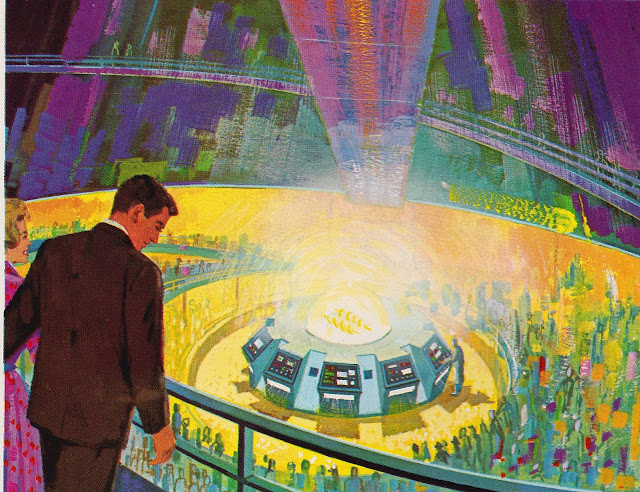
In 1964, the New York World's Fair opened in Flushing Meadows, and over the next two seasons more than 51 million people showed up to see the future.
One of the most popular stops was General Electric's Progressland, designed by Walt Disney and his team of Imagineers. Inside, visitors rode the Carousel of Progress, a rotating theater that follows one American family through the decades as electricity transforms their home, all to the tune of "There's a Great Big Beautiful Tomorrow."
At the end of each show, guests made their way under the pavilion's giant dome for a live demonstration of controlled fusion – the process that powers the sun – with a countdown, a brilliant flash, and a loud CRACK every few minutes.
People walked out believing limitless clean energy was right around the corner.
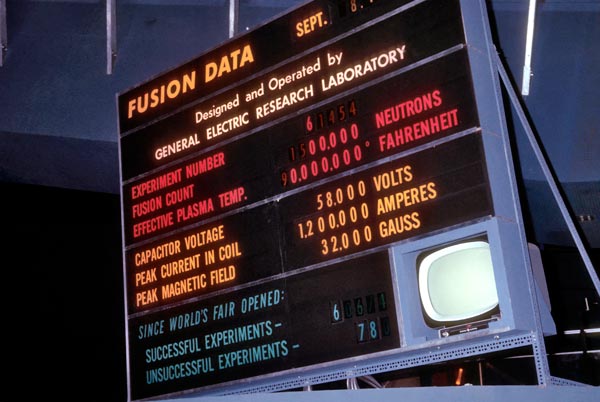
Unfortunately, about a year later GE took a hard look at its own fusion work, concluded that a power plant was unlikely to make money in the foreseeable future, and wound the work down. More than 60 years later, that's still pretty much where things stand, which is why the running joke is that fusion is always just 30 years away.
Earlier this month, I hosted the fourth experience in our Pioneer series at World's Fair Co. inside the warehouse at Marathon Fusion, a startup in San Francisco that is challenging that 60-year-old verdict, and their answer starts with gold.
Let's dive in.
Why Fusion Matters
Before we get into Marathon, I like to start with the basics.
First, we have fusion, which is what powers the sun and every other star, where the lightest atoms get squeezed together so hard that they fuse into heavier ones and release an enormous amount of energy in the process.
The "holy grail" of energy is being able to make fusion happen here on Earth, with a reactor that takes fuel from seawater and lithium and smashes it together to create an incredible amount of energy – without releasing any carbon. Fusion, if deployed at scale, could provide near-limitless clean energy.
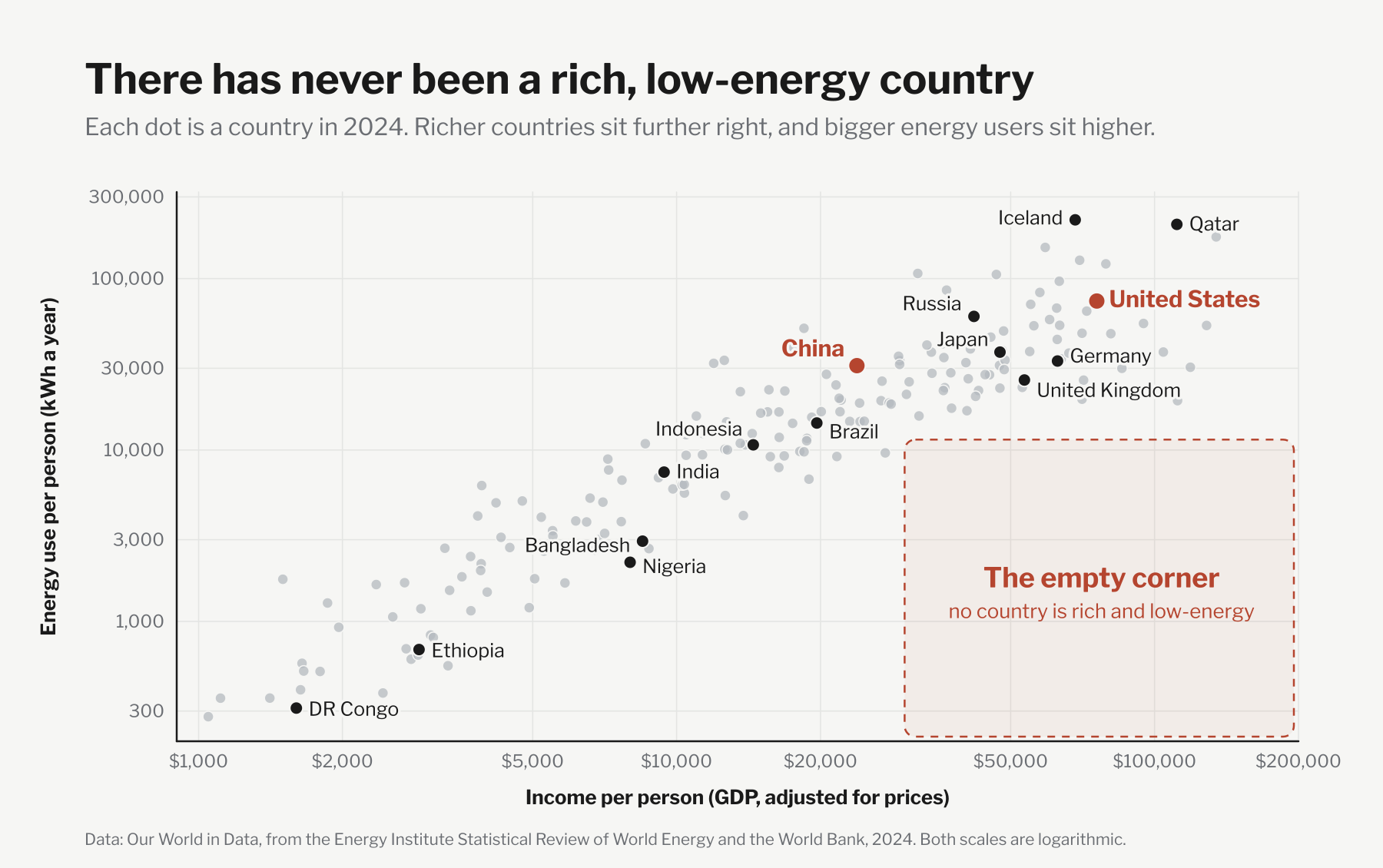
And that matters because energy is the input to almost everything we care about! From clean water and food to medicine and computing, it all runs on energy (which is why there has never been a low-energy, wealthy society).
So what's the issue?
Well, for starters, it's really hard. Holding fuel that's hotter than the center of the sun inside a machine is one of the toughest engineering problems anyone has taken on, and it was only in 2022 that an experiment first got more energy out of its fuel than went into it.
But there's a second problem that gets a lot less attention, which is money. It takes enormous machines (ITER, the flagship experiment in France, is backed by more than 30 countries and could cost anywhere from $22 billion to $65 billion), and a fusion company earns nothing until the entire machine works and can sell its electricity. And even then it has to compete with natural gas, solar, fission, and geothermal, so we're talking about billions in funding essentially on faith that there will be some payout at the end, which is a bit of a hard ask.
That makes fusion a money problem just as much as a physics problem.
Our Friend the Atom
We'll get to how Marathon is tackling that in a second, but first there's one more thing to establish – our friend, the atom.
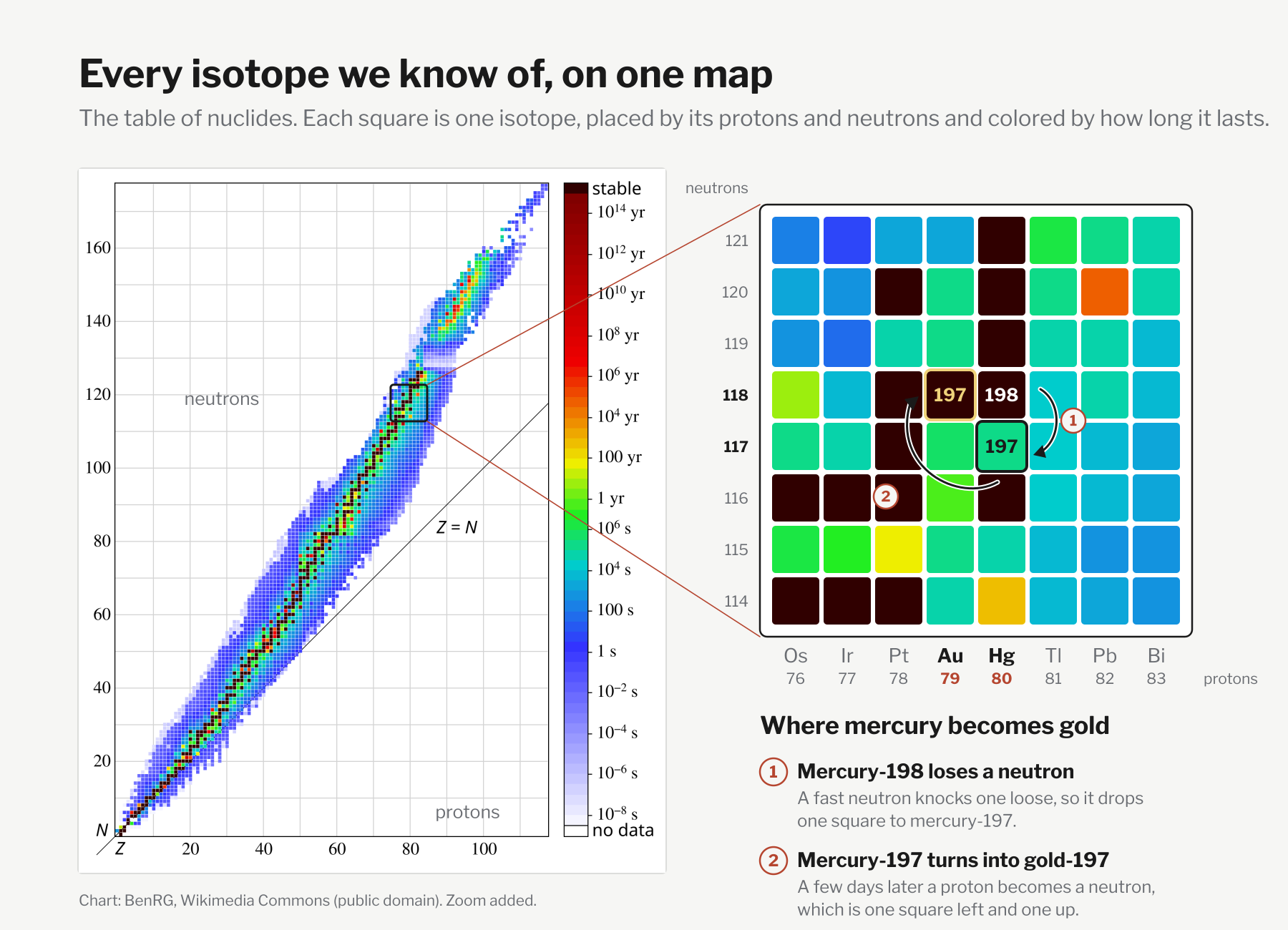
Everything around you is made of atoms, and at the center of each one is a tiny nucleus made of protons (positive charge) and neutrons (no charge at all), with electrons buzzing around the outside. The main thing to remember is that the number of protons decides which element an atom is, so hydrogen has 1, helium has 2, gold has 79, and mercury has 80, which means the difference between a solid bar of gold and a puddle of liquid mercury comes down to a single proton!
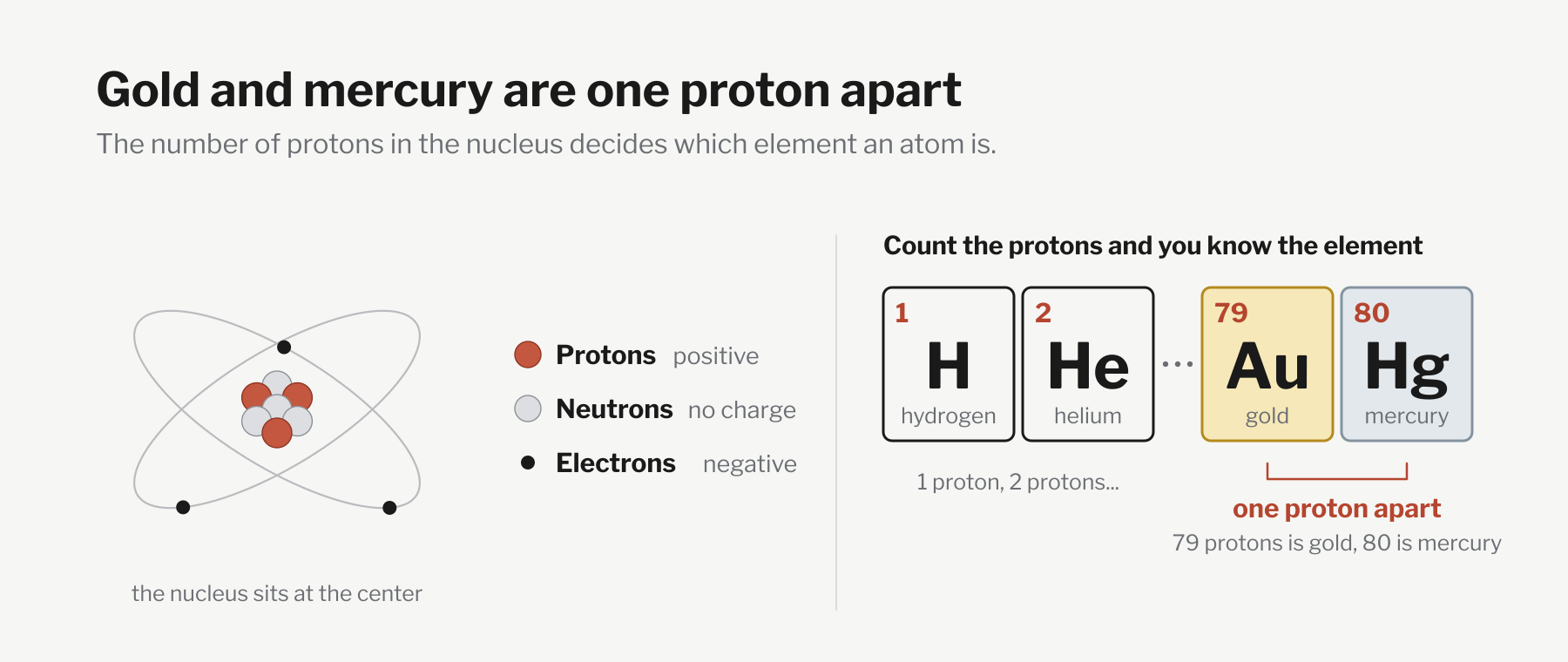
Neutrons, on the other hand, are more flexible, since an atom can gain or lose a few and still be the same element. These versions (same element, different weight) are called isotopes, each named by its total count of protons plus neutrons. For example, hydrogen comes in three – regular hydrogen (a single proton), deuterium (a proton and a neutron), and tritium (a proton and two neutrons).
Now, when it comes to doing anything with these atoms, it's important to remember that every nucleus has a positive charge, and two positive charges push each other away (like trying to press the matching ends of two magnets together). So the only way to fuse two nuclei is to slam them together incredibly fast, and since heat is really just atoms moving fast, that means making the fuel unbelievably hot. The sun gets away with about 15 million degrees because its gravity squeezes everything together and it has billions of years to burn. A power plant doesn't have that luxury, so our machines have to go past 100 million degrees and pack about 100,000 times more power into the same space than a star does!
While the sun does this every second, we can do it on Earth by building machines that heat the fuel into a glowing gas called plasma and use powerful magnets to hold it in place while the atoms fuse. A fusion power plant built this way has three main parts.
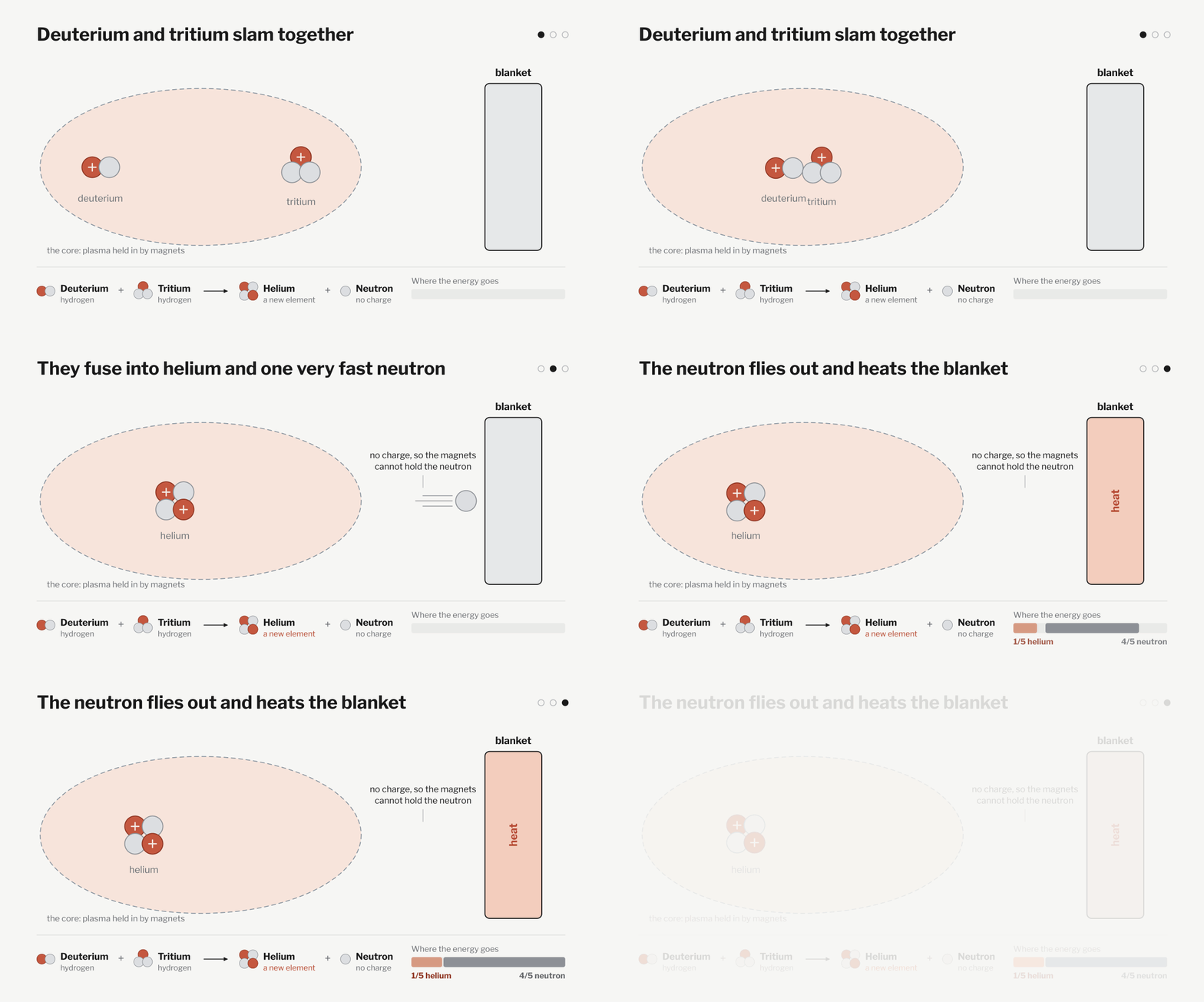
The fuel is generally deuterium and tritium (not what stars burn), because they are the easiest pair to fuse, and when they do, they make helium plus one very fast neutron that carries about four-fifths of the energy.
The core is where the fuel burns as plasma, held in midair by those magnets since nothing solid can touch something that hot. Magnets can only hold on to things that have a charge, though, and the neutron has none, so it flies straight out of the core and into the third part.
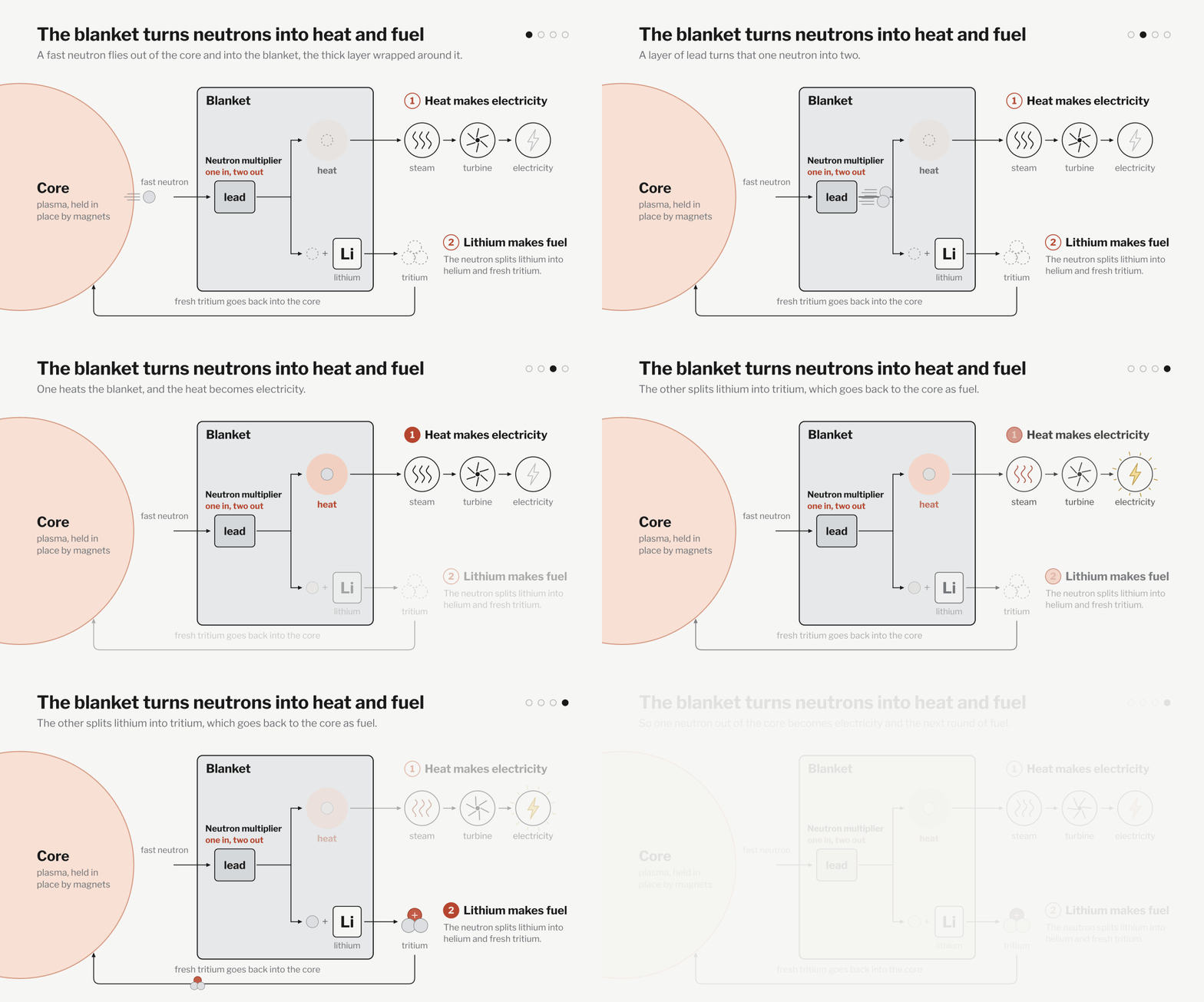
The blanket is a thick layer wrapped around the core, and its job is to catch those neutrons and turn them into something useful. Today that means two things. The first is heat, since the neutrons warm the blanket up and that heat boils water to spin a turbine, like in any other power plant. The second is fuel, since the blanket also uses neutrons to make fresh tritium for the next round.1
There's one wrinkle, which is that a plant has to produce slightly more tritium than it burns, and each reaction only gives off one neutron to make it with. So designers add a material to the blanket called a neutron multiplier, where one neutron goes in and two come out, and for decades the standard choices have been lead and beryllium.
Okay, so we've established the basics. Atoms are made of protons, neutrons, and electrons, and the number of protons decides the element. Fusion is the process of smashing the lightest atoms together so hard that they fuse and throw off fast neutrons, and a power plant catches those neutrons in its blanket and turns them into electricity (via heat) and more fuel.
So far so good?
Now let's bring Marathon back in.
Enter Marathon
Marathon Fusion is a San Francisco startup founded to, in their words, "build the technologies required to deploy economically irresistible fusion energy at scale." They started in 2023 with fuel systems and a variety of other engineering challenges.
Then in 2025, the team asked a simple, seemingly obvious question about that neutron multiplier. Does it have to be lead? Or could it maybe be something else... like mercury?
They ran the numbers and found that mercury not only multiplies neutrons about as well as lead, but also leaves behind gold as a byproduct. They could do what alchemists had been trying to do for centuries: turn another element into gold!
Modern Alchemy
Without getting too far into the weeds, alchemists tried heat, chemicals, and everything else they could think of, and nothing ever worked, because the only thing that changes an element is the number of protons in its nucleus, and nothing they had could touch the nucleus. Changing a nucleus takes an immense amount of energy, and that just wasn't a possibility.
So how does Marathon do this?
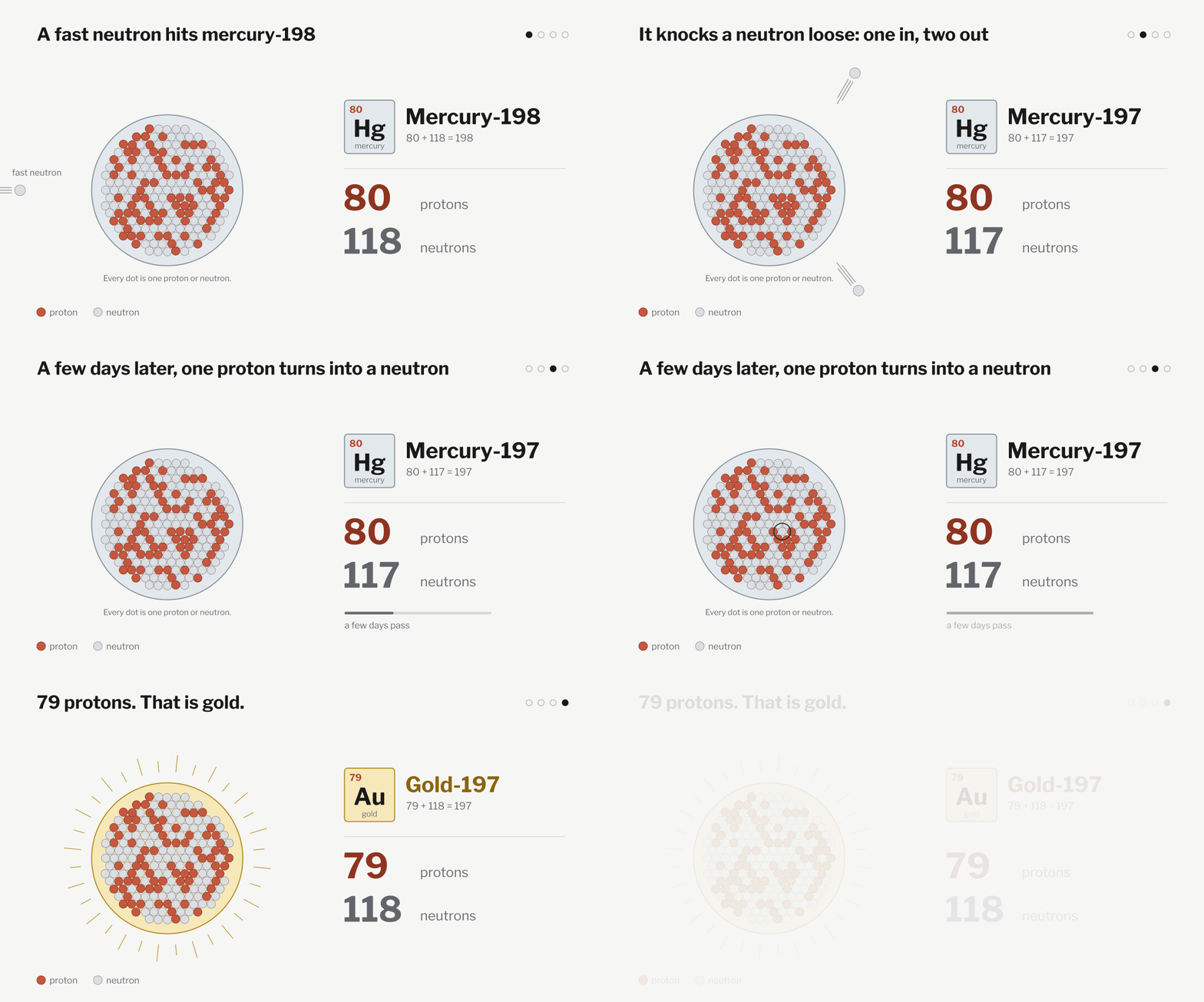
Remember the neutron that shoots out of a fusion reaction? Because it's going so fast when it hits the blanket, it knocks a neutron out of an atom of mercury, which leaves that atom unstable, and within a few days the atom settles down by turning one of its protons into a neutron, and one less proton makes it gold! This graphic may help:
It's pretty crazy when you think about it – you can shoot a neutron into mercury and make gold. In fact, this was so far "out of consensus" that when Adam Rutkowski, Marathon's CTO, called Jason Parisi, a physicist at Princeton, to check the work, Jason didn't believe it at first. Two weeks after that call, though, Jason left Princeton and moved across the country to join Marathon, where he's now Chief Science Officer!
Since then, they've kept up this pursuit. In their 2025 paper, the team estimates that a fusion plant could produce about 2 tons of gold a year for every gigawatt of fusion heat, which would effectively double (or even triple) what the plant earns. Then this October, they announced that they'd turned mercury into stable gold in the lab using fusion neutrons! It was a tiny amount, but put those two together and the economics of a fusion plant suddenly flip.
Of course, there's still a long way to go and plenty of open questions (the gold comes out slightly radioactive, for one, and has to sit in storage for years before anyone can sell it), but there's a clear light at the end of the tunnel. The bigger catch is that making gold at this scale takes a massive fusion plant, which still costs billions.
So what do you do in the meantime?
Paying the Way
When I think about Marathon, I think about SpaceX, where the goal was always Mars, but Mars didn't pay for Mars. Launching satellites for customers paid for the rockets, landing and reusing those rockets made every launch cheaper, and Starlink became the business that funds the rest. (Fittingly, Adam was a propulsion engineer at SpaceX before Marathon.)
Fusion power is Marathon's Mars, and they're getting there the same way, one paying step at a time. This begs the question, what's their version of launching satellites? Well, it turns out that modern alchemy is essentially just a lot of energy plus neutrons, and the question becomes... what else can you make?
In a way, Marathon is arbitraging the periodic table, using neutrons to turn cheap, common elements into rare and extremely valuable ones. Gold does this at a massive scale, but nobody is building those reactors yet, so Marathon is pointing the same underlying technology at smaller, higher-value targets first, where the goal is to make neutrons and not energy. (Marathon says a fusion machine running at kilowatts, a tiny sliver of a power plant, is enough to get started.)
One of the most obvious places to start is medical isotopes.
There's a new generation of cancer drugs that work like guided missiles, where a molecule seeks out cancer cells and carries a tiny radioactive payload right to them, so the radiation hits the tumor and mostly spares the healthy tissue around it. The problem is that the most promising payloads, like actinium-225, are scarce – so scarce, in fact, that in 2024 a Phase 3 clinical trial had to stop enrolling new patients because there wasn't enough to go around.
And there are many other isotopes to go after. Terbium-149 is a cancer fighter that researchers have chased for more than 30 years, and in September Marathon published a new way to make it. Certain copper isotopes help doctors spot cancer on a scan, and in October Marathon said its fusion neutrons had turned zinc into those too.
This is the stepping stone, because isotopes are something people need and will pay for today, which means Marathon can earn revenue, test its technology, and scale up all at the same time. By Jason's estimate, what a single neutron can earn varies by a factor of about ten billion depending on what you make with it, so you start on the top rung of the ladder with products like actinium-225, where every neutron is precious, and work your way down through things like gold as the machines grow and neutrons get cheaper, until you reach the bottom rung, the product that earns the least per neutron and that the world needs the most of: electricity.
So medical isotopes are Marathon's satellite launches, gold is its Starlink, and fusion power is its Mars. And this is my favorite thing about Marathon, that they're going after one of the boldest ideas there is and building the whole technological and economic stack to get there, where every rung pays for the next one. It's the same thing I loved about Until, where the moonshot is cryopreserving a whole person and bringing them back, and the path there runs through donor organs that can help patients today.
Control Over Matter
Now let's take another look at that ladder. I opened this piece the way everyone talks about fusion, as an energy story. But electricity is just one rung, and everything above it (the cancer drugs, the gold) is something a fusion machine makes. Marathon is showing that fusion is about more than energy – it's about control over matter, our ability to create and reshape the stuff the world is made of.
I've started to think of them as a neutron company (my words, not theirs), where fusion makes the neutrons and the business is choosing what each one should become.
And there's SO much left to make! The periodic table has a bigger cousin called the table of nuclides, which maps every isotope of every element – thousands of them – and most have barely been explored. What's about to happen is the arbitrage of that entire map, as cheap neutrons let us make isotopes and materials that were too rare or too expensive to bother with before. Jason hopes alchemy kicks off a renaissance in nuclear science, a second nuclear age where we finally go exploring that map, and I hope so too.
It all reminds me of Iron Man 2, one of my favorite movies (shout-out to the Stark Expo, a World's Fair, of course!). Tony Stark needs a new element, and he finds it hidden in a model of the Expo that his father built decades earlier. His dad had worked out the structure but couldn't make it with the technology of his day, so Tony builds a particle accelerator in his workshop, fires up the beam, and makes the element himself.
Now, Marathon isn't exactly inventing new elements, but it's the same story. The answer was sitting in what an earlier generation left behind, the technology finally caught up, and a small team in a warehouse is firing particles at atoms to make the material it needs.
Go Build
So what do we do with all of this?
Well, start with the fact that nothing in this story required a new scientific discovery! The measurements behind fusion alchemy had been sitting in nuclear data tables since the 1940s, and fusion blankets have been on the drawing board for decades. It was a secret hiding in plain sight, and it stayed hidden because everyone knew the multiplier was lead or beryllium, and nobody thought to ask whether it had to be!
I've been told more than once that the low-hanging fruit in science has been picked, and Marathon is my favorite existence proof that it hasn't (an existence proof is the one real example that shows something is possible). If an idea this valuable sat unused for about 80 years, how much more knowledge is out there waiting for someone to pick it up?
And finding it is getting easier. With new tools like AI and 3D printers, a small team can test an idea in days that used to take years, which means more of us than ever get to take part in fundamental science, and I can't think of a better time to be alive.
So let's go back to 1964 for a second. I think those crowds at Progressland had the right idea and were about 60 years early. The big machines still have to be built and none of this is guaranteed, but if small teams keep finding answers like this one in places nobody thought to look, then we might finally get to say that the future is no longer 30 years away.
We're on our way to fusion, my dear reader, and there's so much more out there waiting to be found, so go find your own version of "does it have to be lead?" and start asking.
Until next time, go build!
Go Deeper
Here's what I found most inspiring and informative while prepping for our conversation and this write-up.
From Marathon
- Why Fusion Alchemy Matters, Jason's plain-English case for alchemy
- Paper Notes #1: The Value and Cost of Fusion Neutrons, Jason on the neutron ladder
- Marathon on alchemy and on medical isotopes
- Marathon is hiring in San Francisco, if fusion is your thing (send careers@marathonfusion.com a resume with two bullets on your most impressive achievements and one on why you're interested), and you can follow along with Marathon on X
The Science
- Scalable Chrysopoeia via (n,2n) Reactions Driven by Deuterium-Tritium Fusion Neutrons (2025), the original paper (chrysopoeia is the alchemists' word for making gold)
- An Unusual Way to End Up With a Whole Lot of Gold, The Atlantic (2025)
- A one-minute explainer on fusion alchemy and Sabine Hossenfelder on fusion alchemy (Jason's take: approximately correct)
The 1964 World's Fair
- Carousel of Progress, GE's ride from the 1964 Fair that still runs today
- When fusion was almost there, ITER on GE's Progressland fusion demo
- Our Friend the Atom, Disney's 1957 TV special on the atom
Thanks
Special thanks to an anonymous donor for making this experience possible, to everyone who came out, and most importantly to Kyle, Jason, Adam, Julia, and the entire team at Marathon for opening up their doors and for the hard work they're doing to bring the power of the stars down to Earth.
Notes
Tritium is radioactive and decays so quickly that there's almost none of it in nature, so a fusion plant has to make its own. It does that with lithium, which splits into helium and a fresh atom of tritium whenever a neutron hits it. ↩︎