

How I Learned to Love Cryopreservation
Field notes from my conversation with Laura Deming and the team at Until
If you grew up a Disney fan like me, you've probably heard the lore that Walt Disney had himself frozen when he died, and that he's sitting in a freezer somewhere (some say under Pirates of the Caribbean!) waiting to be brought back to life.
It's not true, but for most of my life this story was the beginning and the end of my relationship with "cryo," a strange sci-fi idea I never gave much thought to, until recently.
A few weeks ago, I hosted Laura Deming for the third experience in our Pioneer series at World's Fair Co., where we bring people face to face with bold ideas. Laura has been working on the biology of aging since she was 12 and is now the CEO and co-founder of Until Labs. Until is building a pause button for biology – reversible whole-body cryopreservation – where the idea is to give people who are sick more time for medicine to catch up. Along the way, they're also working on preserving donated organs!
While I was prepping for our conversation, I heard Laura talk about how, after all those years trying to slow aging down at Longevity Fund, she came across the problem of cryopreservation, fell in love with it, and decided to go all in. Her passion and complete conviction totally intrigued me, and I wanted to figure out what she was talking about.
After a bunch of reading and research, it clicked for me. And while I'm not a biologist (nor will I pretend to be one on the internet), I want to walk you through what I learned, starting with the basics, and how I too learned to love cryopreservation.
Biology 101
We're going to go back to freshman biology class. Ready?
The mitochondria is the…?
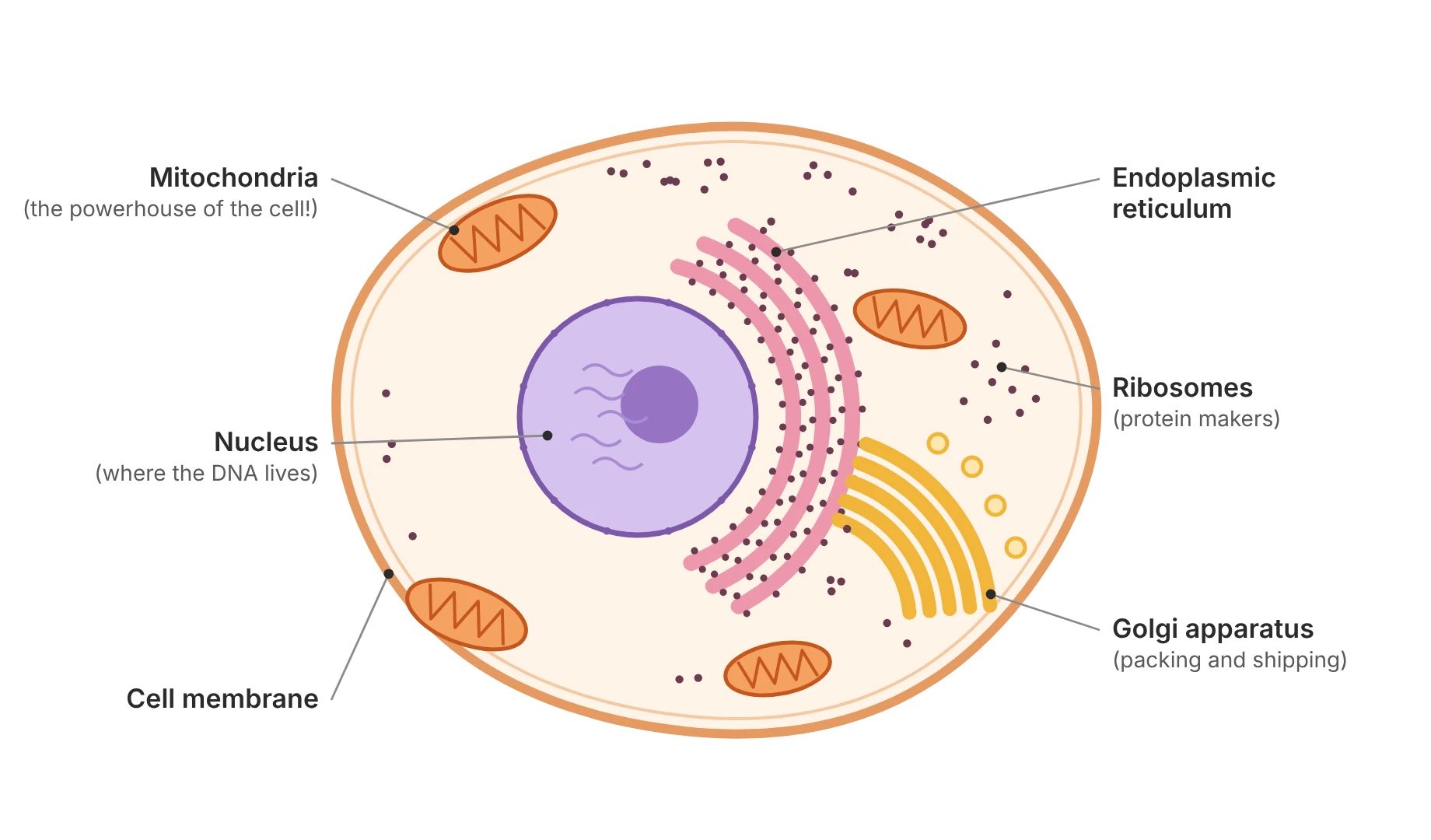
Powerhouse of the cell (nailed it, A+, great job everybody, moving on). That, plus a textbook diagram like this one, was about the extent of what I remembered.
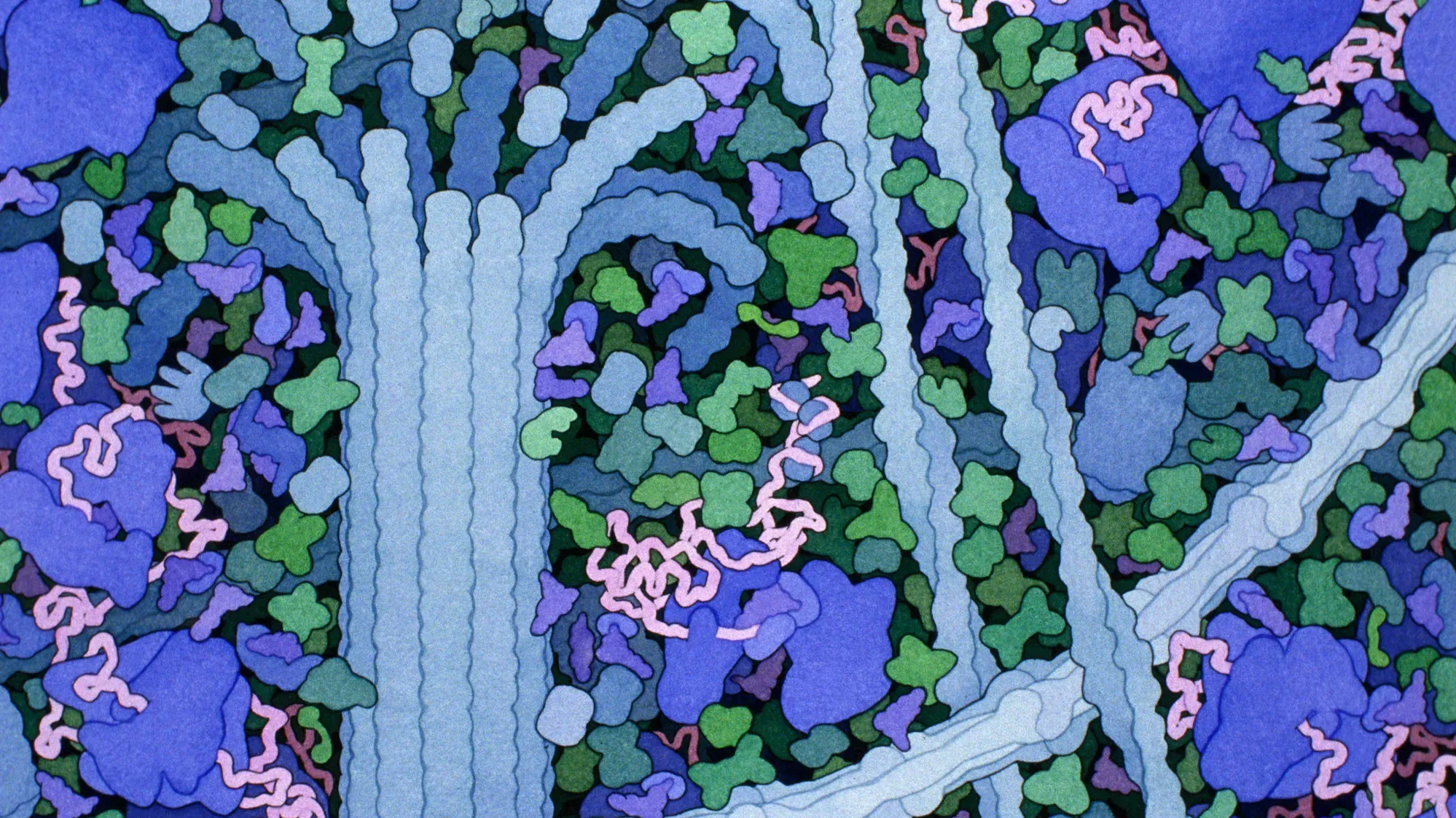
Since then, I haven't really given much thought to what's actually going on inside these cells. Then, a few weeks back I heard David Friedberg on The Diary of a CEO describe a cell like this: blow it up until each protein is the size of a person, and the cell becomes the size of Manhattan, with 10 billion people building, working nonstop. Everything those people would do in 80 years, a cell does in one second.
That's an insane amount of activity, and our bodies have roughly 30 trillion of these cells, all moving and reacting all the time!
Press Pause
Now imagine we just… press pause. On all of it. Like the remote in Click with Adam Sandler, you hit the button and all of Manhattan freezes mid-everything.
Seriously, look up from your screen right now and imagine everything around you stopping.
How insane of an idea is that? And yet, for cells, we can do it today!
We do this by cranking down the temperature, which is basically a measure of how fast the molecules in our cells are moving. So the colder a cell gets, the slower everything inside it runs. If you can get a cell below −130°C, everything goes solid, and the molecules get locked in place, so they can't move around or react with each other anymore.
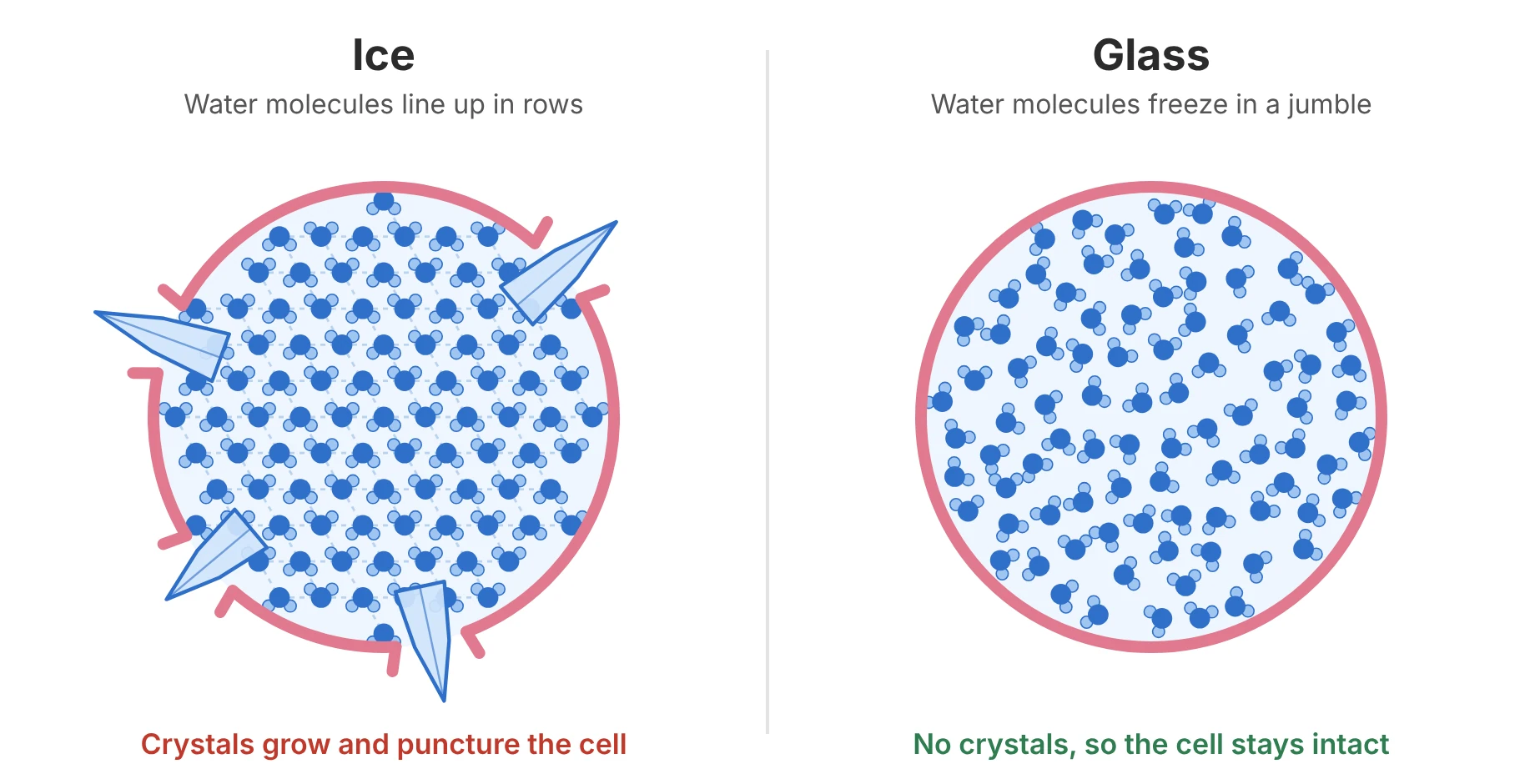
The hard part, though, is getting there. Cells are mostly water, and between 0°C and about −130°C there's a danger zone where water turns to ice. And if you're a cell, ice is not your friend! It helps to think of a cell as a tiny water balloon. As water freezes, it expands into sharp, jagged crystals that poke holes in the balloon and tear it apart. Not good.
Sooo how do you get around this problem?
First, you soak the cells in a cryoprotectant (basically antifreeze for cells), which makes it much harder for water to line up into dangerous ice crystals. Then you cool the cells as fast as you possibly can. Since crystals need time to grow, if you race through the danger zone, the water turns into glass instead of ice (a process called "vitrification"), a solid where the molecules are stuck in a jumble rather than lined up in rows.1 This should give you a pretty good idea:
Warming the cells back up is even trickier, because any tiny ice seeds that did form on the way down get a second chance to grow on the way back up. To solve this, you have to rewarm faster than you cooled and then rinse the cryoprotectant out before it does damage. Do it right, though, and the cells pick up where they left off!
Pause. Play. Pause. Play. Got it?
And we know pausing cells works, because we already do it in lots of places, including IVF! An early embryo is a tiny ball of cells, and today embryos get dipped in cryoprotectant, plunged into liquid nitrogen, and thawed for whenever a family is ready to have a child. In 1994, for example, a couple created four embryos in the same IVF round. One was implanted right away and became a baby girl, while another stayed frozen for three decades, was adopted by a different family, and was born in 2025 as her little brother!
It's pretty astounding that we're able to do this for single cells with a simple process: protect with cryoprotectant, cool it quickly, and rewarm it even faster.
Organs
Now this begs the question, if we can pause a cell, and the dream is to pause a whole body, what would it take to pause an organ? Donor organs are where a lot of the whole-body problems show up first, and where this work can help patients soonest.
There's also an enormous need. Today, more than 100,000 people are on the US waiting list for an organ transplant, and every day, 12 of them die. A big part of the problem is that donated organs don't last long. Once an organ is packed on ice (cold, not frozen), the clock starts ticking, and a heart only lasts about four to six hours. In that window, doctors have to find the right match, get the organ to the right hospital (sometimes across the country), and have a surgical team ready to go. If any piece of that slips, the organ can go to waste, leaving doctors and patients perpetually on edge, hoping and waiting for a lifesaver that might not ever make it to them.
But obviously pausing an organ isn't as simple as scaling up what works for an embryo. See, an embryo is smaller than the period at the end of this sentence, while a kidney is the size of your fist, with billions of cells packed tightly together and laced with blood vessels. So not only do you need a lot more cryoprotectant, you also have to figure out how to cool and rewarm the whole thing evenly. It's kind of like thawing a steak, where the outside is always ready way before the middle.
So again, let's break it down, shall we? We'll start with the cryoprotectant.
Since soaking a kidney from the outside would take days, you have to pump it in through the organ's own blood vessels, which already reach almost every cell. This is a process called perfusion.2 The cryoprotectant dose has to ramp up (and later back down) in gentle steps. Add it too fast, and water rushes out of the cells before the cryoprotectant can get in, so they shrivel up. Take it out too fast, and water rushes back in, so they swell and pop like water balloons.
Next up is cooling, where we get the inverse steak problem. The outside of the kidney races through the ice danger zone while the middle lags behind. To keep ice from forming in the middle, you need even more cryoprotectant, but at those doses it can become toxic to the very cells it's supposed to protect. Too little, and you get ice. Too much, and you risk poisoning the organ. And if the outside gets too far ahead of the middle, the whole thing can crack, like an ice cube dropped into a warm drink.
And finally there's rewarming, which is even harder. You can't just toss a kidney in warm water (that only heats the outside) or in the microwave (hot spots, just like leftovers). Fortunately, brilliant scientists at the University of Minnesota have pioneered a better way called nanowarming, where tiny iron oxide particles ride in with the cryoprotectant to fill up the organ. Then the organ goes inside a coil where a magnetic field flips back and forth hundreds of thousands of times a second. Each particle's magnetism flips with it, giving off a little heat every time, so the organ warms from the inside, everywhere all at once. (Maybe the folks in good ol' Minnesota will figure out how to nanowarm their way through winter.)
Now this may all seem pretty speculative, but that Minnesota team has been working hard to get results. In 2023, they conducted a study to vitrify rat kidneys. They stored them for up to 100 days, rewarmed them (using their nanowarming), and then transplanted them into rats whose own kidneys had been removed… who then lived! More recently, the team at Until, using their own magnet, rewarmed a whole pig kidney fast enough to beat the ice.
If we play this out, we can start to see how the broken system of organ transplantation today could be fixed if we have the ability to confidently pause and rewarm organs. This would mean that patients no longer have to wait on edge or watch precious donor organs go to waste because of timing or logistics. If we play this out further, we can imagine every hospital having its own organ bank ready to transplant at a moment's notice. With some of the breakthroughs in xenotransplantation (modified pig kidneys), hospitals could keep those banks stocked, so people with acute conditions (like a sudden injury or illness) could get a transplant anytime they need one.
The Whole Body
And now, we arrive at the moonshot: whole-body cryopreservation.
That means pausing every single organ in your body and all 30 trillion cells at roughly the same time, then bringing them all back together.
This is where everything clicked for me. Obviously, vitrifying a whole kidney is difficult, but a whole kidney weighs like a third of a pound? Maybe? I weigh hundreds of times more than this! Now we have to go through all of the steps again, but at a much different scale, accounting for all of the different types of organs (especially the brain!) and ensuring that all these systems continue to work together.
I started running through a list of questions. Things like how do you get cryoprotectant into every cell without poisoning any of them? How do you cool an entire person fast enough to beat the ice and rewarm evenly? If you can get that far, how do you then ensure that all of your organs work like they're supposed to? What do these tests even look like?? Assuming it all works, we still have the crazy philosophical implications, things like 1) would you feel anything? 2) what is your perception of time? 3) am I still me? The list feels endless.
Enter Until
Nobody knows the answers to all of these questions yet, and it's going to take a LOT of work to figure them out… which brings us back to Laura and the team at Until.
As we established, their whole mission is whole body cryopreservation – pausing an entire person and bringing them back. This means that they have to figure out each step of the process along the way from cells to individual organs to all of our organs to the entire body and our 30 trillion cells. It's really insane, but also incredibly inspiring because they have to answer so many different questions as they go.
Those questions span biology, chemistry, physics, engineering, and much, much more. There's also no existing playbook for any of this – let alone a deep understanding of it – so they have to experiment over and over and over again. Nor is there any hardware built for this so as part of their exploration, they're building their own devices, like the Mark 1 magnet, and hunting for gentler cryoprotectants. Calling back to freshman bio, it's the scientific method deployed at max capacity.
And then we get into their long-term vision, which is even more ambitious! Someday, Until hopes to become a kind of personalized medicine engine, one that takes sick patients, pauses them, and then actively researches a cure for them. They're not there yet, but it makes total sense when you think about it. To pause and restart an entire human body, you have to understand its cells and biology at an incredibly deep level, and that's a lot of the same understanding you need to figure out how diseases work and how to fix them. So they're building a really incredible body of knowledge…
This is all cool and nerdy, but we still haven't gotten to the most important question.
Why do this at all?
We're making incredible advances in medicine today where fatal diseases are becoming survivable, but this is often a long and arduous process. Hunter Davis, Laura's co-founder at Until, saw this up close with his father-in-law, Mark, who was given six months to live. By the time a clinical trial opened for his cancer, Mark was too sick to qualify and wasn't able to get the treatment he needed. As Hunter puts it, people like Mark don't need a hundred years, they just "need six months."
This is where the pause button comes in. Until calls it "medical hibernation", which means pausing a patient while they're still alive and bringing them back once there's a treatment that can help. Someday, this could give patients like Mark those six months. In Laura's words, "If you could just pause time when you had a terminal illness and turn it back on when the cure was there, that'd be amazing."
If you start digging into all of this, you'll almost certainly run into the cryonics industry, with companies like Alcor that will store your body (or just your head) in liquid nitrogen after you die. It leaves a weird taste in a lot of people's mouths, and I get it. They're freezing people after they've died, with no proven way to bring them back, so it can feel like spooky science fiction, or at best a lottery ticket that will hopefully, maybe, possibly pay out someday.
What I'm so excited about is that Until is coming at this from the other direction. They're figuring out how to bring people back before anyone gets paused, because the people it's for are still alive and just waiting on a treatment.
I think about Ben Wilson, who runs the podcast How to Take Over the World and shared this summer that he has stage 4 neuroendocrine cancer. He has four kids, and like so many people in his shoes, he's racing the clock while promising new therapies for cancers like his work their way through clinical trials.
Now imagine that's your brother, your dad, your sister, or your mom in that situation. Should we just say, sorry, that's it? Tough luck? Of course not! It's absolutely unacceptable that people in the prime of their lives get their time cut short by cancer and other diseases, and a pause button could buy them the time it takes for treatments to catch up.
Honestly, the engineering and science were an incredible rabbit hole here, and I don't think there's a bottom. From the Manhattan-sized city inside every cell to the race against the ice to the question of whether you'd still be you, the complexity and beauty of it all feel endless (which I love!). But what seals it all together for me is the human story. Whether it's Mark, Ben, your mom, or my own family, it's the idea that none of us has to lose time with the people we love.
And that's how I too learned to love cryopreservation.
Go Build
So what do we do with all of this? Well, it helps to look at how Until got started. During our conversation, Laura told the story of how it all began with a cold email. She wrote to Hunter, then a postdoc at Harvard, to ask whether it was possible to reversibly pause biological function. His first reaction was basically "are you kidding me?" But a few days later, he couldn't stop thinking about it, so he flew out to meet her, flew back, and quit his job!
That "are you kidding me?" moment is how a lot of the best ideas start out. They sound way out there, and plenty of people won't believe they're possible. Then a few people can't stop thinking about them and decide to go all in, and this, my friends, is where real progress happens!
It's totally okay to be skeptical. Not long ago, cryo was just a weird Walt Disney story to me! But the next time you hear an idea that sounds like science fiction, before you write it off, think about the kind of world you want to live in. (Perhaps one where our loved ones don't die from diseases?) Similarly, I love the line from Ratatouille that "the new needs friends," and most of the companies and ideas I obsessed over are exactly that kind of new, Until included. So be kind to the new, be curious, and explore – any of the links below is a great place to start.
I also hope some of you decide to go work on the frontier yourselves! If you do, Until is a great option, and they're hiring (you don't even need to be a cryobiologist to apply). If you're just curious, start with their Founder Letter. And in either case, if you end up sending Laura or the team a cold email of your own, tell them Cam sent you :)
It's my hope that this little exploration sparks some curiosity about what might be possible. Someday, Until might give the people we love a little more time. Until then, let's make the most of the time we've got and go build the future.
Go Deeper
Here's what I found most inspiring and informative while prepping for our conversation and this write-up.
From Until
- Founder Letter (2024), Laura and Hunter on why they started Until
- Problem Statement and Roadmap (2024)
- Milestone White Paper I (2024), on reviving slices of rat brain
- Glass, Not Ice (2025), on why ice is the enemy
- Rewarming (2026), on the Mark 1 magnet
- Biocompatible Cryoprotectants (2026), on the hunt for gentler cryoprotectants
The science
- Bringing organ-scale cryopreservation into existence, Hunter Davis on Owl Posting, the best plain-English walk-through
- Improved tissue cryopreservation using inductive heating of magnetic nanoparticles, Science Translational Medicine (2017), the landmark paper that put nanowarming on the map
- Vitrification and nanowarming enable long-term organ cryopreservation and life-sustaining kidney transplantation in a rat model, Nature Communications (2023), the rat kidney study
- David Goodsell's The Machinery of Life and his Molecular Landscapes gallery
Podcasts
- How Until is Engineering Away Time in Organ Transplants, Laura Deming on No Priors
- Biological Time Travel, Laura Deming on The Generalist
- The Science of Pausing and Reversing Aging, Laura Deming and Jacob Kimmel on Builders
- She Raised $100M+ to Build a Pause Button for Biology, Laura Deming on the Luba Show
- David Friedberg on The Diary of a CEO (transcript)
Thanks
Special thanks to Impulse Labs and 1517 for sponsoring our experience, to everyone who came out, and most importantly to Laura Deming, Katherine Baney, and the entire team at Until for the hard work they're doing to help us get more time with those we love.
Notes
Ice vs. glass, a little deeper: both are solids, and the difference is how the molecules are arranged. In ice, water molecules lock into a neat, open lattice, so ice is about 9% less dense than liquid water and takes up more room (that's why ice floats, and why frozen pipes burst). In a glass, the molecules stop moving before they can line up, so they're frozen in the same jumble as the liquid, which means no crystals and no expansion. Window glass is the everyday example, but the glass here is water plus cryoprotectant, which locks solid at around −120 to −130°C, the bottom of the danger zone. Sources: Water Density; Principles of Cryopreservation by Vitrification (2015); Glass, Not Ice. ↩︎
Perfusion is basically what your heart does all day. Oxygen can only travel a tiny distance on its own, so blood has to get within about 10 microns of a cell (a small fraction of the width of a hair), which is why your capillaries are packed in so tight. To perfuse an organ outside the body, you hook a pump up to its main artery and push fluid through that same network of vessels, and it drains out the vein. Source: Regulation of Tissue Oxygenation. ↩︎